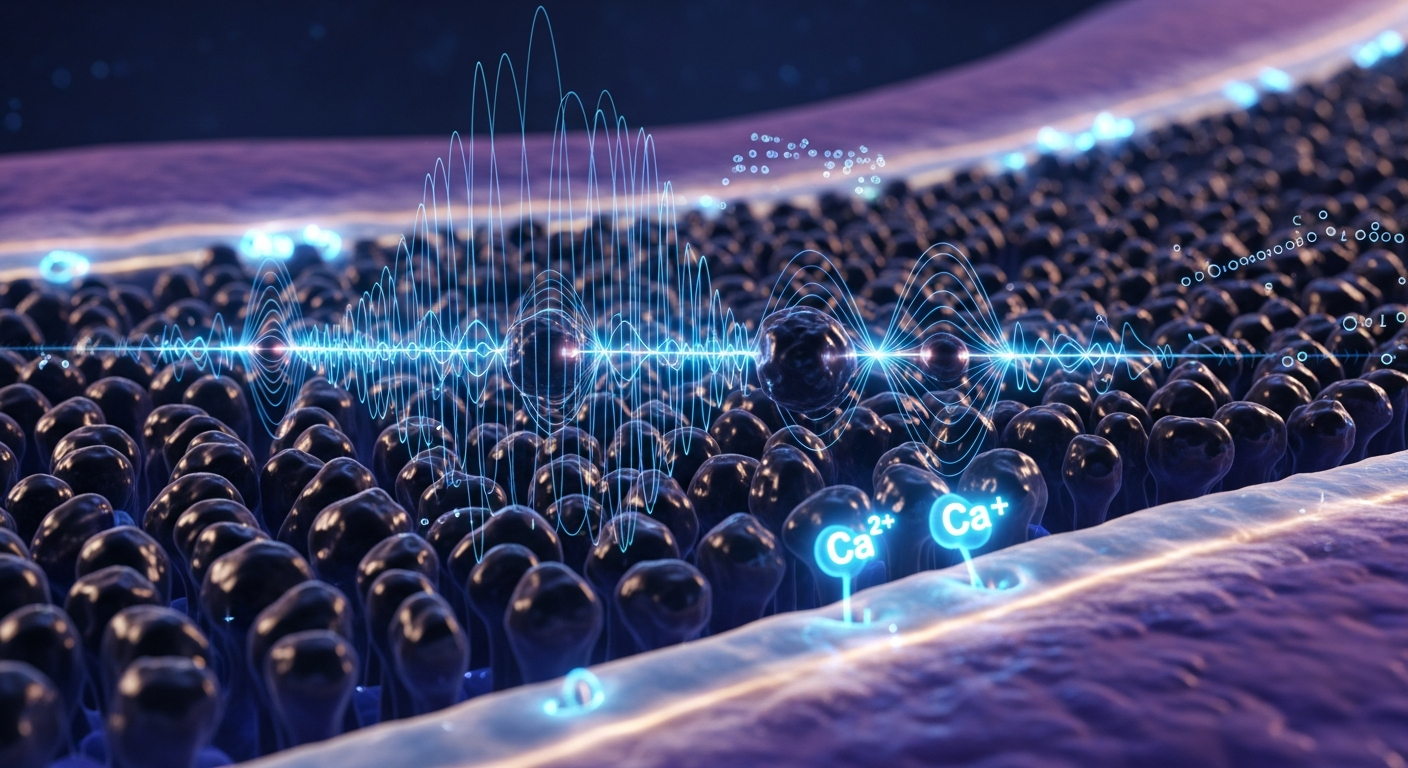
For decades, bioelectromagnetics research has revealed that living systems do not simply react to the intensity of electromagnetic fields, but rather tune into specific frequencies. By exploring non-linear biological windows and calcium signaling, we can better understand how complex biopolymers—particularly melanin—function as highly sensitive biological transducers.
In classical toxicology and radiation physics, the fundamental assumption governing biological response is linear and dose-dependent: more energy deposited into a system equals a correspondingly greater biological effect. Yet, when we expose living tissue to specific, non-ionizing electromagnetic frequencies, biology consistently defies this Newtonian intuition. A whisper can trigger a cellular cascade that a shout cannot. When tissue is exposed to certain extremely low-frequency electromagnetic fields, the biological response does not scale neatly with field strength. Instead, the response spikes dramatically at highly specific frequency and amplitude combinations, only to vanish when the power is increased or the frequency is slightly shifted.
This phenomenon forces a profound re-evaluation of cellular communication. It suggests that biological systems operate less like simple physical masses absorbing bulk energy, and more like precisely tuned radio receivers. Cells appear to utilize resonance phenomena to detect and process environmental and endogenous electromagnetic signals. For those researching the biophysical parameters of living systems, this non-linear tuning presents a vital clue. It points directly toward the need for highly sophisticated molecular antennas within the biological matrix—a role that complex, semi-conductive biopolymers are uniquely positioned to fulfill.
The Adey Window and Non-Linear Biological Tuning
The observation of frequency-specific biological resonance was firmly established in the 1970s through the rigorous work of W. Ross Adey at the Brain Research Institute at UCLA. Investigating the effects of weak electromagnetic fields on brain tissue, Adey's team discovered what is now termed the Adey window. They observed that the efflux of calcium ions from cerebral tissue could be reliably altered by weak external electromagnetic fields, but only if the fields fell within specific parameters.
Adey found that a 147 MHz carrier wave amplitude-modulated at precisely 16 Hz significantly altered calcium efflux. If the modulation frequency was shifted to 6 Hz or 32 Hz, the effect disappeared entirely. Furthermore, the response was confined to specific intensity windows; increasing the field strength did not amplify the effect, but rather negated it. This behavior mirrors acoustic resonance, where a tuning fork will only vibrate sympathetically when struck by sound waves of matching frequencies, regardless of the sheer volume of mismatched noise in the room.
Further validation came from Carl Blackman at the US Environmental Protection Agency, who replicated and expanded upon Adey's work, proving that these Extremely Low Frequency (ELF) effects were highly dependent on the orientation of the local geomagnetic field. This dependence strongly indicated a direct physical interaction at the quantum or atomic level, moving the discussion of bioelectromagnetics out of the realm of mere thermal heating and into the domain of quantum-level resonance mechanisms.
Calcium Signaling and the Bioelectric Membrane
To understand why a 16 Hz window matters, one must understand the primacy of calcium in cellular biology. Calcium is not merely a structural element; it is the universal intracellular messenger. Fluctuations in intracellular calcium concentrations dictate everything from gene expression and cellular division to apoptosis and neuronal firing.
The fact that weak electromagnetic fields can alter calcium ion movement across the cellular boundary intersects directly with the modern understanding of bioelectricity. As demonstrated by researchers like Michael Levin at Tufts University, the resting membrane potential (Vmem) of a cell is not a passive byproduct of metabolism, but an active, instructional code. Endogenous voltage potentials control cell behavior and instruct morphological pattern regulation.
When external ELF fields interact with the bioelectric state of the cell membrane, they likely influence the gating mechanisms of voltage-sensitive ion channels. The mechanism for this interaction remains a subject of intense biophysical study, with theories ranging from ion cyclotron resonance—where the specific mass-to-charge ratio of the calcium ion interacts with the local magnetic field—to the radical pair mechanism. In the latter, the spin states of unpaired electrons are altered by weak magnetic fields, subsequently changing the rate of chemical reactions that govern ion channel opening.
Melanin as a Broadband Bioelectronic Transducer
The existence of highly specific bioelectromagnetic windows necessitates an intra-biological transducer capable of detecting, processing, and responding to these signals. Within the structural biology of the cell, eumelanin stands out as a prime candidate for mediating these complex frequency-dependent interactions.
Melanin is far more than an inert pigment responsible for photoprotection; it is a complex, amorphous semiconductor. Its macromolecular architecture—composed of cross-linked DHI and DHICA oligomers—features a highly conjugated pi-electron system. Landmark research by John McGinness and Peter Proctor in 1974 demonstrated that melanin exhibits bistable electrical switching, acting as an organic semiconductor that can transition between high and low resistance states under specific voltage thresholds.
Crucially, melanin possesses a highly stable population of free radicals, rendering it paramagnetic and readily detectable via Electron Paramagnetic Resonance (EPR) spectroscopy. This paramagnetism makes the melanin polymer inherently responsive to external magnetic fields. Furthermore, melanin's electrical properties are highly dependent on water. As demonstrated by Albertus Mostert and colleagues, melanin exhibits proton conductivity that scales with its hydration state.
This creates a fascinating biophysical intersection: we have a widespread biopolymer that conducts both electrons and protons, harbors field-sensitive unpaired electrons, and exhibits an energy bandgap of approximately 1.85 eV. If cellular networks rely on resonance and frequency-specific windows to communicate via calcium signaling and bioelectric currents, melanin possesses the exact solid-state physical properties required to act as the transducer. It can absorb electromagnetic radiation across a broad spectrum and convert that energy into phonons (vibrational energy) or chemical gradients via its proton-electron coupling.
From Photobiology to Quantum Coherence
When we synthesize the established science of the Adey window with the biophysical realities of melanin, a new theoretical framework for biological regulation emerges. The non-linear, frequency-dependent responses observed in bioelectromagnetics may be governed by the quantum mechanical properties of conductive biopolymers interacting with their aqueous environments.
In the rapidly maturing field of quantum biology, phenomena such as quantum coherence in photosynthesis and electron tunneling in enzymatic reactions are now established science. Melanin sits at the frontier of this field. Because the radical pair mechanism depends on the spin dynamics of electrons, and because melanin is nature's reservoir of stable biological radicals, it is highly probable that melanin networks play an active role in translating ELF fields into the biochemical and bioelectric language of the cell.
If melanin acts as a biological semiconductor embedded within the bioelectric matrix, it may serve to modulate the voltage gradients that Levin's research has identified as crucial for morphogenesis and healing. The specific frequency windows observed by Adey and Blackman could represent the resonant frequencies at which energy transfer within the hydrated melanin polymer is most efficient, briefly altering the local electrostatic environment near calcium channels and triggering ion efflux.
Understanding the resonant frequencies of living systems is not just an academic exercise. By mapping how complex biopolymers like melanin interface with electromagnetic fields, we move closer to non-invasive, bioelectric modalities for modulating cellular behavior. The research suggests that the language of biology is not entirely chemical; it is decidedly electromagnetic, highly tuned, and waiting to be comprehended.
Key Takeaways
- Biological systems exhibit non-linear, frequency-specific responses to electromagnetic fields, demonstrating that cellular communication relies on precise resonant frequencies rather than mere field intensity.
- The "Adey window" describes specific amplitude and frequency ranges—such as a 16 Hz modulation—that are required to trigger biological responses like cellular calcium ion efflux, a critical driver of cellular function.
- Endogenous bioelectric fields and resting membrane potentials actively instruct cellular behavior and tissue patterning, acting as an energetic communication network sensitive to external electromagnetic influence.
- Melanin is a biological amorphous semiconductor with intrinsic proton-electron conductivity, stable free radicals, and a defined bandgap, making it biophysically capable of transducing weak electromagnetic signals.
- The synthesis of bioelectromagnetics and quantum biology suggests that melanin's paramagnetic and semiconductive properties may serve as a primary physical interface for biological electromagnetic resonance.
References
Adey, W. R. "Frequency and Power Windowing in Tissue Interactions with Weak Electromagnetic Fields." Proceedings of the IEEE 68(1), 119-125 (1980). DOI: 10.1109/PROC.1980.11585.
Blackman, C. F., Benane, S. G., Rabinowitz, J. R., House, D. E., & Joines, W. T. "A role for the magnetic field in the radiation-induced efflux of calcium ions from brain tissue in vitro." Bioelectromagnetics 6(4), 327-337 (1985). DOI: 10.1002/bem.2250060402.
Levin, M. "Molecular bioelectricity: how endogenous voltage potentials control cell behavior and instruct pattern regulation in vivo." Molecular Biology of the Cell 25(24), 3835-3850 (2014). DOI: 10.1091/mbc.E13-12-0708.
Liboff, A. R. "Geomagnetic cyclotron resonance in living cells." Journal of Biological Physics 13, 99-102 (1985). DOI: 10.1007/BF01878385.
McGinness, J., Corry, P., & Proctor, P. "Amorphous semiconductor switching in melanins." Science 183(4127), 853-855 (1974). DOI: 10.1126/science.183.4127.853.
Meredith, P., & Sarna, T. "The physical and chemical properties of eumelanin." Pigment Cell Research 19(6), 572-594 (2006). DOI: 10.1111/j.1600-0749.2006.00345.x.
Mostert, A. B., Powell, B. J., Pratt, F. L., Hanson, G. R., Sarna, T., Gentle, I. R., & Meredith, P. "Role of water on electron transport in melanin." Proceedings of the National Academy of Sciences 109(23), 8943-8947 (2012). DOI: 10.1073/pnas.1119948109.