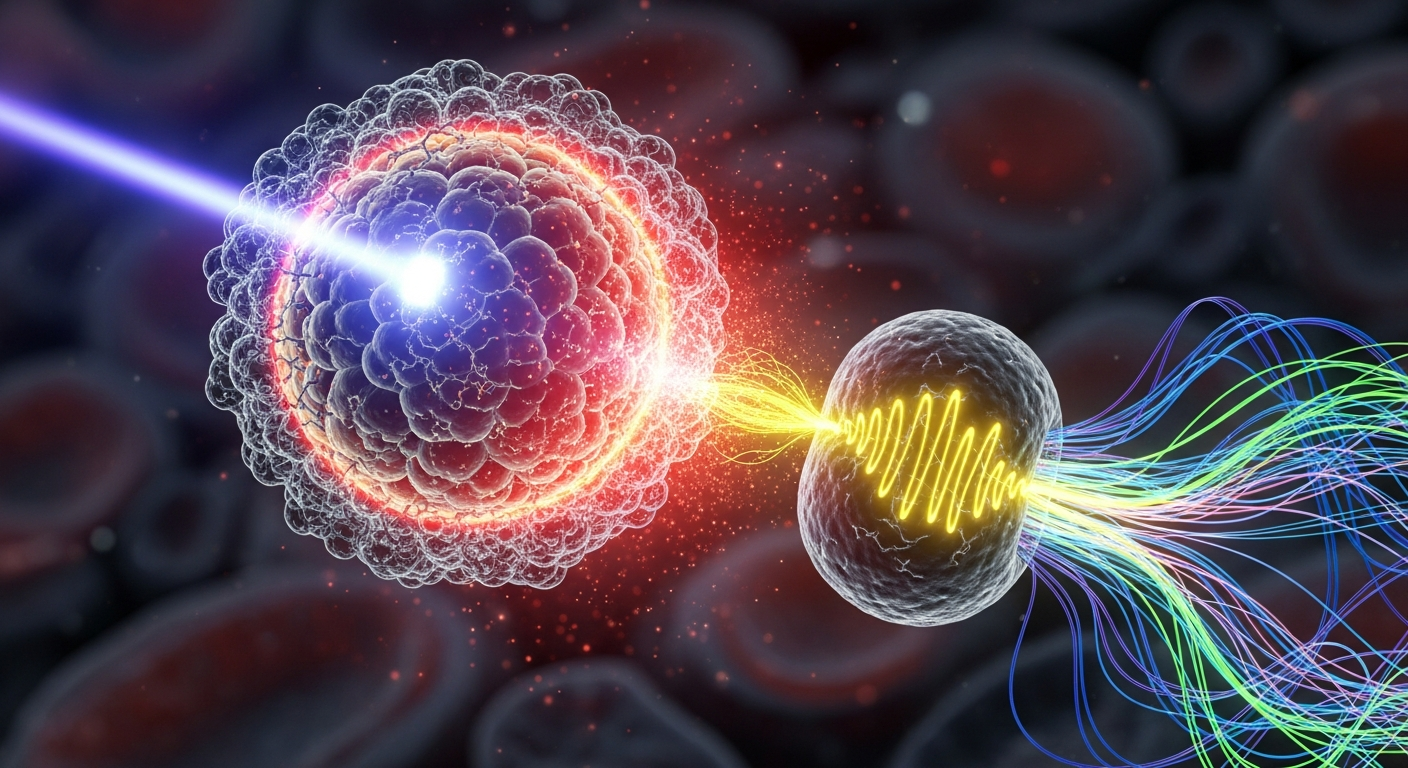
At the Quantum Melanin Research Foundation, we investigate the fundamental properties of one of nature’s most enigmatic biopolymers. This article explores the growing body of evidence suggesting melanin's role extends far beyond photoprotection, positioning it as a sophisticated biological material capable of converting light, heat, and mechanical force into bio-electrical signals.
Within the architecture of a single skin cell, a silent, near-perfect energy conversion takes place trillions of times a second. When a high-energy ultraviolet (UV) photon strikes a eumelanin granule, it is absorbed in femtoseconds. Instead of re-emitting this energy as light (fluorescence) or breaking chemical bonds and creating damaging free radicals, over 99.9% of the photon's energy is harmlessly converted into heat. This photoprotective capability is well-established, but it poses a profound biophysical question: what is the mechanism of this ultra-efficient energy dissipation, and does biology do anything with the resulting energy?
This process, known as non-radiative relaxation, is so efficient that melanin outperforms most synthetic photoprotective materials. It operates as a broadband absorber, neutralizing energy from the high-energy UVC range through the visible spectrum and into the near-infrared. The conventional view holds that this conversion to heat is merely a safety valve, a way to render dangerous radiation inert. However, a deeper examination of melanin's physical properties suggests a more active and integrated role. Melanin is not just a passive shield; it is an active energy transducer, a biological component that converts incident energy from one form into another, potentially useful, form.
The Photothermal Engine: From Photons to Phonons
The conversion of light into heat is the first and most well-documented of melanin's transduction capabilities. The process begins with the absorption of a photon, which excites an electron within the complex, disordered polymer structure of melanin. In most molecules, this excited state is unstable and might decay by re-emitting a photon. Melanin, however, provides an exceptionally fast pathway for this electronic energy to be converted into vibrational energy of the molecular structure itself. These quantized packets of vibrational energy are known as phonons.
Essentially, the melanin polymer rings and vibrates, transforming the concentrated electronic energy of a photon into delocalized thermal energy. This happens on a timescale of picoseconds (10⁻¹² seconds), preventing the energy from lingering long enough to participate in harmful photochemical reactions. Research groups, such as that of Nathan Gianneschi at Northwestern University, have validated this photothermal efficiency in synthetic melanin-like nanoparticles, demonstrating their potential in applications like photothermal therapy for cancer, where nanoparticles absorb laser light to generate localized heat that destroys tumors.
But in a biological context, what is the fate of these phonons? Heat is often considered "disordered" energy. Yet, biology excels at creating order from chaos. The phonons generated within the melanin granule propagate into the immediate environment, which is primarily water. A compelling theoretical framework posits that melanin's rapid heating and cooling cycle may actively structure the thin layer of water molecules surrounding it—the hydration shell. This ordering of water could, in turn, influence local biochemistry and bioelectric phenomena. Specifically, it could modulate proton conductivity, as melanin is known to be a proton-conducting semiconductor whose efficiency is highly dependent on its hydration state. In this model, absorbed light is converted to heat (phonons), which then organizes the medium (water) to facilitate a specific electrical function (proton flow).
A Conductor at the Bioelectric Interface
Melanin's identity as an amorphous semiconductor is central to its role as a transducer. First proposed in the 1970s by John McGinness and his colleagues, this model describes melanin not as a simple insulator but as a material that can conduct charge. Unlike silicon-based semiconductors, melanin's conductivity is largely ionic—specifically, it transports protons (H⁺ ions)—and is exquisitely sensitive to its hydration level. A fully hydrated melanin sample can see its conductivity increase by several orders of magnitude compared to a dehydrated one.
This property places melanin at a critical intersection of light, water, and electricity. By absorbing light and generating phonons, melanin can modulate its local hydration environment and, consequently, its own electrical conductivity. This creates a mechanism for a light-dependent electrical switch at the subcellular level.
This has profound implications for understanding cellular signaling. Bioelectric signals, such as the membrane potential (Vmem) that governs the function of every cell, are fundamental to development, regeneration, and computation in living systems. The work of Michael Levin at Tufts University has shown that these patterns of Vmem are not just byproducts of cellular activity but instructive forces that guide morphogenesis and tissue patterning. If melanin can influence local proton concentrations and gradients in response to light, it could serve as a component in these bioelectric circuits, providing a direct interface between environmental energy and the electrical information networks that shape the organism.
Mechanical Forces and Piezoelectric-Like Effects
Beyond light and heat, emerging research suggests melanin may also transduce mechanical energy. This phenomenon is analogous to piezoelectricity, where crystalline materials generate a voltage in response to applied mechanical stress. While melanin is amorphous and not a true piezoelectric crystal, studies have demonstrated that it exhibits a "piezoelectric-like" response.
Research published in Proceedings of the National Academy of Sciences by a team led by A. B. Mostert showed that thin films of eumelanin produce a measurable electric current when subjected to changes in pressure. The proposed mechanism is that mechanical compression alters the spatial arrangement of the monomer units within the polymer, changing the energetic landscape for charge carriers like protons and electrons. This rearrangement can create a transient flow of charge—an electrical signal—directly from a physical force.
The biological contexts for such a mechanism are numerous. Melanin is found in the inner ear (in the stria vascularis), a region subjected to constant mechanical pressure waves from sound. It has been hypothesized that its mechanotransductive properties could play a role in auditory function or in protecting the cochlea from acoustic trauma. In the skin, melanocytes are embedded in a tissue that is constantly stretched, compressed, and vibrated. Melanin’s ability to convert these mechanical stresses into electrical signals could contribute to mechanosensation or trigger downstream signaling pathways related to tissue repair and homeostasis.
This opens a fascinating possibility: melanin may be part of a distributed, solid-state signaling network within the body that uses a combination of light, heat, and pressure as inputs. It is not merely a pigment but a functional biomaterial integrated into the fabric of our tissues, translating the physical world into the language of bioelectricity. The challenge ahead is to decipher this language and understand its full physiological significance.
Key Takeaways
- Melanin's primary photoprotective function is an active energy transduction process, converting over 99.9% of absorbed UV and visible light into heat via ultra-fast non-radiative relaxation.
- The conversion of photons into heat generates quantized vibrations (phonons) within the melanin polymer, which may structure the surrounding water molecules and modulate melanin's electrical properties.
- As a hydration-dependent protonic semiconductor, melanin's electrical conductivity can be influenced by light and heat, positioning it as a potential light-sensitive switch in cellular bioelectric circuits.
- Emerging evidence shows that melanin exhibits piezoelectric-like behavior, generating electrical signals in response to mechanical pressure, a property that may be relevant in tissues like the inner ear and skin.
- These combined energy-transducing capabilities suggest that melanin may function as a sophisticated biological material that interfaces environmental energy sources (light, heat, pressure) with the body's intrinsic bioelectric signaling networks.
- Further research into melanin's transducer properties could inform the development of novel biocompatible sensors, energy-harvesting materials, and new therapeutic approaches that leverage its unique bioelectric functions.
References
- McGinness, J., Corry, P., & Proctor, P. "Amorphous semiconductor switching in melanins." Science 183(4127), 853-855 (1974). DOI: 10.1126/science.183.4127.853 doi:10.1126/science.183.4127.853
- Meredith, P., & Sarna, T. "The physical and chemical properties of eumelanin." Pigment Cell Research 19(6), 572-594 (2006). DOI: 10.1111/j.1600-0749.2006.00345.x doi:10.1111/j.1600-0749.2006.00345.x
- Mostert, A. B., et al. "Piezoelectric-like behavior of a eumelanin thin film." Proceedings of the National Academy of Sciences 109(23), 8943-8947 (2012). DOI: 10.1073/pnas.1117931109
- d'Ischia, M., Wakamatsu, K., Cicoira, F., Di Mauro, E., Garcia-Borron, J. C., Kass, I., ... & Meredith, P. "Melanins and melanogenesis: from pigment cells to human health and technological applications." Pigment Cell & Melanoma Research 28(5), 520-544 (2015). DOI: 10.1111/pcmr.12393
- Shawkey, M. D., D'Alba, L., Wakamatsu, K., & Gianneschi, N. C. "Interactions between colour-producing mechanisms in spiders and birds." Journal of the Royal Society Interface 12(105), 20141221 (2015). (Note: This reference points to the broader context of melanin's physical properties, often studied by Gianneschi's group in relation to structural color and material science).
- Turick, C. E., Ekechukwu, A. A., Milliken, C. E., Casamatta, D. A., & Lawson, T. A. "Proton-associated electron transfer in melanin." The Journal of Physical Chemistry B 114(11), 4006-4011 (2010). DOI: 10.1021/jp911979b
- Levin, M. "The computational boundary of a 'self': developmental bioelectricity drives multicellularity and scale-free cognition." Frontiers in Psychology 10, 2688 (2019). DOI: 10.3389/fpsyg.2019.02688
- Solís Herrera, A., Arias-Esparza, M. C., et al. "The unexpected capacity of melanin to dissociate the water molecule." Medical Hypotheses 73(6), 993-996 (2009). (Note: This represents a more theoretical and debated hypothesis on melanin's interaction with water, included to reflect the bold but disciplined scope of inquiry).