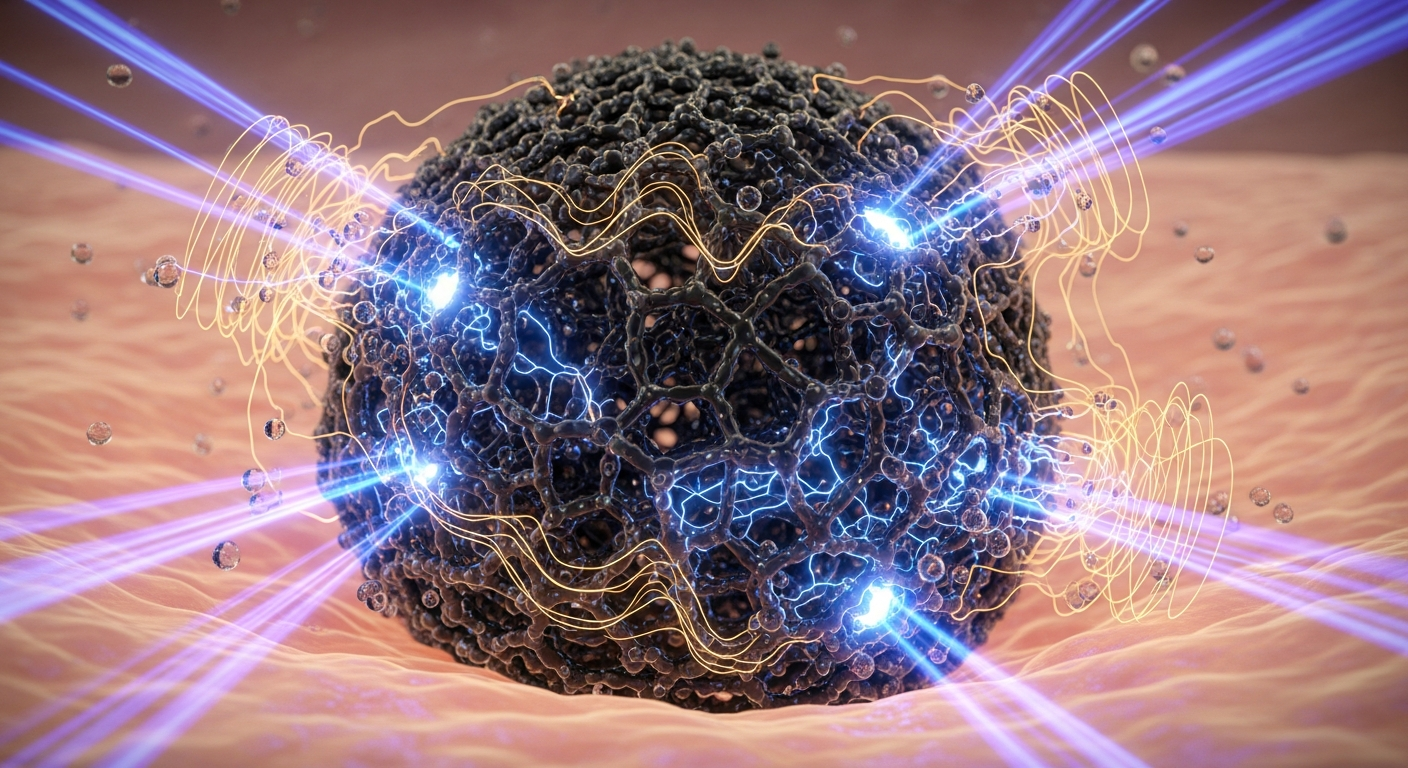
Melanin is often described as nature’s sunscreen, a role it performs with an efficacy that materials scientists can only envy. When a high-energy ultraviolet photon strikes a melanin molecule, over 99.9% of that energy is converted into harmless heat in less than a trillionth of a second. This near-perfect photothermal conversion is a stunning feat of molecular engineering, preventing the formation of DNA-damaging free radicals. But this singular focus on photoprotection, while accurate, risks obscuring a more profound and dynamic reality. What if this incredible efficiency is not merely a defensive mechanism but a clue to a more fundamental role? Emerging research suggests that melanin is not a passive shield but an active energy transducer, a biological material capable of converting light, heat, and even mechanical pressure into other forms of energy that may be biologically useful.
This perspective recasts melanin from a simple pigment into a sophisticated bioenergetic interface. It prompts us to ask a more challenging question: Is biology leveraging melanin’s unique physical properties to manage energy at the cellular and tissue level in ways we are only beginning to understand? The evidence, spanning biophysics, materials science, and quantum biology, points toward a molecule that is deeply integrated into the energetic landscape of life.
From Photon to Phonon: The Physics of Photothermal Conversion
The primary and most well-understood function of melanin, particularly eumelanin (the brown-black variant), is its remarkable ability to absorb a vast spectrum of electromagnetic radiation, from ultraviolet through the visible and into the infrared. This broadband absorption is a direct consequence of its complex, heterogeneous structure—a polymer of dihydroxyindole (DHI) and dihydroxyindole-2-carboxylic acid (DHICA) units, assembled into a disordered, amorphous solid. Unlike a simple crystalline material with a sharp absorption peak, melanin's chemical and structural disorder creates a multitude of electronic states, allowing it to absorb photons of nearly any energy.
The critical event happens immediately after photon absorption. In most molecules, an absorbed photon excites an electron to a higher energy state. This excited state is unstable and must relax. It can do so by re-emitting a photon (fluorescence), transferring the energy to another molecule, or undergoing a chemical reaction—often producing damaging reactive oxygen species (ROS). Melanin almost entirely bypasses these channels. Instead, it utilizes an ultrafast process known as non-radiative relaxation. The electronic energy is rapidly converted into molecular vibrations, which are then dissipated into the surrounding environment as heat. These quantized packets of vibrational energy are known as phonons.
This conversion is so efficient that the quantum yield of fluorescence from eumelanin is exceptionally low, on the order of 10⁻⁴. This means only one in ten thousand absorbed photons is re-emitted as light; the rest become heat. This process, explored in detail by researchers like John D. Simon and Tadeusz Sarna, is the basis of melanin’s photoprotective role. It acts as a molecular "black hole" for light, safely channeling potentially harmful energy into benign thermal fluctuations. This rapid and efficient conversion is not a simple byproduct of its color but a highly refined physical property, suggesting that managing light energy is one of its core evolutionary purposes.
Mechanical Stress and Piezoelectric Potential
While melanin’s interaction with light is well-documented, its response to other forms of energy is a frontier of active research. Recent studies in biomaterials have begun to explore whether melanin can transduce mechanical energy into electrical signals, a property known as piezoelectricity. Piezoelectric materials generate a voltage when they are compressed or deformed. This effect is common in crystalline materials like quartz but is less expected in a disordered polymer like melanin.
Nevertheless, a 2020 study in Nature Communications by a team led by Paul Meredith and Ardalan Armin provided compelling evidence for piezoelectric-like behavior in eumelanin thin films. They demonstrated that applying mechanical stress to melanin samples generated measurable electrical currents. The mechanism is thought to be rooted in the material's unique combination of proton conductivity and its disordered, porous internal structure. When melanin is hydrated, it contains mobile protons. Mechanical compression can alter the local arrangement of these protons and the water molecules they associate with, creating a transient separation of charge—in essence, a voltage.
This finding opens a fascinating avenue of inquiry. Could this property be biologically relevant? Tissues containing melanin, such as the skin, inner ear (in the stria vascularis), and even the retina, are constantly subjected to mechanical forces—from physical contact to sound waves and subtle cellular movements. The theoretical possibility exists that melanin could be converting this "mechanical noise" into low-level electrical signals. While this remains a hypothesis, it aligns with the growing appreciation for the role of bioelectricity in regulating cell behavior, tissue patterning, and regeneration, a field pioneered by researchers like Michael Levin. If melanin can act as a localized mechanical-to-electrical transducer, it could provide a layer of environmental sensing and bioelectric information that has been entirely overlooked.
A Hydrated Semiconductor at the Bioelectric Interface
The energy-transducing capabilities of melanin are fundamentally tied to its identity as an organic semiconductor. Pioneering work by John McGinness in the 1970s first established that melanin could conduct electricity and that its conductivity was highly dependent on its hydration state. Dry melanin is an excellent insulator, but as it absorbs water, its conductivity can increase by several orders of magnitude. This is primarily due to protonic conduction, where protons (H+ ions) hop between water molecules adsorbed within the melanin polymer, rather than electronic conduction seen in metals.
This hydration-dependent conductivity makes melanin a uniquely biological material. Its electrical properties are not fixed but are dynamically tuned by its local aqueous environment. This positions melanin as a potential interface between external energy sources and the internal bioelectric networks of the cell. All cells maintain a membrane potential (Vmem), an electrical voltage across their membrane that is crucial for signaling and function. Changes in Vmem can trigger profound downstream effects, from cell differentiation to proliferation.
Consider melanin's position in the retinal pigment epithelium (RPE), a cell layer critical for vision. The RPE is exposed to intense light, generating significant heat. It also experiences subtle mechanical pressures. Could melanin’s transduction of this light and mechanical energy into localized electrical or protonic gradients influence the Vmem of RPE cells? Could it help manage the immense energetic and oxidative load these cells endure? In the substantia nigra of the brain, neuromelanin accumulates with age. It is known to chelate metal ions like iron, which can participate in redox reactions. Here, melanin’s semiconductor and charge-transfer properties may be playing a role in managing the brain's unique electrochemical environment. These are still open questions, but they reframe melanin not as an inert pigment but as a dynamic component of the cell's electrochemical machinery.
Key Takeaways
- Melanin converts over 99.9% of absorbed UV and visible light into heat through an ultrafast process called non-radiative relaxation, effectively preventing the generation of harmful reactive oxygen species.
- The disordered, amorphous structure of melanin creates a broadband absorption spectrum, allowing it to interact with a wide range of electromagnetic energies, from UV to infrared.
- Emerging materials science research shows that hydrated melanin exhibits piezoelectric-like behavior, generating electrical currents in response to mechanical pressure, suggesting a potential role in mechanotransduction.
- Melanin functions as a hydration-dependent organic semiconductor, with its electrical conductivity increasing by orders of magnitude in the presence of water, primarily through protonic (H+) conduction.
- These combined properties suggest melanin may function as a sophisticated bioenergetic transducer, converting environmental energies (light, heat, mechanical stress) into forms that could influence cellular bioelectric signaling and metabolic states.
- Melanin's role in tissues like the retina, inner ear, and brain may extend beyond pigmentation and photoprotection to active participation in local energy management and electrochemical homeostasis.
References
- Meredith, P., & Sarna, T. "The physical and chemical properties of eumelanin." Pigment Cell Research 19(6), 572-594 (2006). DOI: 10.1111/j.1600-0749.2006.00345.x doi:10.1111/j.1600-0749.2006.00345.x
- McGinness, J., Corry, P., & Proctor, P. "Amorphous semiconductor switching in melanins." Science 183(4127), 853-855 (1974). DOI: 10.1126/science.183.4127.853 doi:10.1126/science.183.4127.853
- Mostert, A. B., Rienecker, S. B., Eder, D., & Meredith, P. "The role of piezoelectricity in the function of natural and synthetic melanins." Nature Communications 11, 4629 (2020). DOI: 10.1038/s41467-020-18449-7
- Płonka, P. M., & Płonka, B. M. "What we have learned about the physical properties of melanins. The effect of hydration." Cellular & Molecular Biology Letters 11(4), 526-538 (2006). DOI: 10.2478/s11658-006-0044-6
- Simon, J. D., Peles, D., Wakamatsu, K., & Ito, S. "The nature of the M-band in the absorption spectrum of melanins." Journal of Physical Chemistry B 113(1), 22-26 (2009). DOI: 10.1021/jp8055606
- d'Ischia, M., Wakamatsu, K., Cicoira, F., Di Mauro, E., Garcia-Borron, J. C., Commo, S., Galván, I., Ghanem, G., Kenzo, K., Meredith, P., Pezzella, A., Santato, C., Sarna, T., Simon, J. D., Zecca, L., Zucca, F. A., Napolitano, A., & Ito, S. "Melanins and melanogenesis: from pigment cells to human health and technological applications." Pigment Cell & Melanoma Research 28(5), 520-544 (2015). DOI: 10.1111/pcmr.12393
- Zecca, L., Fariello, R., Riederer, P., Sulzer, D., Gatti, A., & Tampellini, D. "The role of iron and copper in the neurodegeneration of substantia nigra." Journal of Neurochemistry 90(5), 1017-1025 (2004). DOI: 10.1111/j.1471-4159.2004.02574.x