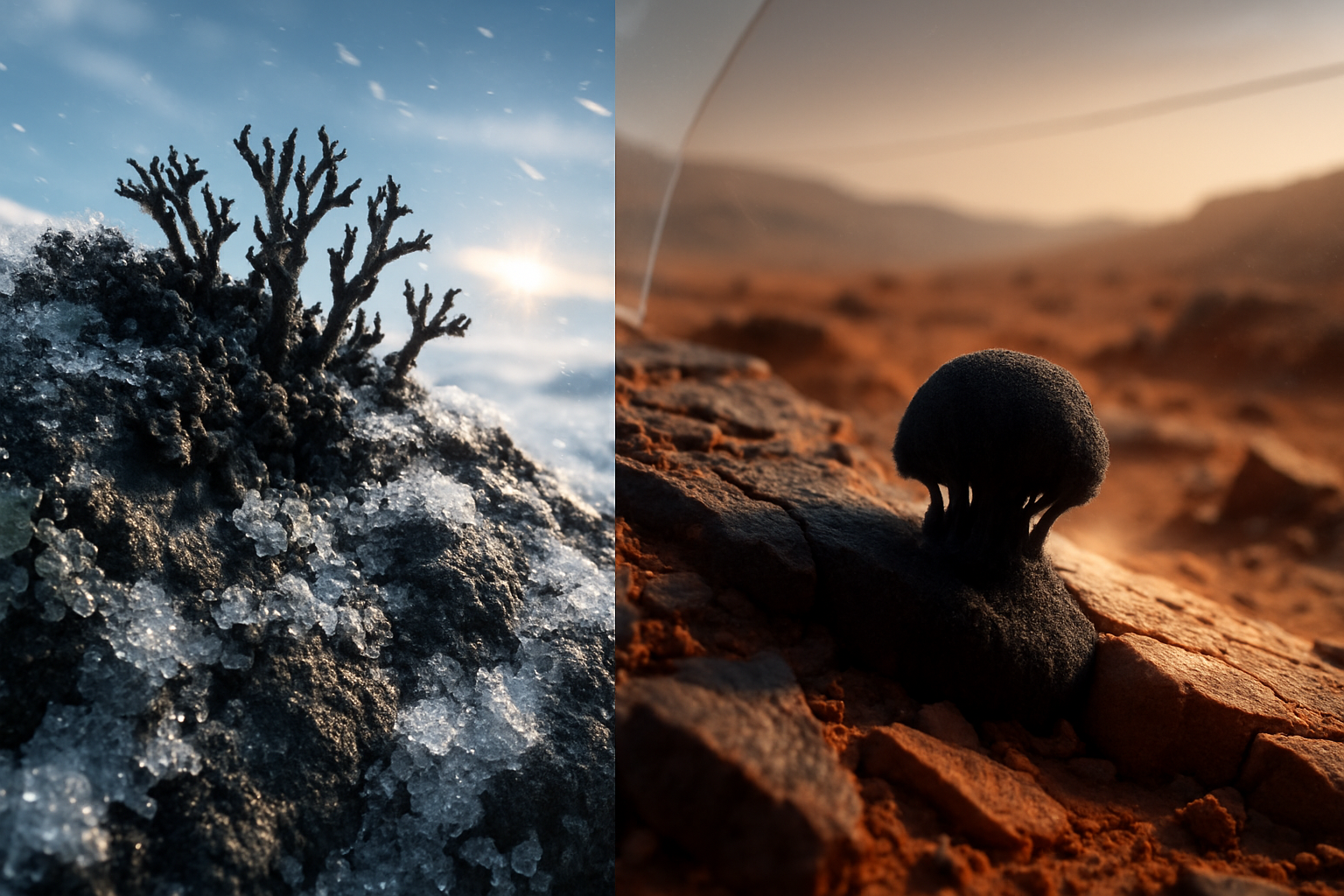
Introduction: Why Dark-Pigmented Life Matters for Mars
Melanized fungi and lichen-associated fungi occupy an unusual position in astrobiology. They are not merely organisms with dark pigmentation; they are comprehensive stress-tolerance systems where pigmentation, cellular architecture, dormancy, repair, antioxidant chemistry, and ecological associations function collectively. Thus, they serve as essential models for evaluating how life reacts to multiple simultaneous environmental stressors.
While comparing Antarctica and Mars is scientifically beneficial, it must remain an experimental analogy rather than a claim of biological equivalence. Antarctic environments impose challenges like low temperatures, desiccation, radiation exposure, nutrient scarcity, and persistent contact with mineral surfaces. Mars presents similar types of stress, though their intensity, timing, atmospheric context, and spatial distribution vary considerably. Survival in Antarctica does not confirm Martian habitability, and the endurance of an Antarctic organism in simulation does not imply its potential for growth, reproduction, or ecological sustainability on Mars.
The pressing question is more focused: Does melanin directly protect cells under Mars-like conditions, or is it merely one element of a broader extremophile phenotype? To answer this, experiments must differentiate pigmentation from dormancy, DNA repair, antioxidant defenses, biofilm formation, symbiosis, and mineral shielding.
The trajectory of the literature transitions from organism-level simulation to fungal astrobiology, lichen radiation studies, and extremophile microbiome theory. The evidence does not support numerical claims regarding survival rates, radiation thresholds, growth rates, or melanin-specific protection coefficients. The most robust conclusion is methodological: melanized fungi and lichens offer tractable systems for studying resilience under combined environmental stress. The Quantum Melanin Research Foundation examines this frontier using biophysics, redox chemistry, charge transport, and ecological systems theory, maintaining a clear boundary between empirical findings and speculation about extraterrestrial habitability.
Melanin’s Biophysics: What the Pigment Can—and Cannot—Explain
Radiation Absorption and Energy Dissipation
Melanin is a chemically diverse, broadband pigment with varying oxidation states, aromatic and conjugated structures, radical species, and supramolecular interactions. This diverse architecture allows absorption across a wide electromagnetic spectrum region. Absorbed radiation energy redistributes through non-radiative pathways like internal conversion and vibrational relaxation, reducing direct damage to cellular structures.
This property is crucial for ultraviolet and ionizing-radiation stress, as cellular damage depends on energy deposition patterns. A pigment-rich cell wall may alter radiation impact on nucleic acids, membranes, or intracellular proteins, functioning as an attenuating and energy-dissipating layer. However, it does not provide absolute radiation protection. While absorption can mitigate exposure, molecular damage remains possible, often generating reactive chemical species.
Distinguishing melanin's radioprotective role is vital. A dark organism may absorb more radiation but experience less biological damage if absorbed energy is safely dissipated. Pigment-associated redox activity could contribute to oxidative chemistry depending on conditions. The outcome depends on pigment composition, localization, hydration, cellular status, radiation quality, and repair system activity. The review The relevance of fungi in astrobiology research – Astromycology frames melanin as part of a broader fungal stress-response repertoire rather than an independent extremotolerance explanation.
Antioxidant and Redox-Buffering Roles
Radiation and desiccation can disrupt redox balance, producing reactive oxygen species directly or through chemical cascades involving macromolecules. Desiccation alters cell organization and repair processes, making rehydration an oxidative challenge as metabolism resumes.
Melanin may stabilize radicals and buffer redox changes due to its paramagnetic properties and diverse subunits. Melanized structures can act as distributed redox-active materials instead of passive dyes. However, melanin does not neutralize all oxidative damage. Enzymatic antioxidants, thiol systems, DNA repair, and metabolic suppression are equally or more crucial depending on situation.
Thus, melanin's role in stress tolerance depends on its interaction with cellular regulation, protecting some compartments while altering redox conditions in others. Its effect varies between dormant and active metabolic states.
Cell-Wall and Structural Protection
In melanized fungi, pigment associates with the cell wall, strategically important due to its environmental interface role. The wall's composition affects permeability, resilience, hydration dynamics, and surface contact. Pigment can change wall rigidity, reduce damage penetration, and alter dehydration patterns by influencing water and solute movement.
Environmental mechanics might see a pigment-containing wall buffering hydration and temperature fluctuations. Radiation physics might place absorbing material outside sensitive structures. Chemically, it could concentrate redox groups at cellular boundaries.
These functions are organism- and pigment-specific. Melanin is not a uniform material. Differences in biosynthesis, oxidation state, polymer organization, and association with cellular components result in diverse properties.
Direct Protection Versus Correlated Phenotype
The primary challenge is distinguishing melanin's effect from co-occurring traits. Melanized fungi could also feature robust DNA repair, antioxidant systems, membrane composition, extracellular matrices, dormancy programs, or protective biofilms. A Martian simulation experiment cannot solely attribute survival to pigment concentration.
Effective research should use matched strains differing primarily in melanization, tested under controlled conditions. Measurements should include viability, damage recovery, metabolic activity, structural integrity, and phenotype persistence. The critical inquiry is not melanin's solo role but its interaction with the extremophile phenotype.
Antarctic Models and Mineral Microhabitats: From Cryomyces antarcticus to Mars Analogues
Why Cryomyces antarcticus is a Valuable Model
Cryomyces antarcticus, a black melanized Antarctic fungus, is a prime candidate for studying responses to simulated Mars and space conditions. Adapted to harsh environments with combined stressors like cold, limited water, nutrient scarcity, and radiation, it offers insights into multi-stressor resilience beyond a lab strain optimized for growth.
The study Responses of the Black Fungus Cryomyces antarcticus to Simulated Mars and Space Conditions on Rock Analogs highlights its examination on rock analogs, acknowledging the environmental geometry in extremophile biology rather than isolating the cell in laboratory settings. However, the analogy's limitations remain: terrestrial evolution under different chemical, gravitational, and ecological conditions. Persisting in exposure tests does not equate to Martian growth. Viability, recovery, active metabolism, growth, and reproduction are distinct outcomes requiring consideration.
Why Rock Analogs Matter
Mineral substrates produce porosities, cracks, shaded interfaces, and heterogeneity that buffer radiation, retain water, and offer protection. Porous surfaces alter gas exchange, hydration, ionic composition, and redox states, differentiating rock-associated organisms fundamentally from exposed cultures.
On flat surfaces, stressors reach organisms uniformly; in protected zones, exposure becomes spatially structured, affecting population refuge. Responses are driven by pigment, architecture, mineralogy, and microclimate.
Combined Stresses Instead of Single-Stressor Tests
Mars-relevant biology arises from interacting stressors. Dehydration lowers metabolism and delays repair. Radiation triggers oxidative stress, low temperatures slow reactions, and rehydration induces mechanical and oxidative injury. Stressors collectively alter biological outcomes, seen in the research progression from Cryomyces antarcticus studies to advanced theories like extremophile microbiome interactions and ecological resilience.
Hypothetical Experimental Scenario: Mineral-Interface Mars Simulation
An insightful experiment would place melanized Cryomyces antarcticus in exposed mineral surfaces, shaded pores, and non-mineral substrates under combined Mars simulation conditions. One group would remain dormant, the other metabolically active. This approach requires diverse measurements beyond simple endpoints, examining structural integrity, metabolic activity, oxidative markers, and recovery. Comparing mineral protection with melanization and physiological states within this framework reveals whether chemical, structural, or ecological refuges predominate.
Lichens, Ionizing Radiation, and the Difference Between Survival and Activity
Why Lichens Add Biological Complexity
Lichens, symbiotic systems of fungi and photosynthetic or metabolically compatible partners, complicate stress response interpretation. Multiple biological compartments within a lichen respond cooperatively, increasing their resilience through spatial separation, metabolic exchange, and collective properties of the symbiotic matrix.
Their complexity makes them valuable for resilience studies at both cellular and consortium levels but complicates causal attribution. A lichen persisting during simulation may attribute success to fungal melanization, partner stress responses, or interactions between these processes.
The Importance of Metabolically Active Organisms
The 2025 study Ionizing radiation resilience: how metabolically active lichens endure exposure to the simulated Mars atmosphere focuses on metabolically active lichens, differentiating temporary viability from continued function, a crucial astrobiological distinction. It highlights:
- Temporary viability for potential post-exposure recovery,
- Recovery after dormancy needing improved conditions for activity,
- Sustained metabolism for continuing biochemical function, and
- Growth and reproduction for acquiring resources and ecological persistence.
Active metabolism is demanding, involving electron transfer, membrane integrity, enzyme function, substrate access, and oxidative balance regulation. A melanized lichen might endure exposure in dormancy yet struggle with function during the same conditions. Conversely, sustained activity might not equate to growth.
Interpreting Radiation Responses Cautiously
Ionizing radiation damages DNA, proteins, membranes, and redox systems. Melanin may lower exposure, stabilize radicals, or alter cell boundary chemistry. Yet repair systems, antioxidant capacity, dormancy, cooperation, and extracellular architecture ultimately determine damage outcomes.
The resilience interpretation must account for multi-layered integration. A functioning consortium under tested conditions doesn't imply melanin-induced radiation tolerance or feasible Martian colonization.
Experimental Priorities
Future experiments should compare various melanization and activity states, isolated and symbiotic organisms, exposed versus mineral-shielded samples, and measurements of viability, activity, structural damage, oxidative stress, DNA integrity, and partner-specific functions. Investigating whether pigmentation predicts performance once other variables are controlled is essential.
From Mars Simulation to Emerging Theories: Microbiomes, Habitability, and Planetary Protection
Microbial Communities as Ecological Systems
Solitary cells don't accurately model environmental persistence. Biofilms, lichen communities, and extremophile microbiomes create polymers, alter diffusion, and establish gradients unavailable to isolated organisms. They enable metabolite exchange, communal repair, or habitat differentiation, highlighted in the review The role of extremophile microbiomes in terraforming Mars. Future studies must address community resilience and collective properties distinct from isolated strains.
Clearly Marked Extrapolation — Melanized Microbiomes Altering Local Habitability?
Speculative scenarios suggest a melanized microbiome might locally alter environments by retaining moisture, modifying surface chemistry, or participating in nutrient cycling. Biofilms might adjust microscale diffusion and hydration, but such changes differ fundamentally from planetary terraforming. The literature supports discussing habitability-impacting scenarios but doesn't confirm environmental alteration on Mars.
Clearly Marked Extrapolation — Encountering or Transporting Melanized Life?
Mars missions face direct planetary-protection issues if melanized terrestrial organisms contaminate hardware, complicating life-detection experiments through false positives or habitat alteration. Introducing organisms to Martian habitats might also change their chemistry or ecology, risking data misinterpretation. Planetary protection is crucial for preserving causal clarity.
Emerging Research Agenda
Upcoming experiments should integrate Mars-relevant minerals, atmospheres, thermal and radiation conditions, and water dynamics beyond binary survival. Accurate measures of survival, recovery, sustained metabolism, growth, reproduction, and community interaction are critical.
Future studies should manipulate melanization, physiological states, mineral contexts, and exposure histories. The Quantum Melanin Research Foundation seeks to unite pigment electronic behavior with redox regulation, structural protection, and ecological persistence across scales—from pigment chemistry to microbial ecology.
Key Takeaways
Melanin may bolster extremophile resilience via broad-spectrum radiation absorption, non-radiative energy dissipation, radical stabilization, oxidative buffering, and cell-wall protection. While these mechanisms are plausible, they don’t establish melanin as the sole determinant of survival.
The phenotype involves multiple layers. DNA repair, antioxidant systems, dormancy, membrane organization, biofilms, symbiosis, extracellular matrices, and mineral shielding all play roles. Cryomyces antarcticus and melanized lichens offer models for understanding responses to harsh environments, celebrating mineral interfaces' capabilities in providing microhabitat refuges.
Current research does not substantiate unverified numerical survival claims or Martian growth rates. Influenced microbiomes or terraforming discussions must maintain a clear separation from experimental results.
Determining whether melanin is directly radioprotective or a marker of a wider extremophile phenotype remains the key question. It requires comparative systems, realistic mineral environments, active-state measurements, and mechanistic analysis spanning pigment chemistry to microbial ecology.
Related Research
- Melanin-Coated Nanoparticles: A New Frontier in Targeted Cancer Hyperthermia
- Bioelectric Signaling in Cancer: The Voltage Hypothesis and Melanin’s Potential Role
- [Melanin as a Biological Semiconductor: Bridging Quantum Physics and Cellular Biology](/articles/melanin-as-a-biological-semiconductor-bridging-quantum-physics-and-cellular-biology-1788964204587)
References
- Claudia Pacelli, Laura Selbmann, Laura Zucconi. "Responses of the Black Fungus Cryomyces antarcticus to Simulated Mars and Space Conditions on Rock Analogs." Astrobiology. 2018. doi:10.1089/ast.2016.1631
- MF Simões, Marta Cortesão, Armando Azúa-Bustos. "The relevance of fungi in astrobiology research – Astromycology." Mycosphere. 2023. doi:10.5943/mycosphere/14/1/13
- Claudia Coleine, Manuel Delgado‐Baquerizo, Alexandre Soares Rosado. "The role of extremophile microbiomes in terraforming Mars." Communications Biology. 2025. doi:10.1038/s42003-025-08973-1
- Kaja Skubała, Karolina Chowaniec, Mirosław Kowaliński. "Ionizing radiation resilience: how metabolically active lichens endure exposure to the simulated Mars atmosphere." IMA Fungus. 2025. doi:10.3897/imafungus.16.145477