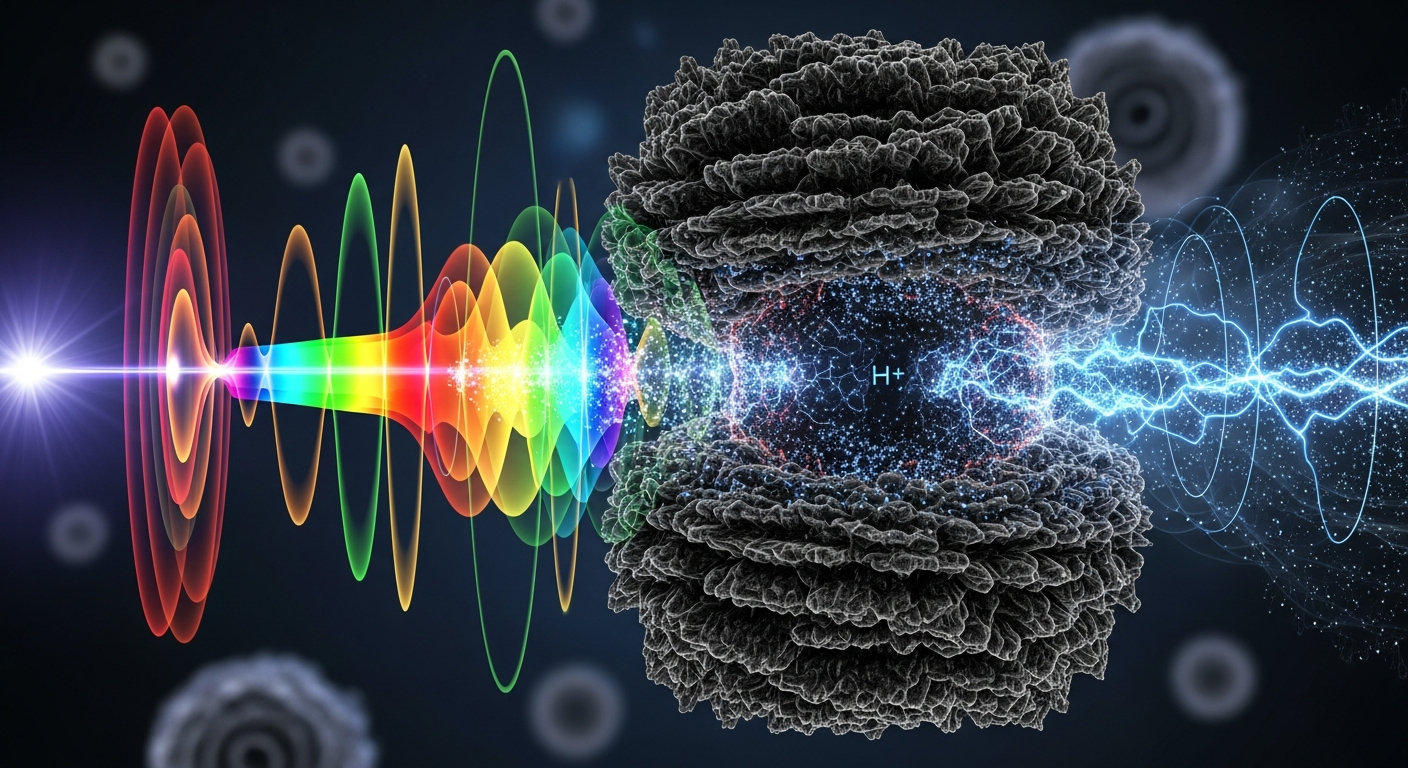
Melanin's broadband absorption capabilities suggest a role far beyond simple photoprotection, positioning it as a key mediator between biological systems and the electromagnetic environment.
It is a molecule defined by its interaction with light. Melanin, the pigment responsible for the vast palette of colors in the living world, is known primarily as our built-in sunscreen. Its ability to absorb high-energy ultraviolet (UV) photons is a masterclass in evolutionary biophysics, protecting the delicate genetic code within our cells from radiation damage. Yet, a closer look at its absorption spectrum reveals a profound anomaly. Unlike most biological pigments, like chlorophyll or hemoglobin which have sharp, characteristic absorption peaks at specific wavelengths, melanin’s absorption is a remarkably smooth, near-featureless curve that spans the entire electromagnetic spectrum—from high-energy UVC, through the visible range, and deep into the near-infrared (NIR). This broadband absorption is so efficient that melanin is often compared to "amorphous carbon" or other engineered light-absorbing materials. This raises a fundamental question: Why would nature evolve a molecule with such an energetically expensive and expansive absorption capability if its only purpose was to block a relatively narrow band of UV radiation? This observation suggests we may be looking at a system with a far more complex and dynamic role in biology, one that positions melanin as a primary interface between life and the electromagnetic environment.
The Physics of a Biological "Black Body"
To understand melanin's expansive capabilities, we must look past the simple model of a single molecule and see it for what it is: a heterogeneous, disordered biopolymer. The most common form in humans, eumelanin, is not a neat, repeating structure but a complex polymer synthesized from tyrosine, primarily composed of 5,6-dihydroxyindole (DHI) and 5,6-dihydroxyindole-2-carboxylic acid (DHICA) units. These planar molecules stack together in a random, layered fashion, reminiscent of disordered graphite. It is this structural chaos that gives rise to its extraordinary optical properties.
In the 1970s, pioneering work by physicist John McGinness and his colleagues first proposed that melanin functions as an amorphous semiconductor. Unlike crystalline semiconductors like silicon, which have a well-defined energy gap between their valence and conduction bands, the structural disorder in melanin creates a near-continuum of electronic energy states. This means there is no single "correct" photon energy required to excite an electron. Instead, a photon from almost anywhere in the UV-Vis-NIR spectrum carries enough energy to promote an electron from one state to another. This is the physical basis for its broadband absorption. It acts less like a tuned fork, which resonates at a single frequency, and more like a dense foam that can absorb and dampen vibrations across a wide range of frequencies. This model has been refined over decades, but its core insight remains: melanin's function is inseparable from its physical form as a disordered, solid-state biological material.
From Photon to Proton: Mechanisms of Energy Transduction
If melanin is constantly absorbing energy across the spectrum, what does it do with it? The most well-documented pathway is its photoprotective function. Upon absorbing a UV photon, the melanin molecule undergoes an "ultrafast internal conversion," dissipating over 99.9% of the absorbed energy as harmless heat. This process is incredibly rapid, occurring on the timescale of picoseconds (10⁻¹² seconds), preventing the formation of reactive oxygen species that would otherwise damage the cell. This remarkable efficiency, detailed in work by Paul Meredith and Tadeusz Sarna, solidifies its role as the ultimate natural sunscreen.
However, heat dissipation is not the whole story. Melanin is also a protonic conductor, meaning it can facilitate the movement of protons (H⁺ ions), especially when hydrated. Water molecules associated with the melanin polymer structure form "proton wires," creating pathways for charge to move. Research by scientists like Arturo Solís Herrera has proposed a provocative hypothesis: that melanin can use the energy from absorbed photons to split water molecules into hydrogen and oxygen, thereby transducing electromagnetic energy into chemical energy. While this specific "photosynthesis-like" capability in human melanin remains a subject of intense scientific debate, the underlying principle that melanin can convert light energy into other forms—such as electrical potential via proton gradients—is gaining traction. This moves melanin from the category of a passive shield to an active energy transducer, a component capable of converting an incoming electromagnetic signal into a biologically relevant electrochemical one.
The Antenna Hypothesis: Interacting with Lower Frequencies
The semiconductor and protonic conductor properties of melanin open the door to a more expansive role. If melanin can interact with high-energy photons, it is plausible that it can also interact with lower-energy, non-ionizing radiation, such as radio frequencies (RF). This is the basis of the "melanin antenna" hypothesis. While the energy of a single RF photon is too low to cause electronic excitation, a coherent electromagnetic field can exert forces on charge carriers within a conductive material. In melanin, these charge carriers could be delocalized electrons within the polymer's π-stacked system or, perhaps more likely, protons moving along hydration layers.
This is where melanin biophysics intersects with the field of bioelectricity. Research from laboratories like that of Michael Levin at Tufts University has demonstrated that cells and tissues use gradients of ions to create voltage potentials that guide embryogenesis, regeneration, and wound healing. These bioelectric signals are a fundamental, non-genetic layer of information in biology. If melanin, strategically positioned within cells and tissues, can be influenced by external EM fields, it could potentially modulate these local bioelectric circuits. It could act as a transducer, converting an ambient RF signal into a subtle change in local proton concentration or electrical potential, thereby influencing ion channel activity and downstream cellular behavior.
Evidence for such interactions remains emergent but is compelling. Studies have shown that melanized fungi, like those found thriving in the high-radiation environment of the Chernobyl reactor, can harness ionizing radiation for growth, a process in which melanin is critically involved. While the frequencies are different, this establishes a clear precedent for melanin mediating biological responses to radiation. The key research challenge now is to determine the precise mechanisms and frequency dependencies of melanin's interaction with non-ionizing EM fields and to understand if these interactions have physiological consequences in organisms, including humans.
Key Takeaways
- Melanin exhibits unique broadband absorption, efficiently absorbing electromagnetic energy from ultraviolet through visible and into the near-infrared spectrum, unlike most biological pigments.
- The physical structure of eumelanin, a disordered polymer of stacked monomers, allows it to function as an amorphous semiconductor with a continuum of electronic states.
- Beyond dissipating UV radiation as heat with over 99.9% efficiency, melanin also functions as a hydration-dependent protonic conductor, capable of transducing absorbed energy into electrochemical potential.
- The "melanin antenna" hypothesis proposes that melanin's conductive properties allow it to interact with non-ionizing electromagnetic fields, such as radio frequencies, potentially by modulating local charge environments.
- This potential interaction with EM fields suggests melanin could interface with the body's native bioelectric signaling networks, representing a frontier of research into the environmental and physiological roles of this ubiquitous biopolymer.
References
- McGinness, J., Corry, P., & Proctor, P. "Amorphous semiconductor switching in melanins." Science 183(4127), 853-855 (1974). DOI: 10.1126/science.183.4127.853 doi:10.1126/science.183.4127.853
- Meredith, P., & Sarna, T. "The physical and chemical properties of eumelanin." Pigment Cell Research 19(6), 572-594 (2006). DOI: 10.1111/j.1600-0749.2006.00345.x doi:10.1111/j.1600-0749.2006.00345.x
- d'Ischia, M., Wakamatsu, K., Cicoira, F., Di Mauro, E., Garcia-Borron, J. C., Commo, S., ... & Ito, S. "Melanins and melanogenesis: from pigment cells to human health and technological applications." Pigment Cell & Melanoma Research 28(5), 520-544 (2015). DOI: 10.1111/pcmr.12393
- Dadachova, E., Bryan, R. A., Huang, X., Moadel, T., Schweitzer, A. D., Aisen, P., ... & Casadevall, A. "Ionizing radiation changes the electronic properties of melanin and enhances the growth of melanized fungi." PLoS ONE 2(5), e457 (2007). DOI: 10.1371/journal.pone.0000457 doi:10.1371/journal.pone.0000457
- Mostert, A. B., Rienecker, S. B., D'Arcy, J. M., Jastrzebska, A., Sarna, T., Kan, S. C., ... & Meredith, P. "The role of hydration in the electrical conductivity of eumelanin." Proceedings of the National Academy of Sciences 113(45), 12649-12654 (2016). DOI: 10.1073/pnas.1610427113
- Levin, M. "Molecular bioelectricity: how cells compute with ions." Progress in Biophysics and Molecular Biology 114(3), 187-195 (2014). DOI: 10.1016/j.pbiomolbio.2014.02.003
- Solís Herrera, A., Arias Esparza, M. C., Solís Arias, R. I., Solís Arias, P. C., & Solís Arias, M. P. "The unexpected capacity of melanin to dissociate the water molecule fills the gap between the life before and after the oxygen." Photosynthesis Research 103(3), 209-216 (2010). DOI: 10.1007/s11120-010-9552-x