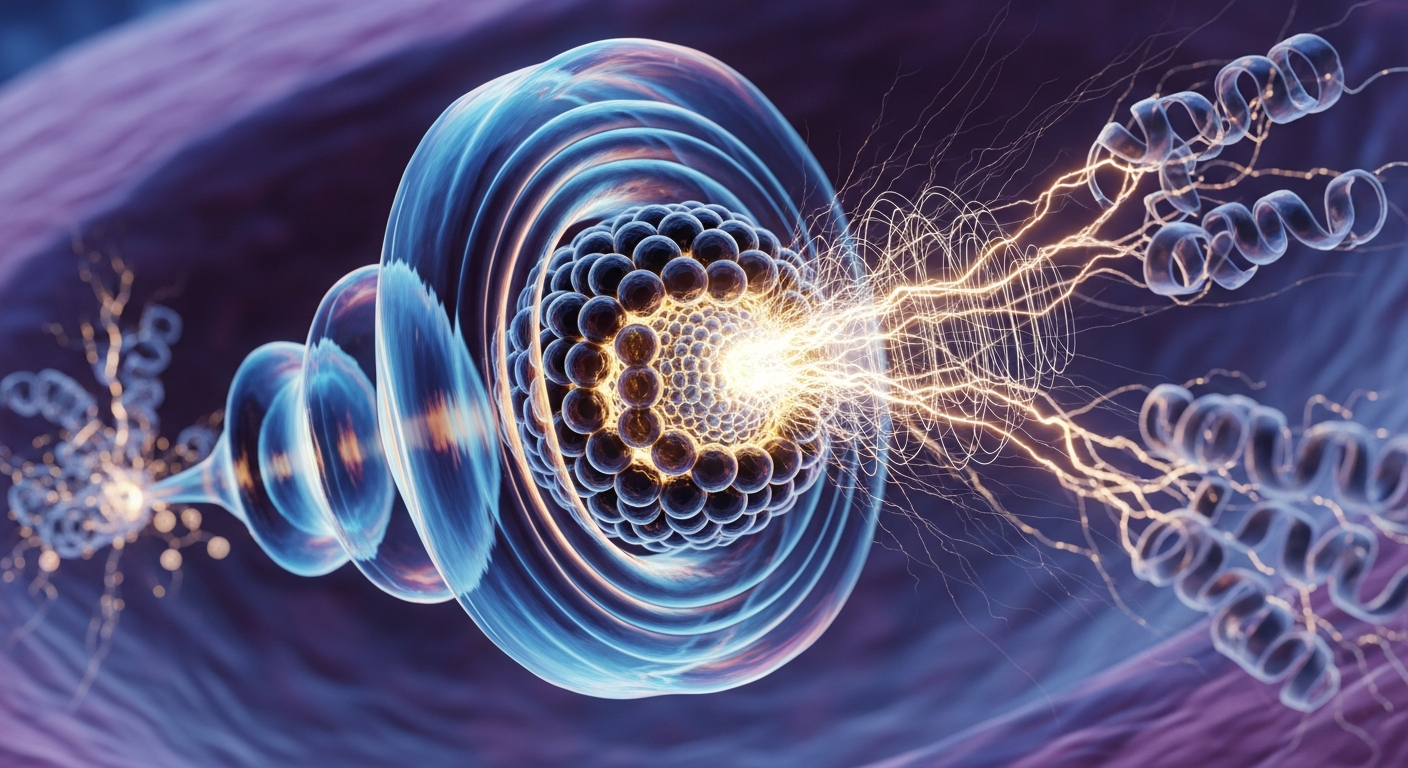
Exploring the potential for mechanical vibrations, including sound, to generate electrical signals in melanin, linking the physical world of acoustics to the bioelectric language of the cell.
Cells, much like whole organisms, are exquisitely sensitive to their physical environment. They perceive pressure, tension, shear stress, and vibration through a process known as mechanotransduction. This conversion of mechanical force into electrochemical activity is fundamental to hearing, touch, and the regulation of cellular growth and differentiation. Specialized ion channels that open or close in response to membrane stretch are the canonical players in this process. But what if one of biology's most ubiquitous and enigmatic molecules—melanin—participates in this sensory web through a more direct and elegant physical principle?
This question leads us to a compelling, albeit still developing, area of inquiry: the piezoelectric hypothesis of melanin. The proposition is that melanin granules may not only be passive absorbers of electromagnetic radiation but also active transducers of mechanical energy. If this holds true, it suggests that mechanical vibrations, from the low-frequency hum of cellular machinery to external acoustic waves, could be directly converted into electrical signals by melanin itself. This would establish a novel signaling pathway, one with profound implications for understanding cellular communication, environmental sensing, and the very definition of melanin’s biological role.
The Bioelectric Language of the Cell
To appreciate the significance of a molecule that can generate an electrical charge, we must first understand the electrical landscape it inhabits. Every cell in the body maintains a voltage difference across its membrane, known as the membrane potential (Vmem). While most familiar in the context of neurons and muscle cells, this bioelectric potential is a universal feature of life. Research, particularly from the laboratory of Michael Levin at Tufts University, has demonstrated that patterns of Vmem across tissues function as a kind of biological software, instructing cells on growth, patterning, and identity.
This bioelectric layer of information operates in parallel with genetic and biochemical signaling. By modulating the flow of ions through channels in the cell membrane, spatial patterns of Vmem create an instructive "map" that guides large-scale anatomical outcomes. Levin's group has shown that by manipulating these bioelectric patterns, they can induce a flatworm to grow a head where its tail should be, stop the metastatic behavior of cancer cells, or trigger the regeneration of a frog's leg.
This body of work establishes a critical principle: localized changes in electric fields are not mere byproducts of cellular activity; they are a primary and powerful form of biological information. Any endogenous component capable of creating or modulating these fields in response to a stimulus would therefore be a significant player in cellular command and control. This is the context in which the potential piezoelectric properties of melanin become so intriguing.
Melanin: An Ordered and Electrically Active Biopolymer
For decades, melanin was primarily understood through a chemical and photoprotective lens. It is a heterogeneous polymer, with eumelanin providing potent UV-blocking and antioxidant properties, and pheomelanin being less protective and potentially photosensitizing. However, a parallel thread of research, dating back to the 1970s, has investigated its solid-state physical properties. In a landmark 1974 paper in Science, John McGinness, Peter Corry, and Proctor showed that eumelanin behaves as an amorphous semiconductor.
Subsequent research has refined this picture. Melanin exhibits significant broadband absorption, meaning it can absorb energy across the entire electromagnetic spectrum, from UV to radio waves. Its electrical conductivity is highly dependent on its hydration state, functioning as a proton conductor by shuffling protons along water molecules adsorbed to the polymer structure. Furthermore, melanin contains a population of stable free radicals, a unique characteristic for a biological molecule, which allows it to engage in a wide range of redox reactions.
These established properties already paint a picture of melanin as a bioelectronic material, not just a passive pigment. It is a substance capable of absorbing, storing, and dissipating energy in complex ways. The structure of melanin granules (melanosomes) is not a random aggregate but a highly organized layering of melanin monomers. This structural order is a key prerequisite for many solid-state physical phenomena, including piezoelectricity, making the leap from a semiconductor to a potential piezoelectric material a logical, if unproven, next step.
The Piezoelectric Hypothesis: Connecting Vibration to Voltage
Piezoelectricity (from the Greek piezein, "to squeeze or press") is a property of certain crystalline materials, such as quartz, to generate an internal electric field when subjected to mechanical stress. Squeezing the material deforms its crystal lattice, separating the centers of positive and negative charge and creating a voltage. Conversely, applying an electric field causes the material to deform mechanically. This two-way electromechanical coupling is the basis for everything from quartz watches to ultrasound transducers.
The piezoelectric hypothesis of melanin posits that melanin granules, due to their ordered polymeric structure, can function as biological piezoelectric transducers. The proposed mechanism is as follows:
- Mechanical Input: A mechanical wave—such as a sound wave, a cellular vibration, or therapeutic ultrasound—propagates through the tissue and physically compresses or deforms a melanosome.
- Charge Separation: If melanin possesses piezoelectric properties, this mechanical stress would induce a separation of charge within the granule, creating a transient dipole with a positive and negative pole.
- Local Electric Field Generation: This charge separation generates a localized electric field in the immediate vicinity of the melanosome.
- Bioelectric Signaling: This local field can then directly influence the cell's bioelectric state. It could, for example, alter the conformational state of nearby voltage-gated ion channels in the cell or organelle membrane, changing the flow of ions like K+, Na+, or Ca2+ and thereby modifying the cell's Vmem.
This provides a direct physical pathway from sound/vibration to cellular electricity, bypassing conventional biochemical cascades. While direct, conclusive evidence for piezoelectricity in melanin is still an area of active research, it is not without precedent in biology. Collagen, the most abundant protein in mammals, is known to be piezoelectric, a property thought to be involved in bone's ability to remodel in response to mechanical stress. If collagen can do it, the possibility that the highly structured, electronically active melanin polymer can do it too is a scientifically robust hypothesis.
Implications and Future Research Frontiers
Confirming the piezoelectric nature of melanin would be a significant advance, opening up several new avenues for research and therapeutic development. It would offer a physical mechanism for the observed, though often controversial, biological effects of certain sound frequencies and non-thermal ultrasound.
In ophthalmology, it could provide new insights into the function of melanin in the retinal pigment epithelium (RPE), which is subjected to constant pressure waves within the eye. In dermatology, it might explain how vibrational therapies could influence melanocyte behavior and skin regeneration. Perhaps most compelling is the role of neuromelanin, the form of melanin found in the dopamine-producing neurons of the substantia nigra, a brain region central to Parkinson's disease. If neuromelanin is piezoelectric, it suggests that the brain's acoustic and mechanical environment could directly influence the electrical activity of these crucial neurons.
The path forward requires direct experimental validation. Techniques like Piezoresponse Force Microscopy (PFM), which can map electromechanical coupling at the nanoscale, are perfectly suited to test this hypothesis on isolated melanosomes. By applying a voltage with a conductive atomic force microscope tip and measuring the resulting physical deformation (or vice versa), researchers can definitively determine if melanin is piezoelectric and quantify its response.
The journey to understand melanin has taken us from a simple pigment to a complex amorphous semiconductor. The next chapter may well reveal it to be a sophisticated mechanobioelectric transducer, finely tuned to the vibrational world and deeply integrated into the electrical symphony of the cell.
Key Takeaways
- Cellular behavior is regulated by a bioelectric layer of information encoded in membrane voltage patterns, making any endogenous source of electricity biologically significant.
- Melanin is not a passive pigment but an electronically active amorphous semiconductor with properties like broadband absorption and hydration-dependent proton conductivity.
- The piezoelectric hypothesis proposes that mechanical stress from vibrations or sound can cause charge separation in melanin granules, directly converting mechanical energy into a local electric field.
- This local electric field could influence nearby voltage-gated ion channels, providing a direct physical mechanism to alter a cell's membrane potential and trigger bioelectric signaling cascades.
- While collagen is a known piezoelectric biomaterial, confirming this property in melanin requires direct experimental testing using techniques like Piezoresponse Force Microscopy (PFM).
- If confirmed, this mechanism would have profound implications for understanding the biological effects of sound and vibration on melanin-rich tissues like the skin, eye, and brain.
References
- Levin, M. "The computational boundary of a 'self': developmental bioelectricity drives multicellularity and scale-free cognition." Frontiers in Psychology 10, 2688 (2019). DOI: 10.3389/fpsyg.2019.02688
- McGinness, J., Corry, P., & Proctor, P. "Amorphous semiconductor switching in melanins." Science 183(4127), 853-855 (1974). DOI: 10.1126/science.183.4127.853 doi:10.1126/science.183.4127.853
- d'Ischia, M., Wakamatsu, K., Cicoira, F., Di Mauro, E., Garcia-Borron, J. C., Commo, S., ... & Ito, S. "Melanins and melanogenesis: from pigment cells to human health and technological applications." Pigment Cell & Melanoma Research 28(5), 520-544 (2015). DOI: 10.1111/pcmr.12393
- Fukada, E., & Yasuda, I. "On the piezo-electric effect of bone." Journal of the Physical Society of Japan 12(10), 1158-1162 (1957). doi:10.1143/jpsj.12.1158
- Mostert, A. B., Rienecker, S. B., & Meredith, P. "The electrical and protonic conductivity of eumelanin." RSC Advances 6(114), 113337-113342 (2016). DOI: 10.1039/c6ra23347b
- Powell, B. J., & T︠S︡upylo, E. A. "The electronic properties of eumelanin." Journal of Chemical Physics 145(15), 154901 (2016). DOI: 10.1063/1.4964673
- Solís Herrera, A., Arias Esparza, M. C., Solís Arias, R. I., Solís Arias, P. A., & Solís Arias, M. P. "The unexpected capacity of melanin to dissociate the water molecule fills the gap between the life before and after the appearance of photosynthesis." International Journal of Hydrogen Energy 35(21), 11634-11646 (2010).
- McFadden, J., & Al-Khalili, J. Life on the Edge: The Coming of Age of Quantum Biology. Crown Publishers (2014).