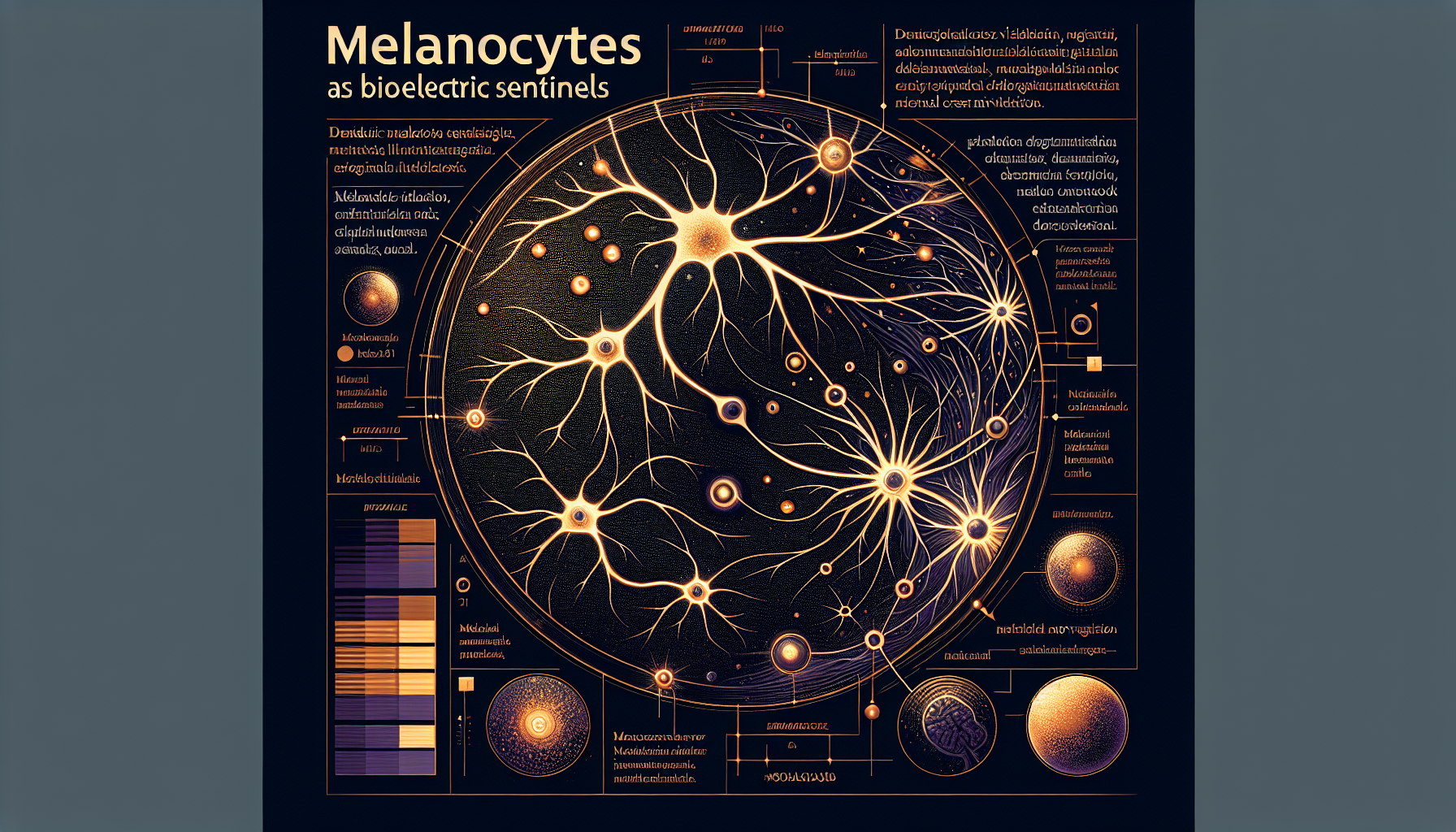
Emerging research reveals that melanocytes function as sophisticated cellular communication networks, leveraging their neural crest heritage and dendritic architecture for roles far beyond pigment production. These findings challenge fundamental assumptions about skin biology and suggest melanocytes operate as bioelectric sentinels throughout the body's largest organ.
The human epidermis contains approximately 1,500 melanocytes per square millimeter, each extending elaborate dendritic processes that contact 30-40 keratinocytes in what dermatologists call the epidermal melanin unit. For decades, scientists viewed this arrangement through the narrow lens of photoprotection—melanocytes producing melanin, packaging it into melanosomes, and transferring these organelles to surrounding keratinocytes like a cellular sunscreen factory. But recent discoveries in bioelectricity and developmental biology are forcing a dramatic reappraisal of this relationship.
Consider that melanocytes derive from neural crest cells, the same embryonic population that gives rise to neurons, glial cells, and peripheral nervous system components. Unlike most skin cells, melanocytes retain striking morphological and functional similarities to their neuronal cousins throughout life. They extend branched processes, respond to neurotransmitters, and maintain electrical activity patterns that suggest computational capabilities far more sophisticated than simple pigment dispensers.
The Neural Heritage of Melanocytes
The developmental origins of melanocytes provide crucial insight into their adult functions. During embryogenesis, neural crest cells undergo an extraordinary migration, traveling from the dorsal neural tube to colonize tissues throughout the body. These cells carry with them a genetic toolkit for electrical signaling, intercellular communication, and environmental sensing that persists even as they differentiate into melanocytes.
Research by developmental biologist Marianne Bronner at Caltech has revealed that neural crest cells maintain expression of key transcription factors like Sox10 and FoxD3 that regulate both neural development and melanocyte function. Importantly, melanocytes retain expression of voltage-gated ion channels typically associated with neurons, including L-type calcium channels and potassium channels that modulate membrane potential.
This electrical machinery isn't vestigial. Studies using patch-clamp electrophysiology demonstrate that melanocytes exhibit spontaneous electrical activity and respond to depolarizing stimuli with calcium influxes reminiscent of neuronal signaling. The presence of gap junctions between melanocytes and keratinocytes further suggests that these cells participate in bioelectric networks that span the epidermis.
Work from Michael Levin's laboratory at Tufts University has established that bioelectric signaling—the flow of ions across cell membranes that creates voltage gradients—serves as a fundamental control mechanism for cell behavior, tissue patterning, and regeneration. Melanocytes, with their neural heritage and electrical activity, appear uniquely positioned to participate in such bioelectric circuits.
Dendritic Networks as Information Highways
The morphology of melanocytes tells a story of communication, not just pigmentation. Each melanocyte extends 5-7 primary dendrites that branch extensively, creating a network that can span 200-300 micrometers in diameter. This dendritic architecture bears striking resemblance to neurons, but serves functions that extend far beyond melanosome delivery.
Recent live-cell imaging studies have revealed dynamic behaviors of melanocyte dendrites that suggest active information processing. The dendrites exhibit varicosities—swellings along their length that contain not only melanosomes but also mitochondria, endoplasmic reticulum, and importantly, ion channels and neurotransmitter receptors. These structures position melanocytes to sense and respond to local chemical and electrical signals throughout their territorial domain.
The transfer of melanosomes from melanocytes to keratinocytes occurs through multiple mechanisms—phagocytosis, membrane fusion, and cytophagocytosis—but the timing and regulation of this transfer appears to depend on factors beyond UV exposure. Keratinocytes in different epidermal layers receive varying amounts of melanin despite similar UV exposure, suggesting that melanocytes actively modulate transfer based on local cellular conditions.
Research by Vincent Hearing at the National Cancer Institute has shown that melanocytes respond to dozens of signaling molecules beyond the well-known melanocyte-stimulating hormone (MSH). These include neurotransmitters like norepinephrine and acetylcholine, inflammatory mediators, and even mechanical forces. The diversity of these inputs suggests that melanocytes integrate complex environmental information to coordinate responses across their dendritic territories.
Bioelectric Communication in the Melanocyte-Keratinocyte Unit
The concept of melanocytes as bioelectric sentinels gains support from emerging research on electrical signaling in skin. Keratinocytes maintain membrane potentials around -40 to -70 millivolts, and these voltages change dramatically during wound healing, differentiation, and stress responses. Melanocytes, through their extensive dendritic contacts, are positioned to both sense and influence these bioelectric patterns.
Studies using voltage-sensitive dyes have revealed that skin exhibits coordinated electrical activity during healing and regeneration. Melanocytes appear to participate in these bioelectric waves, potentially serving as nodes in a distributed sensing network that monitors tissue health and coordinates repair responses. The melanin itself may contribute to this electrical activity—its semiconductor properties and ability to conduct protons could facilitate charge transfer between cells.
The clinical relevance of melanocyte bioelectric function becomes apparent in conditions like vitiligo, where melanocyte loss correlates with altered electrical properties of affected skin. Research suggests that vitiligo may represent not just pigment cell death but disruption of bioelectric networks that normally maintain epidermal homeostasis.
Similarly, the behavior of melanoma cells may reflect corruption of normal melanocyte bioelectric signaling. Melanoma cells often lose normal dendritic morphology and electrical properties while gaining invasive capabilities, suggesting that bioelectric dysfunction contributes to malignant transformation beyond simple genetic mutations.
Implications for Regenerative Medicine and Beyond
Recognition of melanocytes as bioelectric sentinels opens new avenues for understanding skin biology and developing therapeutic interventions. If melanocytes truly function as distributed sensors and communication nodes, then strategies to enhance their bioelectric function might improve wound healing, reduce inflammation, and even prevent skin cancer.
Research groups are beginning to explore bioelectric modulation as a therapeutic approach. Weak electrical fields applied to skin can influence melanocyte behavior and pigmentation patterns, suggesting that external bioelectric stimulation might restore function in conditions like vitiligo or accelerate healing in chronic wounds.
The melanin produced by these sentinel cells may itself serve bioelectric functions. Beyond its well-known antioxidant and photoprotective properties, melanin's ability to bind metals, conduct charges, and interact with electromagnetic fields positions it as a multifunctional biomaterial that could enhance cellular communication and environmental sensing.
Key Takeaways
• Melanocytes retain sophisticated electrical signaling capabilities inherited from their neural crest origins, including voltage-gated ion channels and neurotransmitter responsiveness that enable complex information processing.
• The extensive dendritic networks of melanocytes create communication highways that span large epidermal territories, positioning these cells to coordinate responses across multiple keratinocyte populations.
• Melanosome transfer represents only one aspect of melanocyte function—these cells appear to serve as bioelectric sentinels that monitor tissue health and participate in coordinated signaling networks.
• Skin diseases like vitiligo and melanoma may involve disruption of melanocyte bioelectric function, not just pigment production or genetic mutations alone.
• The semiconductor properties of melanin itself may contribute to bioelectric signaling in skin, suggesting that pigmentation and electrical communication are intimately linked functions.
• Understanding melanocytes as bioelectric cells opens new therapeutic possibilities for wound healing, regenerative medicine, and cancer prevention through bioelectric modulation approaches.
References
Bronner, M.E. & LeDouarin, N.M. "Development and evolution of the neural crest: an overview." Developmental Biology 366(1), 2-9 (2012).
Hearing, V.J. "Determination of melanin synthetic pathways." Journal of Investigative Dermatology 131(E1), E8-E11 (2011).
Levin, M. "Bioelectric signaling: Reprogrammable circuits underlying embryogenesis, regeneration, and cancer." Cell 184(8), 1971-1989 (2021).
McGinness, J., Corry, P. & Proctor, P. "Amorphous semiconductor switching in melanins." Science 183(4127), 853-855 (1974).
Plonka, P.M. et al. "What are melanocytes really doing all day long?" Experimental Dermatology 18(9), 799-819 (2009).
Slominski, A.T. et al. "Melanin pigmentation in mammalian skin and its hormonal regulation." Physiological Reviews 84(4), 1155-1228 (2004).
Tsatmali, M., Ancans, J. & Thody, A.J. "Melanocyte function and its control by melanocortin peptides." Journal of Histochemistry & Cytochemistry 50(2), 125-133 (2002).