Melanin is often defined by its absence. In the stark white of an albino peacock's feathers or the pale skin of a person with albinism, we see what happens when the cellular machinery for producing this pigment is missing. This has led to a view of melanin as biology's sunglasses—a passive shield against ultraviolet radiation, critical for protection but otherwise inert. This view, however, fails to account for a startling and ubiquitous reality: melanin is one of the most ancient and widespread molecules in the entire tree of life, present in organisms that have never seen the sun and in kingdoms that diverged over a billion years ago.
In 1991, a robotic exploration of the melted-down Unit 4 reactor at the Chernobyl Nuclear Power Plant made a discovery that science is still working to fully comprehend. Clinging to the intensely radioactive walls were tenacious colonies of black fungi. These organisms were not merely surviving in an environment delivering radiation doses 500 times higher than background levels; they were actively thriving. Analysis revealed they were rich in melanin, and, most remarkably, they were growing toward the sources of most intense radiation. This observation posed a profound question that challenges the foundations of bioenergetics: Could melanin be doing more than just providing protection? Could it be actively harnessing the energy of ionizing radiation for metabolic gain? The answer appears to be yes, suggesting that melanin’s primary evolutionary role may be far more fundamental than we ever imagined.
The Ancient and Ubiquitous Polymer
Before there were eyes to see or skin to burn, there was melanin. This complex polymer is found across all biological kingdoms: in the ink of cephalopods, the dark soils enriched by bacteria, the resilient cell walls of fungi, the seeds of plants, and the brains of vertebrates. Its evolutionary persistence is remarkable. While the specific chemical precursors and polymerization pathways can vary—leading to brown-black eumelanin, reddish-yellow pheomelanin, or the neuromelanin in our own brains—the core structure remains a highly stable, heterogeneous polymer. This stability is so extreme that researchers have identified melanin patterns in fossilized dinosaur-era squid ink sacs, perfectly preserved for over 150 million years.
This ancient lineage forces a re-evaluation of its purpose. The classic role of UV photoprotection, while certainly valid in vertebrates, cannot be the sole or even primary reason for its evolutionary conservation. Melanin is abundant in organisms that live in total darkness, such as deep-sea bacteria and subterranean fungi. It is integral to the virulence of many pathogenic fungi, like Cryptococcus neoformans, where it helps the organism evade the host's immune system. Its presence in the human brain, specifically in the substantia nigra—the region that degenerates in Parkinson's disease—has long been a puzzle, with proposed roles in binding toxins and chelating metals like iron.
The common thread is not pigmentation but interaction with the environment at a fundamental energetic level. Melanin’s persistence suggests it provides a robust survival advantage across an immense range of ecological niches. The key to understanding this advantage lies not in its color, but in its underlying biophysical properties.
A Biological Semiconductor in Disguise
Decades of research have revealed that melanin is not an inert pigment but a highly functional organic material with electronic and energetic properties that are rare in biology. In 1974, John McGinness and his colleagues published a seminal paper in Science demonstrating that melanin behaves as an amorphous semiconductor. Unlike the ordered crystalline silicon in a computer chip, melanin is a disordered polymer, but it possesses a distinct energy gap—around 1.85 electron volts (eV)—that electrons must overcome to conduct electricity. This endows it with the ability to absorb energy, promote electrons to a higher energy state, and potentially use that energy to do work.
One of its most striking features is its broadband absorption. Melanin can absorb energy from across the entire electromagnetic spectrum, from high-energy UV and gamma rays down to visible light, infrared, and possibly even radio frequencies. This is unlike most biological pigments, like chlorophyll or hemoglobin, which have sharp, specific absorption peaks. Melanin acts like a sponge for electromagnetic energy, a property conferred by its complex, heterogeneous structure of stacked aromatic rings.
Furthermore, melanin is a stable free radical. This means it has an unpaired electron in its molecular structure, a feature easily detectable using electron paramagnetic resonance (EPR) spectroscopy. In most biological contexts, free radicals are transient, highly reactive molecules that cause cellular damage. Melanin, however, stabilizes this radical, allowing it to act as an electron donor or acceptor. This makes it a superb redox buffer, capable of quenching dangerous reactive oxygen species but also, potentially, participating directly in electron transfer chains—the fundamental currency of cellular energy metabolism. Crucially, its electrical conductivity is highly dependent on its hydration state, suggesting it can interface seamlessly with the aqueous environment of the cell, conducting not just electrons but also protons (hydrogen ions).
Evidence from Chernobyl: The Radiotrophic Fungi
The biophysical properties of melanin remained a fascinating but somewhat abstract area of study until the discoveries at Chernobyl provided a dramatic biological context. Research led by Ekaterina Dadachova and Arturo Casadevall at the Albert Einstein College of Medicine provided the first strong evidence for what they termed "radiosynthesis." They demonstrated that melanized fungal species, such as Wangiella dermatitidis and Cryptococcus neoformans, grew significantly faster in the presence of ionizing gamma radiation than non-melanized counterparts or controls.
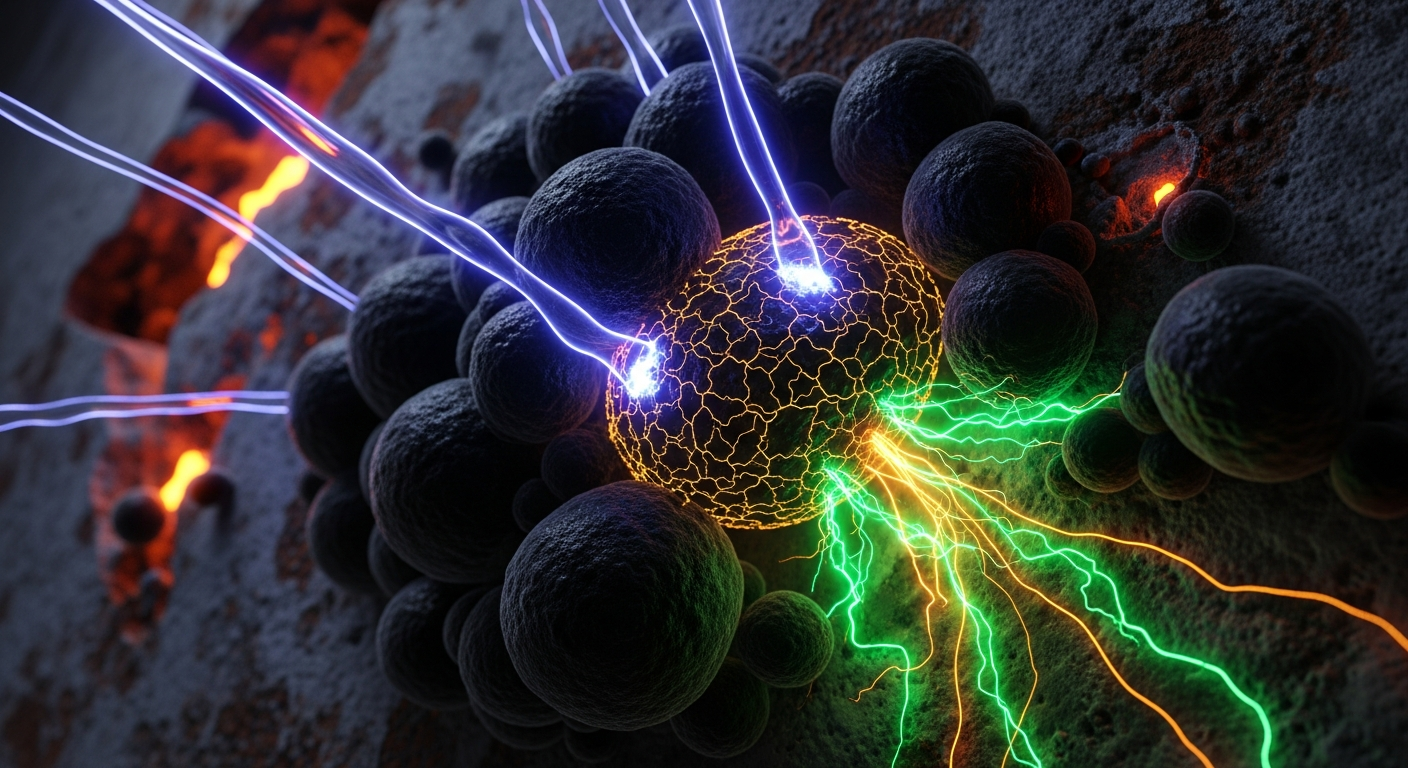
Their 2007 study in PLoS One showed that radiation exposure altered the electron spin resonance signal of melanin, consistent with a change in its electronic structure. This suggests a physical mechanism: the gamma photons strike the melanin polymer, boosting its electrons to a higher energy state. Melanin appears to be able to channel this energy, possibly transferring the high-energy electrons to metabolic pathways like the NADH/NAD+ system, which powers cellular respiration. This would be analogous to photosynthesis, but instead of using visible light to split water, it uses high-energy radiation to supercharge the cell's existing metabolic engine.
Subsequent work by Charles Turick and colleagues further solidified this model. They demonstrated that irradiating melanin suspensions could generate a sustained electric current, directly showing that melanin can convert radiation into a flow of electrons. While the precise molecular pathway linking melanin's excited electronic state to ATP production remains an active area of investigation, the evidence strongly supports the hypothesis that melanin allows these fungi to use a previously unrecognized energy source. This capability would be a powerful evolutionary advantage in high-radiation environments, including not just nuclear accident sites but also high-altitude regions, the Earth's poles, and even outer space.
Melanin as a Primordial Bioelectric Interface
The ability to transduce external energy into a biologically useful form—a flow of electrons—positions melanin at the intersection of biophysics and bioelectricity. The work of researchers like Michael Levin at Tufts University has shown that cellular collectives use ion flows and voltage gradients to store and process information, guiding complex processes like embryonic development, organ regeneration, and cancer suppression. Cells and tissues form bioelectric circuits that operate much faster than sluggish chemical gradients, enabling large-scale anatomical patterning.
Given this context, it is compelling to consider a broader evolutionary hypothesis for melanin. Perhaps its most ancient and conserved function is to serve as a primordial bioelectric interface—a molecular transducer that allows an organism to sense and respond to its ambient electromagnetic environment. In early life, before the evolution of complex nervous systems, a molecule that could convert sunlight, geothermal radiation, or other environmental energy sources into a localized electrical or chemical signal would provide an invaluable survival advantage. It could allow a simple organism to orient itself, regulate its metabolism, or trigger protective responses.
From this perspective, melanin’s more specialized roles—UV protection, thermal regulation, coloration for camouflage or display—are later evolutionary adaptations built upon this fundamental bioelectric foundation. The stable free radical acts as a charge reservoir. Its semiconductor nature allows it to process that charge. And its ability to conduct both electrons and protons allows it to interface directly with cellular machinery. This framework helps unify its disparate roles in fungi, bacteria, and animals into a single, coherent evolutionary narrative centered on energy and information transduction. What we see in the ghost-like outlines of fossilized melanin and the thriving fungi of Chernobyl may be two ends of the same billion-year story of life learning to plug into the energy of the universe.
Key Takeaways
- Melanin is an ancient and ubiquitous polymer found across all kingdoms of life, indicating a fundamental biological role that predates and extends beyond pigmentation or UV protection in animals.
- The discovery of radiotrophic fungi at Chernobyl, which grow toward sources of gamma radiation, provides powerful evidence that some organisms use melanin to convert ionizing radiation into metabolic energy.
- Biophysically, melanin functions as a hydrated amorphous organic semiconductor, capable of absorbing a vast spectrum of electromagnetic energy and conducting both electrons and protons (ions).
- The proposed mechanism for "radiosynthesis" involves melanin capturing high-energy photons, which alters its electronic state and facilitates the transfer of energetic electrons to cellular metabolic pathways, analogous to photosynthesis.
- A compelling theoretical framework suggests melanin’s primary evolutionary role may be as a bioelectric interface, allowing organisms to transduce ambient electromagnetic energy into biologically useful electrical signals and chemical work.
References
- Dadachova, E., Bryan, R. A., Huang, X., Moadel, T., Schweitzer, A. D., Aisen, P., Nosanchuk, J. D., & Casadevall, A. "Ionizing radiation changes the electronic properties of melanin and enhances the growth of melanized fungi." PLoS One 2(5), e457 (2007). DOI: 10.1371/journal.pone.0000457. doi:10.1371/journal.pone.0000457
- McGinness, J. E., Corry, P., & Proctor, P. "Amorphous semiconductor switching in melanins." Science 183(4127), 853-855 (1974). DOI: 10.1126/science.183.4127.853. doi:10.1126/science.183.4127.853
- Cordero, R. J. B., & Casadevall, A. "Functions of fungal melanin beyond virulence." Fungal Biology Reviews 31(2), 99-112 (2017). DOI: 10.1016/j.fbr.2016.12.003. doi:10.1016/j.fbr.2016.12.003
- Turick, C. E., Ekechukwu, A. A., Milliken, C. E., Casadevall, A., & Dadachova, E. "Gamma radiation interacts with melanin to alter its oxidation–reduction potential and results in electric current production." Bioelectrochemistry 82(1), 51-56 (2011). DOI: 10.1016/j.bioelechem.2011.04.009. doi:10.1016/j.bioelechem.2011.04.009
- Glass, K., Ito, S., Wilby, P. R., Sota, T., Nakamura, A., Wakamatsu, K., Briggs, D. E. G., & Wogelius, R. A. "Direct chemical evidence for eumelanin pigment from the Jurassic period." Proceedings of the National Academy of Sciences 109(26), 10218-10223 (2012). DOI: 10.1073/pnas.1118448109. doi:10.1073/pnas.1118448109
- Levin, M. "The computational boundary of a 'self': developmental bioelectricity drives multicellularity and scale-free cognition." Frontiers in Psychology 10, 2688 (2019). DOI: 10.3389/fpsyg.2019.02688.
- Brenner, M. & Hearing, V. J. "The protective role of melanin against UV damage in human skin." Photochemistry and Photobiology 84(3), 539-549 (2008). DOI: 10.1111/j.1751-1097.2007.00226.x. doi:10.1111/j.1751-1097.2007.00226.x
- Casadevall, A., Dadachova, E., & Pirofski, L. A. "The nature of the melanin ghost and its implications for the pathogenesis of cryptococcosis." Infection and Immunity 72(1), 8-16 (2004). DOI: 10.1128/IAI.72.1.8-16.2004.