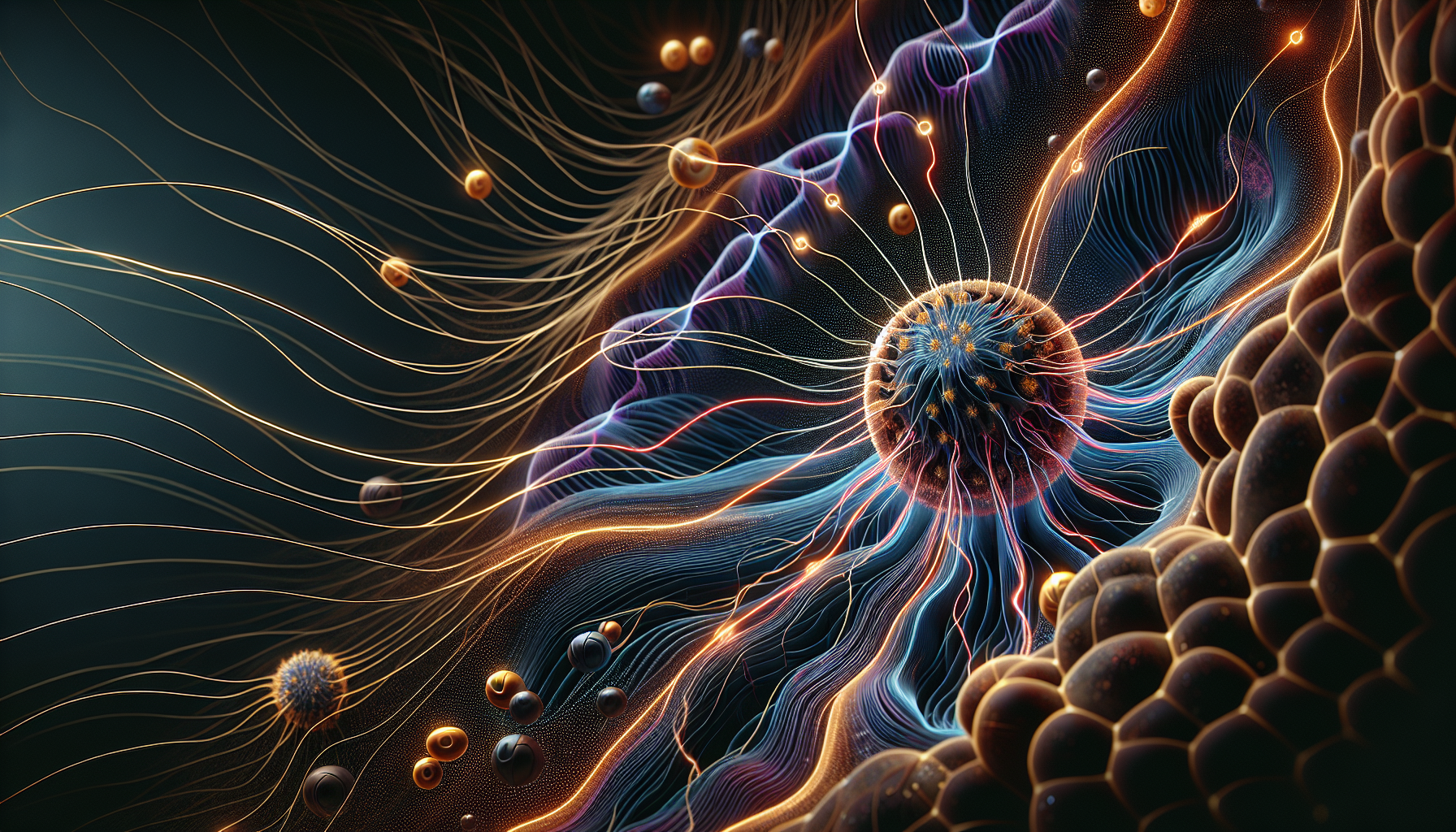
Emerging evidence suggests melanin-producing cells may function as bioelectric regulators in tissue, influencing membrane voltage patterns that control cell fate, proliferation, and morphogenesis. This connection between pigmentation and bioelectricity reveals a previously unrecognized role for melanin in fundamental biological processes. Understanding this relationship could transform our approach to cancer research, regenerative medicine, and developmental biology.
When Michael Levin's laboratory at Tufts University demonstrated that cells maintaining membrane potentials below -20mV tend toward proliferative, dedifferentiated states—including cancer—they opened a new window into how bioelectricity controls cell behavior. What they couldn't have anticipated was how this discovery would intersect with melanin biology in ways that challenge our understanding of both pigmentation and cellular voltage regulation.
Recent investigations into melanin's electrical properties reveal that this ancient pigment does far more than absorb light and scavenge free radicals. Melanin exhibits semiconductor behavior with a bandgap of approximately 1.85 electron volts, positioning it perfectly to interact with the bioelectric fields that govern cellular function. More intriguingly, melanin's conductivity increases dramatically with hydration—a property that may allow melanocytes and other melanin-containing cells to dynamically modulate their electrical environment in response to physiological conditions.
Membrane Voltage as Cellular Software
To understand melanin's potential role in bioelectric signaling, we must first grasp how membrane potential (Vmem) functions as a form of cellular software. Every cell maintains an electrical charge across its membrane, typically ranging from -90mV in highly polarized neurons to -10mV in rapidly dividing cells. This voltage isn't just a byproduct of metabolism—it's an active signaling system that determines cell fate.
Levin's research has shown that depolarization below -20mV serves as a critical threshold. Cells that cross this electrical boundary often shift toward proliferative, stem-like states characterized by increased division rates and reduced differentiation. In pathological contexts, this same electrical signature appears in cancer cells, suggesting that bioelectric disruption may precede or drive malignant transformation.
The mechanism involves voltage-sensitive ion channels and gap junctions that create bioelectric networks spanning entire tissues. These networks can store and process information about tissue architecture, wound healing needs, and growth patterns. When the electrical harmony of these networks is disrupted, the consequences can range from developmental abnormalities to tumor formation.
Melanin's Electrical Properties and Cellular Context
Melanin's unique electrical characteristics position it as a potential modulator of cellular membrane voltage. Unlike conventional biological conductors, melanin's proton conductivity increases with water content, creating a moisture-sensitive electrical pathway. This property becomes particularly relevant in the context of melanocytes, which are distributed throughout the body and maintain intimate contact with surrounding keratinocytes, neurons, and immune cells.
The stable free radicals inherent in melanin's structure, detectable through electron paramagnetic resonance (EPR) spectroscopy, create a persistent electrical field around melanin-containing cells. These radicals don't behave like typical reactive oxygen species—they're stable, long-lived, and may serve as electrical reservoirs that influence local membrane potentials.
Research by John McGinness and colleagues in the 1970s demonstrated that melanin could function as a biological switch, changing its electrical properties in response to environmental conditions. While this work focused primarily on melanin's semiconductor behavior, the implications for cellular bioelectricity remained largely unexplored until recent advances in bioelectric research provided the conceptual framework to understand these connections.
The Melanocyte Network as Bioelectric Regulator
Melanocytes don't exist in isolation—they form extensive networks through dendritic processes that contact multiple surrounding cells. This architecture resembles the bioelectric networks that Levin's team has identified as crucial for tissue-level pattern regulation. If melanocytes can influence local membrane potentials through their melanin content, they may function as bioelectric pacemaker cells that help maintain tissue electrical homeostasis.
This hypothesis gains support from observations of melanocyte behavior during development and wound healing. Melanocytes migrate along specific pathways during embryogenesis, following routes that correlate with bioelectric gradients. During tissue repair, melanocyte activity often increases in wounded areas—a response that may serve bioelectric as well as protective functions.
The connection becomes more compelling when considering neuromelanin in the substantia nigra. These neurons, rich in iron-chelating melanin, are particularly vulnerable in Parkinson's disease. While traditionally explained through oxidative stress mechanisms, the bioelectric perspective suggests that neuromelanin may be crucial for maintaining proper membrane potentials in these critical motor control neurons.
Implications for Disease and Therapy
If melanin indeed influences cellular membrane voltage, this connection could explain several puzzling observations in medicine. The inverse relationship between melanoma risk and Parkinson's disease, documented in multiple epidemiological studies, might reflect shared bioelectric mechanisms rather than purely genetic factors. Individuals with robust melanin-mediated bioelectric regulation might be protected from both the electrical disruptions that lead to neurodegeneration and the membrane voltage changes that promote cancer.
This framework also offers new perspectives on vitiligo, the autoimmune condition that destroys melanocytes. Beyond the obvious cosmetic effects, vitiligo might disrupt local bioelectric patterns, potentially explaining why affected individuals show increased rates of certain autoimmune conditions. The loss of melanocyte-mediated bioelectric regulation could create electrical "dead zones" that compromise tissue function.
For cancer research, the melanin-bioelectric connection suggests novel therapeutic approaches. Rather than focusing solely on genetic mutations or metabolic disruptions, treatments could target the bioelectric environment that supports malignant transformation. Melanin-based interventions might help restore healthy membrane potentials in tissues at risk for cancer development.
Key Takeaways
• Melanin's semiconductor properties and proton conductivity position it to influence cellular membrane voltage, potentially connecting pigmentation to bioelectric signaling networks that control cell fate and tissue pattern formation.
• The critical -20mV depolarization threshold identified by Levin's research may be modulated by melanin-containing cells, suggesting melanocytes function as bioelectric regulators beyond their traditional role in photoprotection.
• Melanocyte networks throughout the body mirror the architecture of bioelectric signaling systems, supporting the hypothesis that these cells help maintain tissue electrical homeostasis through their melanin content.
• The inverse epidemiological relationship between melanoma and Parkinson's disease might reflect shared bioelectric mechanisms rather than purely genetic factors, with melanin playing a protective role in both contexts.
• Vitiligo and other conditions affecting melanocyte function may disrupt local bioelectric patterns, potentially explaining the increased autoimmune disease risk observed in these patients beyond cosmetic effects.
• Understanding melanin's bioelectric properties could lead to novel therapeutic approaches for cancer, neurodegeneration, and autoimmune diseases that target electrical rather than purely biochemical mechanisms.
References
Levin, M. "Bioelectric signaling: Reprogrammable circuits underlying embryogenesis, regeneration, and cancer." Cell 184(8), 1971-1989 (2021). DOI: 10.1016/j.cell.2021.02.034
McGinness, J., Corry, P., and Proctor, P. "Amorphous semiconductor switching in melanins." Science 183(4127), 853-855 (1974). DOI: 10.1126/science.183.4127.853
Charkoudian, L.K. and Franz, K.J. "Fe(III)-coordination properties of neuromelanin components: 5,6-dihydroxyindole and 5,6-dihydroxyindole-2-carboxylic acid." Inorganic Chemistry 45(9), 3657-3664 (2006). DOI: 10.1021/ic060014r
Bustamante, J., Bredeston, L., Malanga, G., and Mordoh, J. "Role of melanin as a scavenger of active oxygen species." Pigment Cell Research 6(5), 348-353 (1993). DOI: 10.1111/j.1600-0749.1993.tb00612.x
Yang, M. and Brackenbury, W.J. "Membrane potential and cancer progression." Frontiers in Physiology 4, 185 (2013). DOI: 10.3389/fphys.2013.00185
Solís-Herrera, A., Arias-Esparza, M.C., Solís-Arias, R.I., Solís-Arias, P.E., and Solís-Arias, M.P. "The unexpected capacity of melanin to dissociate the water molecule fills the gap between the life before and after ATP." Biomedical Research 21(2), 224-226 (2010).
Binhi, V.N. and Prato, F.S. "Biological effects of the hypomagnetic field: An analytical review of experiments and theories." PLOS ONE 12(6), e0179340 (2017). DOI: 10.1371/journal.pone.0179340