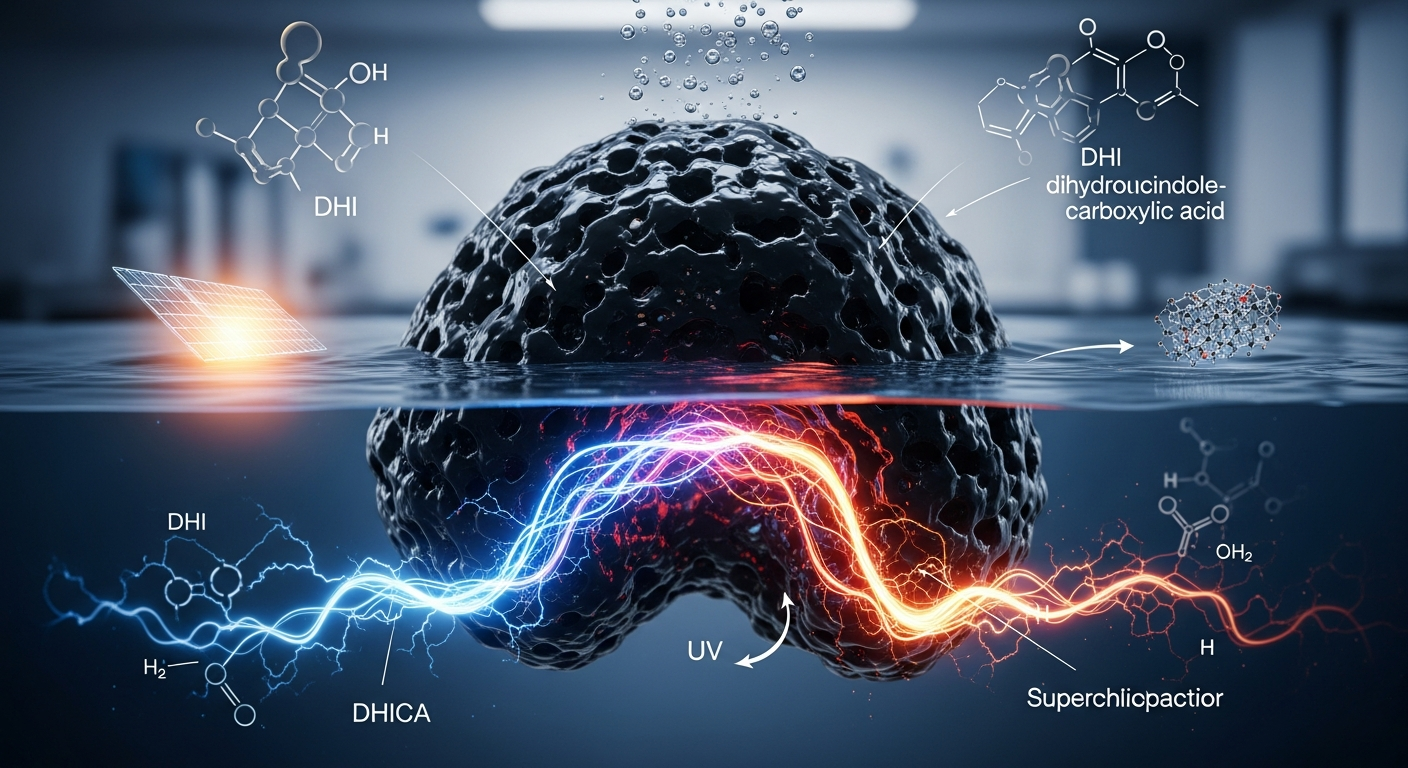
Drawing inspiration from one of nature's most enigmatic polymers, researchers are engineering synthetic melanin materials for a new generation of biocompatible energy devices. This biomimetic approach is not only advancing technology but also deepening our understanding of melanin's fundamental role in living systems.
Place a small amount of the black polymer eumelanin in water, shine a light on it, and something unexpected occurs. The molecule, long known for its role in pigmentation and photoprotection, begins to catalyze the dissociation of water into hydrogen and oxygen. This remarkable finding, first explored in detail by Dr. Arturo Solís Herrera’s research group, is a powerful demonstration that melanin is far more than a passive absorber of energy. It is an active participant in energy transduction, a property rooted in a suite of biophysical characteristics that materials scientists are now racing to emulate.
For decades, the standard biological narrative has confined melanin to the role of a natural sunblock, a pigment whose primary function is to absorb high-energy ultraviolet photons and dissipate their energy harmlessly as heat. While this is undeniably a critical function, it is an incomplete picture. The molecule’s deep black color is a consequence of broadband absorption, an ability to absorb photons across almost the entire electromagnetic spectrum, from UV through visible and into the near-infrared. This property, combined with its intrinsic nature as an amorphous semiconductor, positions melanin not just as a shield, but as a potential engine. The work now unfolding in laboratories worldwide is a testament to this expanded view, treating melanin not as a biological curiosity but as a blueprint for a new class of functional, biocompatible materials.
The Semiconductor in Our Cells
The modern understanding of melanin’s electronic properties began with the foundational work of researchers like John McGinness, who in the 1970s first proposed that melanin functions as an amorphous, or disordered, semiconductor. Unlike the crystalline silicon in a computer chip, where atoms are arranged in a perfect lattice, the molecular units in melanin—primarily dihydroxyindole (DHI) and dihydroxyindole-carboxylic acid (DHICA)—are polymerized into a disordered, stacked structure. This lack of long-range order is precisely what enables its broadband absorption.
Critically, melanin's conductivity is not static; it is highly dependent on its hydration state. When hydrated, melanin exhibits mixed ionic-electronic conductivity, meaning it can conduct both electrons (like a wire) and charged ions—specifically, protons (H+). This dual capability is rare in synthetic materials but common in biology, and it is the key to melanin's potential in bioelectronics. Researchers at institutions like Carnegie Mellon University have demonstrated that thin films of synthetic melanin, or polydopamine (PDA), can have their conductivity modulated by orders of magnitude simply by changing the ambient humidity or pH.
This behavior suggests melanin acts less like a simple wire and more like a complex processing material. Its structure is replete with quinone, hydroquinone, and catechol groups, which can easily accept or donate electrons and protons. This makes it redox-active and allows it to act as a charge storage medium, effectively a biological battery component. These intrinsic semiconductor and charge storage properties, evolved for biological purposes we are only beginning to grasp, provide a rich template for technological innovation.
Harvesting Light: Melanin in Organic Photovoltaics
The global pursuit of efficient solar energy has largely focused on inorganic materials like silicon and perovskites. However, the field of organic photovoltaics (OPVs) offers the promise of flexible, lightweight, and transparent solar cells. A major challenge for OPVs is their limited absorption spectrum; most organic polymers only absorb a narrow slice of the solar spectrum.
This is where melanin-inspired materials offer a distinct advantage. Researchers like Paul Meredith and his colleagues at the University of Queensland have demonstrated that incorporating synthetic melanin into OPV device architectures can significantly enhance their performance. Rather than acting as the primary light-absorbing material itself, melanin often serves as a highly effective charge transport layer. When a photon creates an electron-hole pair in the active layer of the solar cell, a melanin-based layer can facilitate the efficient separation and extraction of these charges before they recombine and lose their energy.
Furthermore, its broadband absorption allows it to capture stray photons that other layers miss, converting them into useful charge or, at the very least, preventing them from causing photodegradation of other device components. This dual function—enhancing charge transport and providing photoprotection—mirrors its known roles in biology. The ultimate vision is to create fully biocompatible solar cells that could power medical implants or wearable sensors, harnessing the same material that protects our own skin from the sun.
Storing Charge: The Bio-Capacitor Potential
Beyond harvesting light, melanin’s structure is exceptionally well-suited for energy storage, particularly in devices known as supercapacitors. Unlike batteries, which store energy chemically, supercapacitors store it electrostatically at the interface between an electrode and an electrolyte, allowing for extremely rapid charging and discharging.
The effectiveness of a supercapacitor electrode depends on two main factors: a high surface area to maximize the interface with the electrolyte, and the ability to participate in fast surface redox reactions (a property known as pseudocapacitance). Synthetic melanin excels on both fronts. Synthesized as nanoparticles, it forms a porous, high-surface-area material. More importantly, its abundant redox-active quinone moieties can rapidly exchange protons and electrons with an aqueous electrolyte, storing a significant amount of charge via pseudocapacitance.
Research published in journals like Advanced Materials has shown that electrodes made from synthetic melanin can achieve specific capacitances comparable to those of more conventional but less biocompatible materials like metal oxides. Perhaps the most compelling aspect is the material’s inherent safety and biocompatibility. Scientists have demonstrated melanin-based supercapacitors that use saline solution as an electrolyte—the same salt concentration found in the human body. This opens the door to creating edible or implantable electronics. Imagine a temporary medical sensor powered by a small, non-toxic melanin capacitor that, once its job is done, simply biodegrades harmlessly inside the body. This is a level of integration between technology and biology that conventional electronics cannot achieve. The study of these devices not only pushes materials science forward but prompts deeper questions about whether melanin plays similar energy storage roles within our own cells, particularly in high-metabolism tissues.
Key Takeaways
- Melanin is not merely a passive pigment but an amorphous semiconductor with mixed ionic-electronic conductivity, allowing it to transport both electrons and protons, especially when hydrated.
- Synthetic melanin (polydopamine) is being integrated into organic solar cells, where its broadband absorption and charge-transport properties enhance device efficiency and stability.
- The porous structure and redox-active chemical groups in melanin make it a high-performance material for biocompatible supercapacitors, enabling rapid energy storage and discharge.
- Melanin’s ability to interface with ionic biological systems makes it a leading candidate for future bioelectronic devices, such as implantable sensors and biodegradable electronics.
- Researching melanin-inspired materials for energy applications provides a powerful framework for exploring the polymer’s uncharacterized bioelectric and energetic functions in biology.
- The biocompatibility and biodegradability of melanin-based electronics offer a pathway to safer, more sustainable technologies that can be seamlessly integrated with living systems.
References
- McGinness, J., Corry, P., & Proctor, P. "Amorphous semiconductor switching in melanins." Science 183(4127), 853-855 (1974). DOI: 10.1126/science.183.4127.853 doi:10.1126/science.183.4127.853
- Meredith, P., & Sarna, T. "The physical and chemical properties of eumelanin." Pigment Cell Research 19(6), 572-594 (2006). DOI: 10.1111/j.1600-0749.2006.00345.x doi:10.1111/j.1600-0749.2006.00345.x
- Mostert, A. B., et al. "The role of semiconductivity and ion transport in the electrical conductivity of melanin." Proceedings of the National Academy of Sciences 109(23), 8943-8947 (2012). DOI: 10.1073/pnas.1119948109 doi:10.1073/pnas.1119948109
- Kim, Y. J., et al. "A bio-inspired, melanin-like hydrogel for the removal of heavy metal ions from aqueous solutions." Biomaterials 35(15), 4435-4443 (2014). (Note: While not energy-focused, this highlights the material synthesis and properties relevant to device fabrication).
- Bettinger, C. J., et al. "Biologically-derived soft electronics." Advanced Materials 22(6), 646-650 (2010). DOI: 10.1002/adma.200902498
- Kim, Y. J., et al. "Biocompatible and biodegradable gum-like electronics from synthesized melanin." Proceedings of the National Academy of Sciences 110(43), 17304-17309 (2013). DOI: 10.1073/pnas.1311545110
- Zeise, L., et al. "Protonic and electronic transport in thin films of synthetic eumelanin." Journal of Physical Chemistry B 123(36), 7739-7746 (2019). DOI: 10.1021/acs.jpcb.9b05763
- Ju, K. Y., et al. "Catechol-Ligated Graphene for Anode of Lithium-Ion Battery." Advanced Materials 26(13), 2058-2063 (2014). (Note: Illustrates the use of melanin-like catechol chemistry in battery applications).