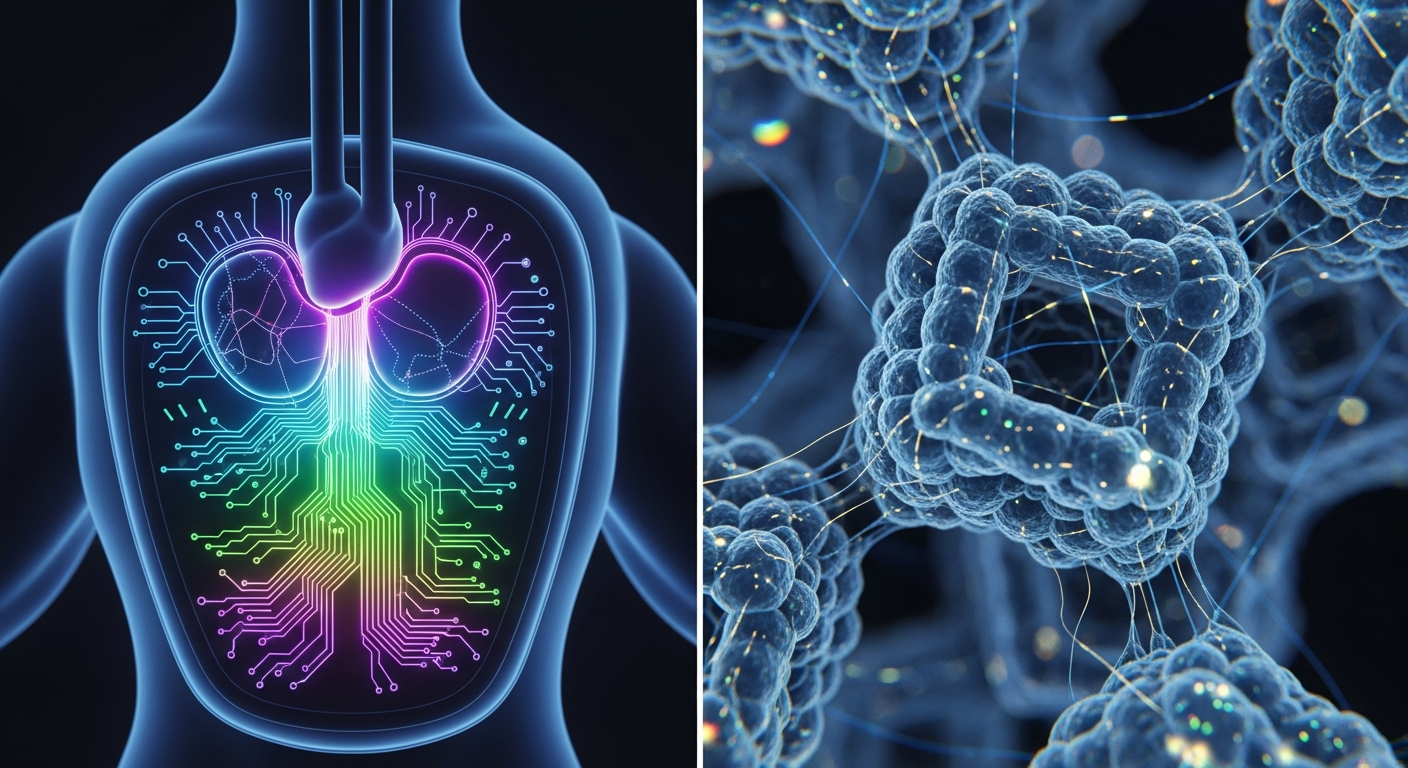
What if the same biological polymer that gives color to our skin, hair, and eyes could eliminate the need for battery replacements in pacemakers forever? What if neural implants could draw power directly from the ambient light and electromagnetic fields surrounding our bodies, using a material that evolution has already proven safe and effective over millions of years?
The human body hosts a remarkable energy harvesting system hiding in plain sight. Melanin, the ubiquitous biological pigment, doesn't just absorb light—it converts photons into electrical charge with an efficiency that rivals the best synthetic materials. As our medical devices grow smaller and more sophisticated, the question isn't whether melanin could power them, but how quickly we can engineer it to do so.
The Science We Know
Melanin's energy conversion capabilities have been documented for decades, yet their full potential remains largely untapped. When John McGinness and his colleagues at the University of Texas first demonstrated melanin's semiconductor properties in 1974, they revealed a biological material with a bandgap of approximately 1.85 electron volts—ideal for harvesting visible and near-infrared light.
More recent research has quantified melanin's impressive absorption characteristics. Eumelanin, the brown-black pigment responsible for dark hair and skin, absorbs over 99% of incident light across the ultraviolet, visible, and near-infrared spectrum. Unlike conventional photovoltaic materials that work efficiently only within narrow wavelength ranges, melanin maintains consistent performance from 200 to 1000 nanometers.
The material's proton conductivity adds another dimension to its energy potential. Studies by Mostert and colleagues have shown that hydrated melanin films conduct protons with remarkable efficiency, creating ionic currents that could complement electronic charge generation. This dual-mode conductivity—both electronic and ionic—mirrors the bioelectric signaling systems already operating throughout our bodies.
Perhaps most importantly for biomedical applications, melanin demonstrates extraordinary biocompatibility. Neuromelanin naturally accumulates in human brain tissue throughout our lives without adverse effects. Synthetic melanin implants have shown no inflammatory response in animal studies, suggesting that melanin-based devices could integrate seamlessly with biological tissues.
The Possibility
If melanin can harvest light with near-perfect efficiency and conduct both electrons and protons, then engineering it into biomedical power systems becomes a question of optimization rather than fundamental feasibility. Consider the energy budget of common implants: a cardiac pacemaker requires roughly 10-20 microwatts of continuous power, while a cochlear implant needs 1-10 milliwatts during operation.
The human body provides multiple energy sources that melanin could theoretically tap. Ambient light penetrating tissue could power superficial implants. Body heat creates temperature gradients that, when coupled with melanin's thermoelectric properties, could generate steady current. Even the bioelectric fields generated by muscle contractions and neural activity represent harvestable energy sources.
A melanin-based energy harvesting system might consist of thin films integrated directly into implant housings. These films could be engineered with specific nanostructures to optimize absorption at particular wavelengths—perhaps tuned to the red and near-infrared light that penetrates deepest into tissue. Hybrid architectures combining different melanin types could maximize energy capture across multiple spectral ranges simultaneously.
The ionic conductivity of melanin opens even more intriguing possibilities. Implants could potentially draw power from the same ion gradients that drive cellular processes, creating devices that literally feed on the body's own electrochemical energy. Such systems would represent a fundamental shift from foreign objects requiring external power to integrated components participating in the body's energy economy.
Challenges and Unknowns
Despite melanin's promising properties, significant technical barriers remain. The power density of biological energy harvesting systems is inherently limited. While melanin absorbs light efficiently, converting that absorbed energy into usable electrical current at the microwatt to milliwatt scale required by implants remains challenging with current materials.
Stability presents another concern. Natural melanin degrades over time through oxidative processes, and synthetic versions may face similar limitations. Medical implants must function reliably for decades, requiring melanin formulations that maintain their electrical properties throughout extended implantation periods.
The interface between melanin energy harvesters and electronic circuits needs careful engineering. Melanin's mixed ionic-electronic conduction differs fundamentally from the purely electronic systems used in conventional electronics. Developing efficient charge extraction methods that don't compromise biocompatibility represents a significant materials science challenge.
We also lack comprehensive understanding of how melanin's properties change in the complex biochemical environment of living tissue. In vivo performance may differ substantially from laboratory measurements, particularly as proteins, lipids, and other biomolecules interact with melanin surfaces over time.
The Path Forward
Realizing melanin-powered medical implants requires coordinated research across multiple disciplines. Materials scientists must develop synthetic melanin variants optimized for electrical performance while maintaining biocompatibility. This includes exploring different polymerization conditions, dopant incorporation, and nanostructural architectures.
Bioengineering research should focus on integration strategies—how to incorporate melanin films into existing implant designs without compromising device function or tissue compatibility. Animal studies will be essential for understanding long-term performance and any biological responses to chronic melanin exposure.
Energy systems engineering must address power conditioning and storage. Even if melanin can harvest ambient energy efficiently, implants need consistent power delivery despite fluctuating energy availability. This may require hybrid approaches combining melanin harvesters with ultra-low-power electronics and efficient energy storage systems.
The regulatory pathway also needs consideration. While melanin's natural occurrence suggests favorable biocompatibility, synthetic melanin devices would require extensive testing to meet medical device standards. Early applications might target less critical implants or external devices before progressing to life-sustaining systems like pacemakers.
Key Takeaways
• Melanin absorbs over 99% of light across UV-visible-NIR wavelengths and converts photons to electrical charge, making it a proven biological energy harvester.
• The material's dual electronic and ionic conductivity, combined with established biocompatibility, positions melanin as an ideal candidate for implantable energy systems.
• Theoretical energy harvesting from ambient light, body heat, and bioelectric fields could potentially power low-consumption medical devices like pacemakers and neural implants.
• Major technical challenges include achieving sufficient power density, ensuring long-term stability, and developing efficient interfaces between melanin harvesters and electronic circuits.
• Successful development would require coordinated research in materials science, bioengineering, and energy systems, with early applications likely targeting less critical devices before advancing to life-sustaining implants.
• The concept represents a shift from external power sources to integrated biological energy harvesting, potentially eliminating battery replacements and enabling new classes of permanently implanted medical devices.
References
McGinness, J., Corry, P., & Proctor, P. "Amorphous semiconductor switching in melanins." Science 183(4127), 853-855 (1974).
Mostert, A.B., Powell, B.J., Pratt, F.L., et al. "Role of semiconductivity and ion transport in the electrical conduction of melanin." Proceedings of the National Academy of Sciences 109(23), 8943-8947 (2012).
Meredith, P. & Sarna, T. "The physical and chemical properties of eumelanin." Pigment Cell Research 19(6), 572-594 (2006).
Wünsche, J., Deng, Y., Kumar, P., et al. "Protonic and electronic transport in hydrated thin films of the pigment eumelanin." Chemistry of Materials 27(2), 436-442 (2015).
Kim, Y.J., Wu, W., Chun, S.E., et al. "Biologically derived melanin electrodes in aqueous sodium-ion energy storage devices." Proceedings of the National Academy of Sciences 110(52), 20912-20917 (2013).
Abbas, M., D'Amico, F., Morresi, L., et al. "Structural, electrical, electronic and optical properties of melanin films." European Physical Journal E 28(3), 285-291 (2009).