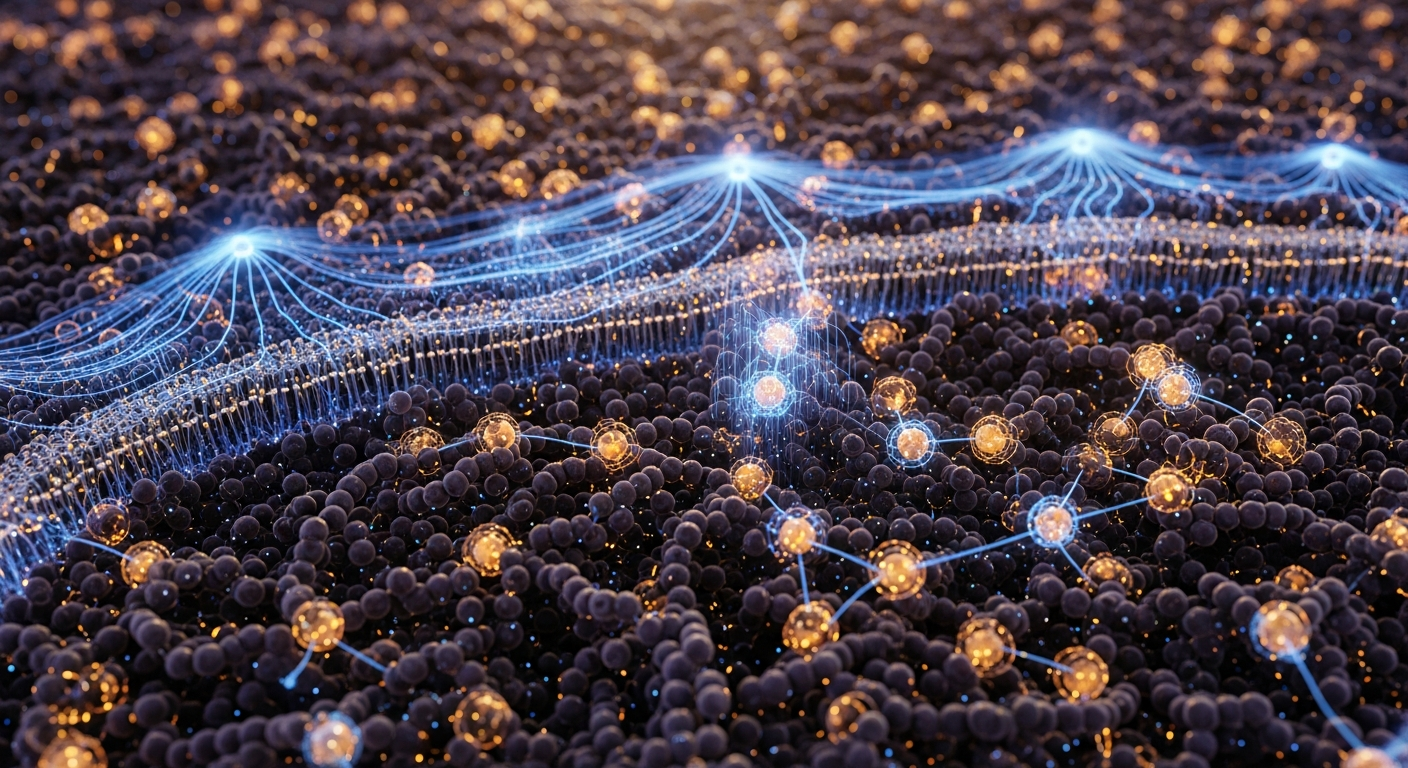
Melanin is unique among biological polymers for its persistent, stable free radicals detectable by magnetic resonance. By examining the spin dynamics of its semiquinone populations, biophysicists are exploring whether this ubiquitous pigment could function as a biological matrix for quantum memory.
Place a biological tissue sample into the cavity of an electron paramagnetic resonance (EPR) spectrometer, and you will typically observe a flat line. In biological systems, free radicals—molecules with unpaired electrons—are notoriously transient. They are highly reactive, often destructive entities that exist for mere fractions of a second before stripping an electron from a neighboring lipid or DNA strand, driving the oxidative stress associated with aging and disease. But when researchers place a sample of eumelanin into that same magnetic field, the instrument registers a distinct, persistent hum.
Melanin possesses a stable, intrinsic free radical signature that does not rapidly decay. It defies the standard biological rule that unpaired electrons must be volatile. Instead, melanin captures, stabilizes, and maintains these electrons in a state of suspended animation. For decades, this EPR signal was treated merely as a structural curiosity—a byproduct of melanin’s complex polymeric architecture. Today, however, researchers operating at the intersection of biophysics and quantum biology are re-evaluating this phenomenon.
If a biological molecule can maintain stable populations of unpaired electrons, it possesses the physical prerequisites for processing quantum information. The sustained spin states of melanin’s radicals are now at the center of a provocative scientific frontier: the quantum memory hypothesis. This framework suggests that melanin may not merely absorb light and scavenge toxins, but could actively preserve quantum coherence long enough to dictate macro-scale biological and bioelectric outcomes.
The Semiquinone Equilibrium: Taming the Free Radical
To understand melanin’s quantum potential, we must first examine the chemical origin of its EPR signal. Eumelanin, the dark brown to black pigment found in human skin, hair, and the substantia nigra of the brain, is a heterogeneous polymer constructed primarily from 5,6-dihydroxyindole (DHI) and 5,6-dihydroxyindole-2-carboxylic acid (DHICA).
Within this dense, amorphous matrix, the molecules exist in varying states of oxidation. The stable radicals in melanin are primarily semiquinone radicals. They are generated through a continuous thermodynamic process known as comproportionation. When a fully oxidized quinone molecule interacts with a fully reduced hydroquinone molecule within the polymer, they exchange an electron to form two semiquinone radicals.
Crucially, the stability of these radicals is highly dependent on their microenvironment. Research by Paul Meredith and others has demonstrated that melanin’s radical concentration increases with hydration. Water introduces protons into the matrix, and melanin’s capacity for proton conductivity couples with its electron transport. This interplay creates a dynamic, responsive radical population. Because the unpaired electrons are delocalized—spread out across the extended pi-electron systems of the indole rings—they are shielded from immediate chemical reactions. They exist in a protected thermodynamic pocket, perfectly positioned for quantum mechanical interactions.
Spin-Spin Interactions and the Radical Pair Mechanism
In quantum mechanics, an electron's "spin" is a fundamental property representing its angular momentum, existing in discrete states typically denoted as "up" or "down." When two radicals are created simultaneously—such as through the absorption of a photon or a specific redox reaction—their electrons are quantum mechanically entangled. This is the foundation of the Radical Pair Mechanism (RPM).
The RPM is currently the most robustly supported model in quantum biology, famously used to explain how migratory birds navigate using the Earth's weak magnetic field via cryptochrome proteins in their retinas. In a radical pair, the two electrons can exist in a singlet state (spins are antiparallel) or a triplet state (spins are parallel). The transition between these states is highly sensitive to external magnetic fields and the local nuclear magnetic environment. Because the chemical reactivity of the radical pair depends entirely on whether it is in a singlet or triplet state, quantum spin dictates the macroscopic chemical outcome.
In melanin, the high density of stable semiquinone radicals creates a complex landscape for spin-spin interactions. Unlike the isolated radical pairs in cryptochrome, melanin's radicals are embedded in a solid-state or hydrogel-like matrix. Magnetic resonance studies indicate that as melanin becomes more hydrated, the distance between these spins changes, altering their dipolar and exchange interactions. When incident ultraviolet radiation strikes melanin, it excites electrons across its ~1.85eV bandgap, generating transient radical pairs that interact with the pre-existing pool of stable radicals.
If the spin states of these photo-induced or chemically-induced radical pairs in melanin can maintain their coherence—resisting the thermal noise of the biological environment—they act as a mechanism of quantum control. The chemical disorder of melanin, once thought to be a barrier to organized function, might actually serve to decouple these spins from environmental decoherence, protecting the fragile quantum states.
The Quantum Memory Hypothesis
The concept of "quantum memory" in biology does not imply that melanin functions like the RAM in a computer, storing binary data for later retrieval. Rather, in a biophysical context, quantum memory refers to the persistence of spin information over timescales relevant to biological processes. It is the ability of a macromolecule to "remember" a quantum state (like a specific spin polarization) long enough for that state to direct an electron transfer event, modulate a localized electric field, or alter a chemical reaction pathway.
The hypothesis that melanin functions as a form of quantum memory rests on its established role as an amorphous organic semiconductor. In 1974, John McGinness, Peter Corry, and Peter Proctor published a landmark paper in Science demonstrating that melanin functions as an amorphous semiconductor threshold switch. When an electric field applied to melanin reaches a critical threshold, the material rapidly transitions from a highly resistive state to a highly conductive one.
Modern interpretations of this switching behavior suggest that melanin's charge transport is heavily influenced by its spin states. If the stable free radicals in melanin can act as "spin valves"—where electron transport is either facilitated or blocked depending on the spin alignment of the interacting radicals—then the pigment effectively stores physical information. A specific optical or electrical input alters the spin state (writing the memory), which subsequently alters the polymer's conductivity or redox buffering capacity (reading the memory). This allows melanin to act as an environmental transducer, integrating signals from light, radiation, and local redox conditions, and holding that physical "memory" to modulate cellular responses.
Bridging Quantum Spin to Bioelectric Computation
The implications of melanin's quantum spin dynamics extend far beyond the melanocyte. If melanin processes environmental information via spin states, it fundamentally changes how we view its integration with cellular bioelectricity.
Groundbreaking work from Michael Levin’s laboratory at Tufts University has established that cells use membrane potential (Vmem)—the electrical voltage across cell membranes—to communicate, coordinate morphogenesis, and suppress cancer. This bioelectric signaling relies on the precise orchestration of ion channels. Melanin’s unique combination of proton conductivity, hydration-dependent electron transport, and spin-mediated redox capacity positions it as an ideal modulator of these local bioelectric fields.
Consider neuromelanin, the dark pigment accumulating in the dopaminergic neurons of the substantia nigra. Neuromelanin chelates heavy metals like iron, which possesses its own complex magnetic properties. The interaction between iron and neuromelanin's free radicals creates a highly sophisticated paramagnetic environment. If the quantum memory hypothesis holds, the spin dynamics of neuromelanin could be actively buffering local electron flow, maintaining the delicate redox and bioelectric gradients required for proper neuronal firing and survival. The loss of this protective spin-matrix could be a profound, yet underappreciated, mechanism in neurodegenerative diseases like Parkinson's.
By acting as an interface between the quantum realm of electron spin and the classical realm of ion gradients, melanin may serve as a critical biological component for cellular computation. It is an active participant in the bioelectric network, capable of transducing quantum states into the ionic currents that drive biology.
As researchers continue to probe melanin with advanced pulsed EPR and multidimensional spectroscopy, the paradigm is shifting. Melanin is not merely a passive evolutionary sunscreen. It is a complex, quantum-active biopolymer capable of sustaining coherence, processing physical information, and bridging the microscopic laws of physics with the macroscopic phenomena of life.
Key Takeaways
- Persistent Radical Populations: Unlike most biological molecules, melanin possesses intrinsic, highly stable free radicals (semiquinones) generated via a comproportionation equilibrium, making it uniquely suited for quantum-level interactions.
- Spin-Spin Interactions: The high density of unpaired electrons in melanin allows for complex dipolar and exchange interactions, creating a sophisticated magnetic environment responsive to light and hydration.
- The Radical Pair Mechanism: Photoexcitation and redox reactions in melanin generate radical pairs whose chemical fate is determined by their quantum spin states (singlet vs. triplet), allowing quantum mechanics to drive macroscopic chemical outcomes.
- Biological Quantum Memory: The structural and chemical complexity of melanin may protect spin states from rapid decoherence, allowing the polymer to "remember" physical inputs and modulate its semiconductor properties accordingly.
- Bioelectric Integration: By controlling electron transfer and proton conductivity through spin states, melanin has the potential to interface with cellular membrane potentials (Vmem), linking quantum biophysics to cellular computation and morphological signaling.
References
Blois, M. S., Zahlan, A. B., & Maling, J. E. "Electron Spin Resonance Studies on Melanin." Biophysical Journal 4(6), 471-490 (1964). DOI: 10.1016/S0006-3495(64)86796-0
Hore, P. J., & Mouritsen, H. "The Radical-Pair Mechanism of Magnetoreception." Annual Review of Biophysics 45, 299-344 (2016). DOI: 10.1146/annurev-biophys-032116-094545
Levin, M. "Bioelectric mechanisms in regeneration: Unique aspects and future perspectives." Seminars in Cell & Developmental Biology 20(5), 543-556 (2009). DOI: 10.1016/j.semcdb.2009.04.013
McGinness, J., Corry, P., & Proctor, P. "Amorphous semiconductor switching in melanins." Science 183(4127), 853-855 (1974). DOI: 10.1126/science.183.4127.853
Meredith, P., & Sarna, T. "The physical and chemical properties of eumelanin." Pigment Cell Research 19(6), 572-594 (2006). DOI: 10.1111/j.1600-0749.2006.00345.x
Mostert, A. B., Powell, B. J., Pratt, F. L., Hanson, G. R., Sarna, T., Gentle, I. R., & Meredith, P. "Role of water on electron transport in melanin." Proceedings of the National Academy of Sciences 109(23), 8943-8947 (2012). DOI: 10.1073/pnas.1119948109
Sealy, R. C., Felix, C. C., Hyde, J. S., & Swartz, H. M. "Structure and reactivity of melanins: influence of free radicals and metal ions." Free Radicals in Biology 4, 209-259 (1980). DOI: 10.1016/B978-0-12-566504-9.50014-9