Melanin is often defined by what it absorbs: light. This remarkable biopolymer is biology's primary defense against ultraviolet radiation, a role it performs with quantum-level efficiency. But what if melanin's function is also defined by what it feels? In tissues throughout the body, cells are constantly subjected to a symphony of physical forces—the pressure of blood flow, the tension of muscle contraction, and the pervasive vibration of sound. The process by which cells convert these mechanical cues into biochemical signals, known as mechanotransduction, is fundamental to life. This raises a provocative question: could melanin, one of our most ubiquitous molecules, be an active participant in this process, acting as a microscopic transducer that turns physical vibration into bioelectric information?
This question is the foundation of the piezoelectric hypothesis of melanin. It proposes that this complex polymer possesses a property common to materials like quartz crystals and advanced ceramics: the ability to generate an electrical voltage in response to applied mechanical stress. While this remains a frontier concept in melanin research, exploring its plausibility opens a new window onto the molecule's potential role as an active, information-processing component of the cell, far exceeding its passive function as a simple sunblock. This inquiry invites us to listen for a different kind of signal in the dark pigment—one created not by light, but by resonance.
A Material Unlike Any Other
Before considering its potential piezoelectric properties, it is crucial to appreciate that melanin is already recognized as a profoundly unusual and versatile biomaterial. It is not a single, well-defined molecule but rather a heterogeneous polymer assembled from indolequinone subunits (in the case of eumelanin) or benzothiazine units (in pheomelanin). This structural disorder, which frustrates easy characterization, is also the source of its most remarkable capabilities.
As early as 1974, a landmark paper in Science by John McGinness, Peter Corry, and Proctor showed that solid-state melanin functions as an amorphous semiconductor, capable of switching between "on" and "off" states of electrical conductivity. Its band gap—the energy required to excite an electron into a conductive state—is approximately 1.8 electron volts (eV), placing it firmly within the range of synthetic organic semiconductors. Unlike silicon, melanin’s conductivity is highly dependent on its hydration state, suggesting that water and protons play a key role in its electronic behavior. This property, known as protonic conductivity, means melanin can transport not just electrons, but charged protons, a critical currency in biological energy transfer.
Furthermore, melanin is a broadband absorber, uniquely capable of absorbing energy across the entire electromagnetic spectrum, from ultraviolet to visible and infrared light, and even radio waves. It harmlessly dissipates over 99.9% of this absorbed energy as heat, a photoprotective mechanism of unparalleled efficiency. This combination of semiconductor physics, proton transport, and broadband absorption establishes melanin as an electroactive and photoactive substance. It is not an inert pigment but a functional material integrated into our biology. These proven properties provide the necessary biophysical context to ask more advanced questions: if melanin can manage energy from photons, could it also manage energy from phonons—the quantum units of vibration?
The Piezoelectric Hypothesis Explained
Piezoelectricity (from the Greek piezein, "to press or squeeze") is a property of certain materials that allows them to convert mechanical energy into electrical energy, and vice versa. When you apply pressure to a piezoelectric crystal, its internal crystalline structure is deformed, causing a separation of positive and negative charge centers. This creates a measurable voltage across the material. Conversely, applying a voltage to the material causes it to physically deform. This principle is at the heart of countless technologies, from the quartz crystal that keeps time in your watch to ultrasound transducers and microphones.
For a material to be piezoelectric, it must lack a center of symmetry in its molecular structure. When a force is applied, this asymmetry allows for a net displacement of charge, creating an electric dipole. While perfect crystals are the classic examples, piezoelectricity has also been observed in biological polymers like collagen and even DNA, whose helical, non-centrosymmetric structures fulfill this requirement.
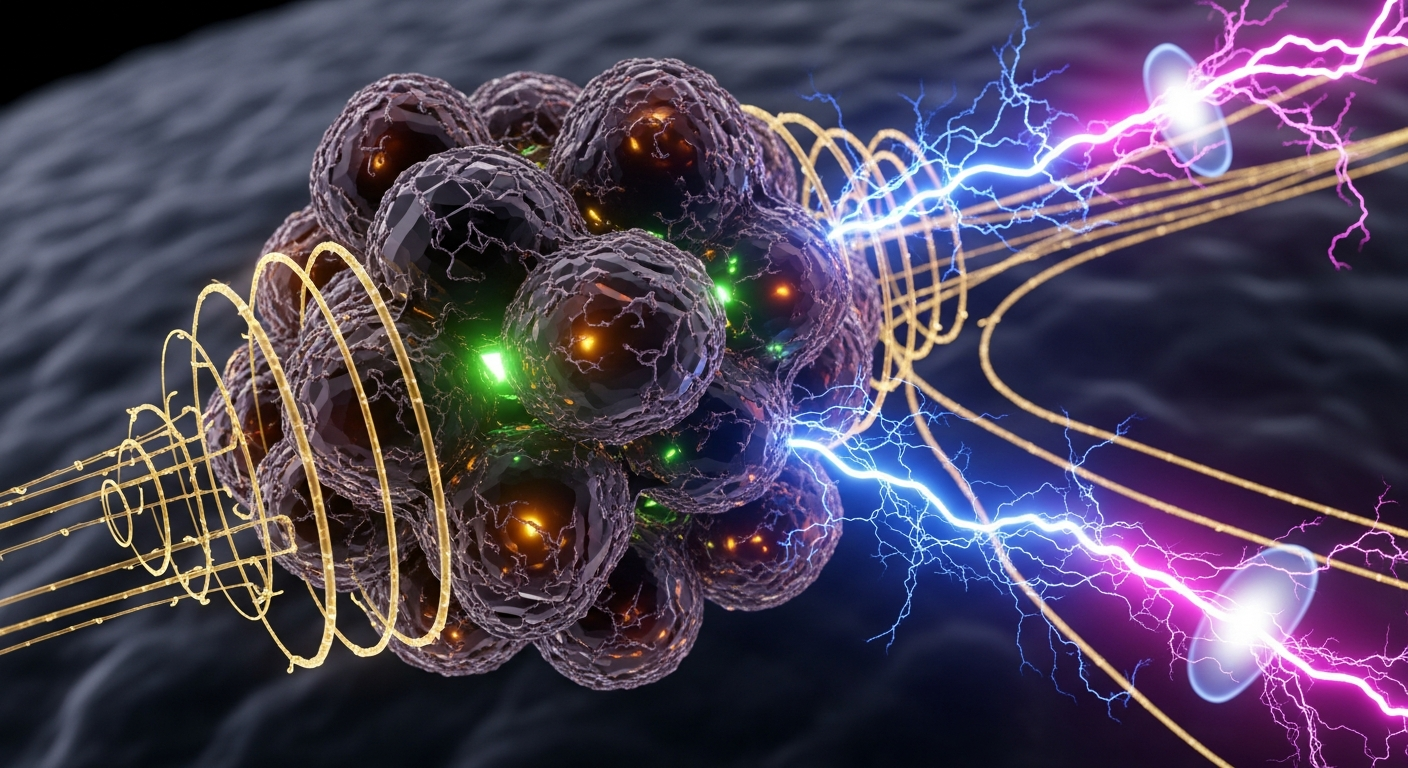
The piezoelectric hypothesis for melanin posits that although it is an amorphous (non-crystalline) polymer, it possesses localized regions of structural order and asymmetry. The stacked planar arrangements of its DHI and DHICA monomer units could, under compression or vibration, experience a charge separation analogous to that in a classic piezoelectric crystal. Imagine a melanin granule, or melanosome, within a cell. As sound waves or other mechanical vibrations pass through the tissue, they would rhythmically compress and decompress the granule. If the piezoelectric hypothesis holds, each compression cycle would generate a tiny pulse of voltage. The granule would essentially act as a microscopic acoustic-to-electric converter. This proposed mechanism requires direct experimental validation, for instance, using tools like Piezoresponse Force Microscopy (PFM) to measure electrical responses to mechanical stress on melanin films at the nanoscale.
From Nanoscale Vibration to Bioelectric Signaling
If melanin granules can indeed generate voltage from vibration, the biological implications are profound. This mechanism would provide a direct physical link between the mechanical environment and the cell's electrical signaling network. The field of bioelectricity, advanced significantly by the work of researchers like Michael Levin at Tufts University, has demonstrated that cellular function is governed not just by genetics and chemistry, but by a layer of electrical information encoded in patterns of cellular resting potential, or membrane potential (Vmem).
These bioelectric signals are not mere byproducts of cellular activity; they are instructional. They guide embryonic development, coordinate tissue regeneration, and can suppress or enable cancer progression. This signaling is mediated by the flow of ions through channels in the cell's membrane. A localized change in voltage can open or close these ion channels, creating a cascade of downstream effects.
Here is where the piezoelectric hypothesis becomes powerfully relevant. The small voltage generated by a vibrating melanin granule could be sufficient to influence the Vmem of the cell membrane or the membrane of an organelle like the mitochondrion. By being located adjacent to these membranes, piezoelectric melanosomes could act as "antennas" that transduce specific mechanical frequencies into localized electrical fields. This could, in turn, modulate the behavior of voltage-gated ion channels, effectively translating a vibrational signal into a canonical bioelectric signal that the cell already understands.
This model could offer new explanations for the function of melanin in unexpected places. For example, melanin is densely packed in the stria vascularis of the inner ear, a region critical for maintaining the electrochemical gradients necessary for hearing. While its role is often attributed to mopping up free radicals, a piezoelectric function would mean it could be actively involved in transducing the acoustic energy that is the very essence of hearing. Similarly, neuromelanin, found in the dopamine-producing neurons of the substantia nigra (the brain region implicated in Parkinson's disease), is constantly exposed to the micro-vibrations of cerebral activity. A piezoelectric role could add another layer to its known functions of iron chelation and antioxidant/pro-oxidant activity.
The piezoelectric hypothesis for melanin remains on the cutting edge of biophysical inquiry. It requires rigorous testing to move from a compelling idea to an established fact. However, by framing melanin as a potential mechanotransducer, it pushes us to see this ancient pigment not just as a shield, but as a sensor—a resonant material woven into the fabric of life, converting the silent language of vibration into the vital electrical dialogue of the cell.
Key Takeaways
- The piezoelectric hypothesis proposes that melanin can convert mechanical stress, such as pressure from sound vibrations, directly into an electrical voltage, a property observed in materials like quartz.
- This hypothesis is grounded in melanin's established identity as a complex amorphous semiconductor with localized structural order, a prerequisite for potential piezoelectric behavior.
- If proven, this property would position melanin as a primary mechanotransducer, a biological component that translates physical forces into cellular signals.
- Piezoelectric melanin could directly influence a cell's bioelectric state by locally altering the membrane potential (Vmem), thereby modulating ion channel activity and downstream cellular functions.
- This framework could provide new functional explanations for the presence of melanin in tissues subjected to mechanical vibration, such as the inner ear (hearing) and the brain (neuromelanin).
- Verifying this hypothesis requires advanced nanoscale techniques, such as Piezoresponse Force Microscopy, to directly measure electrical generation in melanin samples under mechanical load.
References
- McGinness, J., Corry, P., & Proctor, P. "Amorphous semiconductor switching in melanins." Science 183(4127), 853-855 (1974). DOI: 10.1126/science.183.4127.853 doi:10.1126/science.183.4127.853
- d'Ischia, M., Wakamatsu, K., Cicoira, F., Di Mauro, E., Garcia-Borron, J. C., Commo, S., ... & Ito, S. "Melanins and melanogenesis: from pigment cells to human health and technological applications." Pigment Cell & Melanoma Research 28(5), 520-544 (2015). DOI: 10.1111/pcmr.12393
- Levin, M., Pezzulo, G., & Finkelstein, J. M. "Endogenous bioelectric signaling networks: a new frontier in developmental and regenerative medicine." Journal of Clinical Investigation 127(7), 2471-2480 (2017). DOI: 10.1172/JCI90264
- Mostert, A. B. "The functional role of melanin in the inner ear: a review." Journal of Laryngology & Otology 124(6), 579-583 (2010). DOI: 10.1017/S002221510999298X
- Panzella, L., & Napolitano, A. "Natural and synthetic melanins: chemical structure, physical properties, and biological activities." In Comprehensive Natural Products II (pp. 371-398). Elsevier (2010).
- Fukada, E., & Yasuda, I. "On the piezoelectric effect of bone." Journal of the Physical Society of Japan 12(10), 1158-1162 (1957). (Classic reference establishing piezoelectricity in a biological material). doi:10.1143/jpsj.12.1158
- Meredith, P., & Sarna, T. "The physical and chemical properties of eumelanin." Pigment Cell Research 19(6), 572-594 (2006). DOI: 10.1111/j.1600-0749.2006.00345.x doi:10.1111/j.1600-0749.2006.00345.x
- Zucca, F. A., Segura-Aguilar, J., Ferrari, E., Muñoz, P., Paris, I., Sulzer, D., ... & Zecca, L. "Interactions of iron, dopamine and neuromelanin in brain aging and Parkinson's disease." Progress in Neurobiology 155, 96-119 (2017). DOI: 10.1016/j.pneurobio.2015.09.012