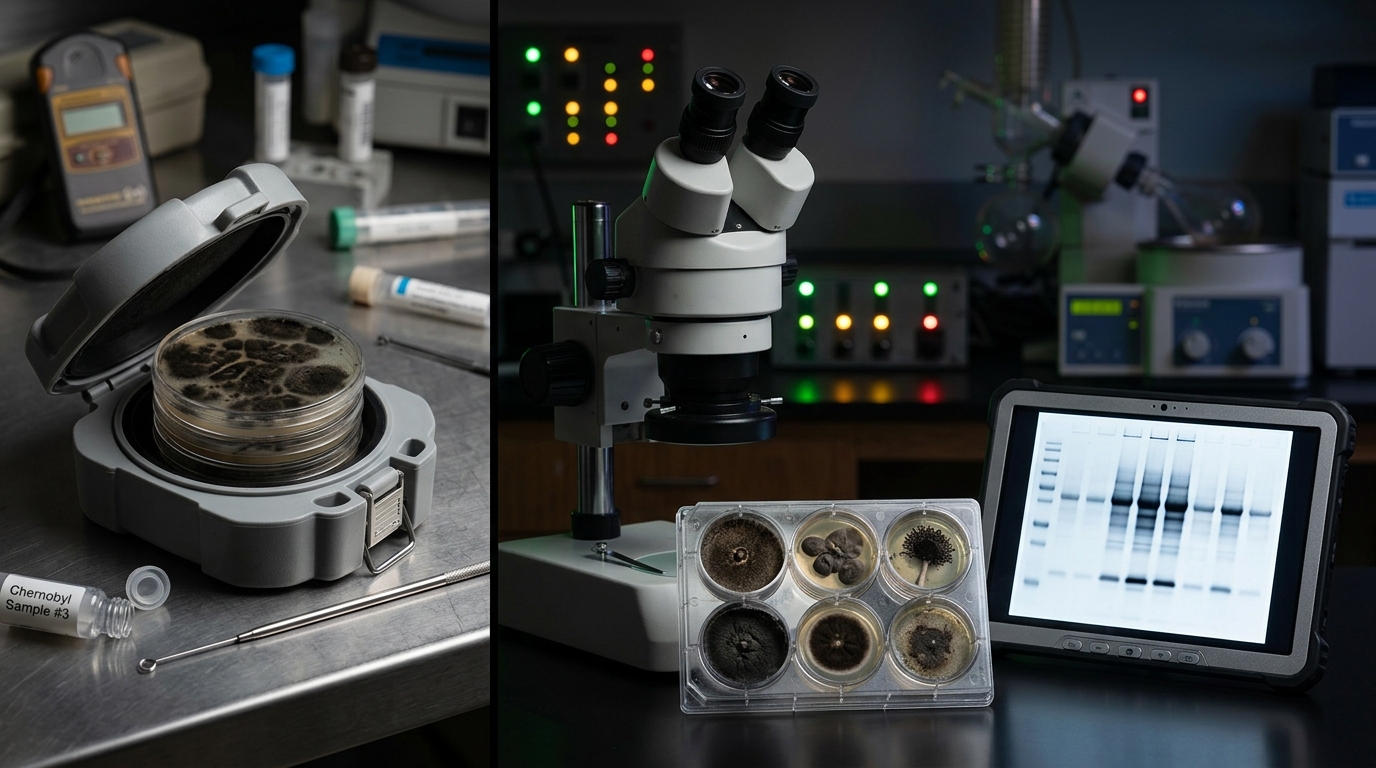
Melanin is far more than the polymer that colors our skin, hair, and eyes. This ancient molecule appears in all kingdoms of life, from the ink of a cephalopod to the dark spots on a banana. This evolutionary persistence begs a fundamental question: if natural selection is a ruthless editor, why has it preserved and independently evolved this pigment for billions of years across wildly divergent lineages? The answer may lie in a place of extreme environmental stress—the ruins of the Chernobyl Nuclear Power Plant. There, melanized fungi are not merely surviving; they are thriving. Cladonia raiata and other species are observed growing towards sources of intense gamma radiation, a behavior that forces us to reconsider melanin’s primary role in biology. This is not the profile of a passive shield but of an active participant in cellular energy dynamics.
The persistence of melanin across all domains of life—Archaea, Bacteria, and Eukarya—is a testament to its profound utility. Its appearance is a striking example of convergent evolution, where unrelated organisms independently evolve similar traits to adapt to similar necessities. While the melanin in a human retinal pigment epithelium and the melanin in a Cretaceous-period ammonite fossil are chemically similar, they arose from separate evolutionary pathways. This repeated, independent emergence strongly implies that melanin confers a significant selective advantage far beyond its well-documented role in UV photoprotection. The question is, what is that advantage? The answer lies in its unique and versatile biophysical properties, which position it as one of nature's most sophisticated biomaterials.
From Passive Shield to Active Transducer
For decades, melanin's primary function was framed as photoprotection. Its remarkable capacity for broadband absorption, absorbing energy from the ultraviolet to the near-infrared spectrum, is unparalleled among biological pigments. It can absorb over 99.9% of incident UV radiation and dissipate this energy as heat with phenomenal efficiency, preventing the formation of DNA-damaging photoproducts. This is a critical function, but it is an incomplete picture. The Chernobyl fungi have forced a re-evaluation of this paradigm.
Research led by Ekaterina Dadachova and Arturo Casadevall, then at the Albert Einstein College of Medicine, provided compelling evidence for a phenomenon they termed radiotropism. Their 2007 study in PLOS ONE demonstrated that melanized fungal species exposed to ionizing radiation levels 500 times higher than background showed significantly enhanced growth. Crucially, the melanin itself appeared to be the engine of this process. Using Electron Paramagnetic Resonance (EPR) spectroscopy, a technique that detects unpaired electrons, they found that exposure to gamma radiation altered the electronic properties of melanin, suggesting that the molecule was capturing and transducing this high-energy radiation.
The proposed mechanism is that melanin acts as an energy converter. It captures the energy from photons—whether from the sun or a radioactive source—and transduces it into a chemical form the cell can use. While the precise metabolic pathways are still under investigation, this finding reframes melanin not as a simple sunblock but as a potential biological energy harvester. It behaves less like a shield and more like a biological solar panel, converting environmental electromagnetic energy into metabolically relevant potential.
The Biophysics of a Bio-Electronic Material
To understand how melanin accomplishes such a feat, we must look beyond its color and into its fundamental physics. In the 1970s, John McGinness and his colleagues published a landmark paper establishing that melanin is not an insulator but a disordered semiconductor. Unlike the crystalline silicon in our computers, melanin is an amorphous, polymer-based semiconductor. It possesses a band gap—the energy required to excite an electron from a bound state to a conductive state—of approximately 1.85 electron volts (eV), allowing it to interact with a wide range of photon energies.
This semiconductor nature is only the beginning. Melanin is also a remarkable proton conductor, particularly when hydrated. Water molecules absorbed into the melanin polymer structure can form "proton wires" (a Grotthuss-like mechanism), allowing for the rapid transport of protons (H+ ions). This is a profoundly important property in biology, as proton gradients are the fundamental currency of cellular energy, driving the synthesis of ATP in mitochondria. Melanin's ability to absorb energy and potentially mediate proton flow positions it as a unique interface between environmental energy sources and cellular bioenergetics.
Furthermore, melanin's structure gives it other vital, non-pigmentary roles. In the brain, for instance, neuromelanin accumulates in the dopaminergic neurons of the substantia nigra. For years, its presence was a mystery, often considered a byproduct of dopamine metabolism. However, research now shows that neuromelanin is a powerful chelator of metal ions, particularly iron. By sequestering reactive iron, it can protect the cell from oxidative stress. The loss of neuromelanin-containing neurons is a hallmark of Parkinson's disease, suggesting that this form of melanin plays a crucial neuroprotective role. It simultaneously acts as a redox buffer, both quenching and participating in electron-transfer reactions, highlighting its dynamic electrochemical functionality.
An Interface for Bioelectric Information
The convergence of melanin's properties—broadband absorption, semiconduction, proton transport, and redox activity—suggests a role that may extend even beyond energy transduction to information processing. The field of bioelectricity, advanced by researchers like Michael Levin at Tufts University, has demonstrated that cellular collectives use ion gradients and electrical potentials to store and process information, guiding morphogenesis, regeneration, and tissue repair.
Melanin, with its ability to interact with both photons and ions (protons, metal ions), is perfectly situated to act as an interface between environmental signals and a cell's bioelectric state. As a hypothesis, it is conceivable that melanin's absorption of light could locally alter charge distribution or proton availability, thereby influencing the membrane potential of a cell or organelle. This could provide a direct pathway for electromagnetic energy to modulate bioelectric signaling, a form of cellular computation that predates the nervous system.
While this remains an area of active theoretical and experimental inquiry, it provides a compelling framework for understanding melanin's evolutionary persistence. A material that can offer UV protection, harvest energy from diverse sources, manage oxidative stress, and potentially interface with a cell's fundamental bioelectric control system is not just useful—it's a multi-tool for survival. Evolution doesn't discard tools of such profound versatility. Instead, it deploys them again and again, from the deepest oceans to the most irradiated landscapes on Earth. The story of melanin is not just about color; it is about the physics of life itself.
Key Takeaways
- Melanin's presence across all kingdoms of life is a result of convergent evolution, indicating a fundamental biological utility far beyond pigmentation.
- The discovery of radiotrophic fungi at Chernobyl provided strong evidence that melanin can harness ionizing radiation as a source of metabolic energy, reframing it as an active energy transducer.
- Melanin is a disordered semiconductor that exhibits broadband absorption of electromagnetic energy and hydration-dependent proton conductivity, positioning it at the crossroads of energy conversion and cellular bioenergetics.
- Different forms of melanin serve specialized, non-pigmentary roles, such as the neuroprotective chelation of iron by neuromelanin in the brain.
- The combined biophysical properties of melanin suggest it may function as an interface between environmental energy and cellular bioelectric signaling systems, a frontier for future research.
- Understanding melanin not just as a pigment but as a sophisticated bio-electronic material is crucial for appreciating its deep evolutionary significance and potential applications in bio-inspired technology.
References
- Dadachova, E., et al. "Ionizing Radiation Changes the Electronic Properties of Melanin and Enhances the Growth of Melanized Fungi." PLOS ONE 2(5), e457 (2007). DOI: 10.1371/journal.pone.0000457. doi:10.1371/journal.pone.0000457
- McGinness, J., Corry, P., & Proctor, P. "Amorphous semiconductor switching in melanins." Science 183(4127), 853-855 (1974). DOI: 10.1126/science.183.4127.853. doi:10.1126/science.183.4127.853
- Meredith, P., & Sarna, T. "The physical and chemical properties of eumelanin." Pigment Cell Research 19(6), 572-594 (2006). DOI: 10.1111/j.1600-0749.2006.00345.x. doi:10.1111/j.1600-0749.2006.00345.x
- Solís Herrera, A., et al. "The unexpected capacity of melanin to dissociate the water molecule fills the gap between the life before and after the great oxidation event." International Journal of Molecular Sciences 23(17), 9993 (2022). DOI: 10.3390/ijms23179993.
- Zecca, L., et al. "The role of neuromelanin in neurodegenerative diseases." Nature Reviews Neuroscience 5(11), 863-873 (2004). DOI: 10.1038/nrn1547.
- Turick, C. E., et al. "In situ analysis of radiation-induced spectral changes in melanin from a radio-tolerant fungus." Bioelectrochemistry 82(1), 53-58 (2011). DOI: 10.1016/j.bioelechem.2011.04.004.
- Levin, M., Pezzulo, G., & Finkelstein, J. M. "Endogenous bioelectric signaling networks: exploiting voltage gradients for control of growth and form." Annual Review of Biomedical Engineering 19, 353-387 (2017). DOI: 10.1146/annurev-bioeng-071516-044647. doi:10.1146/annurev-bioeng-071114-040647