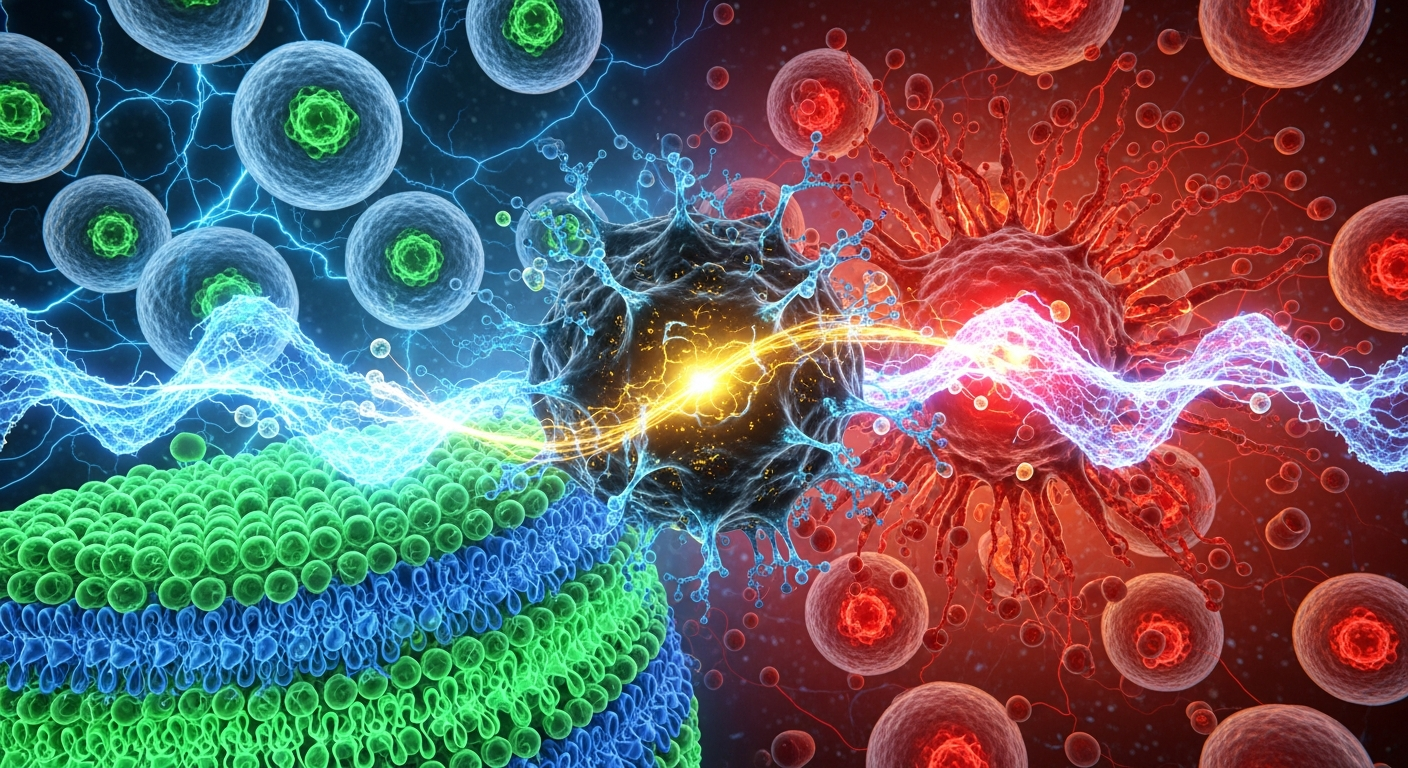
Explore how cellular membrane potentials dictate oncogenic transformation and examine the theoretical intersection with melanin's unique semiconductor properties. By bridging established bioelectric discoveries with the biophysics of complex melanic polymers, we map a rigorous new frontier in understanding the tumor microenvironment.
Long before a cell begins to exhibit the uncontrolled division characteristic of cancer, its bioelectric profile undergoes a profound and measurable shift. Traditional oncology has spent half a century viewing cancer almost exclusively through the lens of the somatic mutation theory—a model positioning genetic damage as the prime mover of oncogenesis. However, emerging biophysical research reveals a parallel, equally critical control system: the bioelectric state of the cell. Tissues are not merely biochemical networks; they are complex electrical circuits governed by the flow of ions across cellular membranes. When this localized electrical grid drops in voltage, the biological software of the cell reboots, shifting from a cooperative, differentiated state back into an isolated, highly proliferative mode.
This realization shifts our perspective of cancer from a purely genetic malfunction to an electrophysiological disease. If tissue architecture and cellular behavior are maintained by bioelectric signaling, then the intrinsic electronically active materials within biology demand immediate and rigorous investigation. It is here that melanin—long relegated by classical biology to a mere biological sunscreen—emerges as a critical subject of inquiry. Because melanin is a functional organic semiconductor capable of conducting both electrons and protons, its presence within the cellular microenvironment introduces an entirely distinct biophysical variable. Understanding how biological materials handle charge transport is no longer just materials science; it is the vanguard of cancer biology.
The Voltage Hypothesis: Depolarization as an Oncogenic Trigger
Every living cell acts as a microscopic battery. The continuous pumping of ions—primarily sodium, potassium, chloride, and calcium—across the lipid bilayer creates a measurable electrical gradient known as the resting membrane potential ($V_{mem}$). In healthy, fully differentiated tissue, cells are highly hyperpolarized, maintaining a strong negative charge relative to their extracellular environment, typically ranging between -60 mV and -90 mV. This steep electrical gradient is actively maintained by specific ion channel expression and serves as a continuous bioelectric signal enforcing cellular identity, spatial awareness, and growth suppression.
However, researchers mapping the bioelectric parameters of oncogenesis have observed a striking anomaly: cancer cells are significantly depolarized. Their internal voltage drops dramatically, often hovering between -10 mV and -20 mV. Crucially, this depolarization is not merely a byproduct of the cancer state; it is an active driver of it. Landmark research led by developmental biologist Michael Levin at Tufts University has demonstrated that artificial depolarization of tissue in Xenopus (frog) embryos can induce metastatic melanoma-like tumors in the absence of any genetic carcinogens or mutations.
Conversely, Levin’s lab showed that artificially hyperpolarizing existing tumor cells—forcing their $V_{mem}$ back toward a healthy -70 mV by introducing new ion channels or using targeted drugs—can suppress tumor formation and force cancer cells to normalize their behavior. The membrane potential acts as an epigenetic master switch. When the voltage drops, cells lose their bioelectric connection to the surrounding tissue network. They revert to an ancient, unicellular state of continuous, voltage-gated proliferation. This mechanism highlights $V_{mem}$ as a vital bioelectric cancer marker, providing a target for both early detection and novel therapeutic intervention.
Melanin as an Endogenous Organic Semiconductor
To understand how endogenous structures might interact with these bioelectric fields, we must examine the biophysical properties of one of nature's most ubiquitous, yet misunderstood, biopolymers. Melanin is not a simple molecular structure; it is an amorphous organic semiconductor. In 1974, physicist John McGinness and his colleagues published a foundational paper in Science demonstrating that melanin exhibits bistable electrical switching—a property characteristic of solid-state electronic devices.
Modern biophysics has since characterized eumelanin (the dark brown/black variant) as a broadband absorber with an energy bandgap of approximately 1.85 electron volts (eV). This bandgap allows melanin to absorb diverse electromagnetic frequencies and safely dissipate them as heat, but its electronic capabilities extend much further. Research by Paul Meredith, Albert Mostert, and their teams has elucidated that melanin’s electrical conductivity is governed by hydration-dependent proton conductivity. Melanin behaves as a mixed ionic-electronic conductor. The presence of water within the melanin matrix facilitates a complex internal transport system where both electrons and protons flow through the biopolymer network.
Furthermore, melanin hosts a population of stable free radicals, readily detectable via electron paramagnetic resonance (EPR) spectroscopy. Unlike the destructive reactive oxygen species (ROS) that cause cellular damage, melanin’s free radicals are stabilized by the polymer's extensive conjugated double-bond system. This allows melanin to act as a potent redox buffer, continually donating or accepting electrons depending on the surrounding chemical environment. It is a dynamic, charge-handling material embedded directly within the biological matrix.
Modulating the Microenvironment: Melanin's Theoretical Bioelectric Role
When we overlay Levin’s discoveries regarding depolarized $V_{mem}$ with the biophysical realities of melanin, a compelling theoretical framework emerges. If cancer is fundamentally driven by a disruption in the local ionic and electrical environment, and melanin is an endogenous mixed-conductor capable of moving protons and electrons, melanin cannot be viewed as a biologically inert bystander in tissues where it is present.
Consider the tumor microenvironment (TME). Cancer cells, relying heavily on glycolysis (the Warburg effect), export massive amounts of protons ($H^+$) into the extracellular space, creating an aggressively acidic and electrically altered microenvironment. This proton flux is directly tied to the depolarization of the cell membrane. We hypothesize that in highly melanized tissues—such as in cutaneous melanoma or heavily pigmented organs—melanin's robust proton conductivity must physically interface with this altered pH gradient.
By acting as a proton sink or a biological wire, melanin could theoretically modulate the local ionic gradients that dictate $V_{mem}$. Does high intracellular melanin concentration help buffer the bioelectric drop, resisting oncogenic depolarization? Or, under certain pathological conditions, does pheomelanin—the sulfur-containing, highly pro-oxidant form of melanin—contribute to the localized bioelectric short-circuiting that precedes tumor formation?
While direct in vivo measurements mapping melanin’s real-time effect on cancer $V_{mem}$ are still an emerging frontier, the biophysical prerequisites for this interaction are firmly established. Melanin acts as a bio-capacitor and transducer. Its ability to undergo continuous redox cycling means it actively participates in the electron transfer chain of its immediate environment. In the context of the voltage hypothesis, melanin is theoretically capable of absorbing external electromagnetic energy (such as specific frequencies of light) and transducing that energy into local proton gradients—a mechanism that could be harnessed to artificially hyperpolarize depolarized tumor cells.
Implications for Oncology and Bioelectronic Medicine
The synthesis of bioelectricity and melanin biophysics offers entirely new vectors for oncological research. Traditional pharmacology seeks to bind a chemical drug to a specific protein receptor. Bioelectronic medicine, however, seeks to manipulate the electrical gradients that control cellular behavior.
If we recognize that cells require a hyperpolarized membrane potential to maintain healthy differentiation, therapeutic strategies can pivot toward ion channel therapeutics—repurposing existing drugs (like anti-arrhythmics or anti-epileptics) to open or close specific ion channels in tumors. But recognizing melanin's role expands this toolkit. Because melanin is a semiconductor sensitive to electromagnetic fields, it presents a potential non-pharmacological target.
Future research must investigate whether targeted electromagnetic or photobiomodulation therapies can exploit melanin's 1.85 eV bandgap to safely trigger proton movement within the tumor microenvironment, artificially shifting the localized pH and repolarizing the tissue. Furthermore, identifying the specific EPR signatures of melanin in benign nevi versus malignant melanomas may provide highly sensitive diagnostic tools based entirely on the biophysical, rather than genetic, state of the tissue.
The Quantum Melanin Research Foundation views this intersection as a critical juncture. By treating complex biological systems as sophisticated bio-electronic networks, and respecting the remarkable biophysics of endogenous materials like melanin, science moves closer to an era where we do not simply poison cancer cells, but bioelectrically command them to normalize.
Key Takeaways
- Cellular membrane potential ($V_{mem}$) is a primary epigenetic regulator of cell behavior; healthy cells are highly hyperpolarized (-60 to -90 mV), while cancer cells exist in a chronic depolarized state (-10 to -20 mV).
- Artificial manipulation of ion channels to repolarize a cell’s $V_{mem}$ has been shown in laboratory models to suppress tumor formation and reverse oncogenic behavior without altering the underlying DNA.
- Melanin is an amorphous organic semiconductor with an energy bandgap of ~1.85 eV, capable of hydration-dependent proton conductivity and stable electron transfer.
- Because cancer survival relies on acidic extracellular environments and disrupted proton gradients, melanin’s intrinsic capacity to conduct protons suggests it may actively modulate the tumor microenvironment's bioelectric landscape.
- Integrating melanin biophysics with the bioelectric voltage hypothesis opens novel therapeutic pathways, including using electromagnetic fields to leverage melanin's semiconducting properties to artificially hyperpolarize target tissues.
References
Chernet, B. T., & Levin, M. "Transmembrane voltage potential is an essential cellular parameter for the detection and control of tumor development in a Xenopus model." Disease Models & Mechanisms 6(3), 595-607 (2013). DOI: 10.1242/dmm.010835
D'Ischia, M., Wakamatsu, K., Cito, A., & Ito, S. "Melanins and melanogenesis: from pigment cells to human health and technological applications." Pigment Cell & Melanoma Research 28(5), 520-544 (2015). DOI: 10.1111/pcmr.12393
Levin, M. "Bioelectric signaling: Reprogramming circuits underlying morphogenesis and regeneration." Cold Spring Harbor Perspectives in Biology 13(12), a040584 (2021). DOI: 10.1101/cshperspect.a040584
McGinness, J., Corry, P., & Proctor, P. "Amorphous semiconductor switching in melanins." Science 183(4127), 853-855 (1974). DOI: 10.1126/science.183.4127.853
Mostert, A. B., Powell, B. J., Pratt, F. L., Hanson, G. R., Sarna, T., Gentle, I. R., & Meredith, P. "Role of water in solid-state melanin conductivity." Proceedings of the National Academy of Sciences 109(23), 8943-8947 (2012). DOI: 10.1073/pnas.1119948109
Yang, M., & Brackenbury, W. J. "Membrane potential and cancer progression." Frontiers in Physiology 4, 185 (2013). DOI: 10.3389/fphys.2013.00185