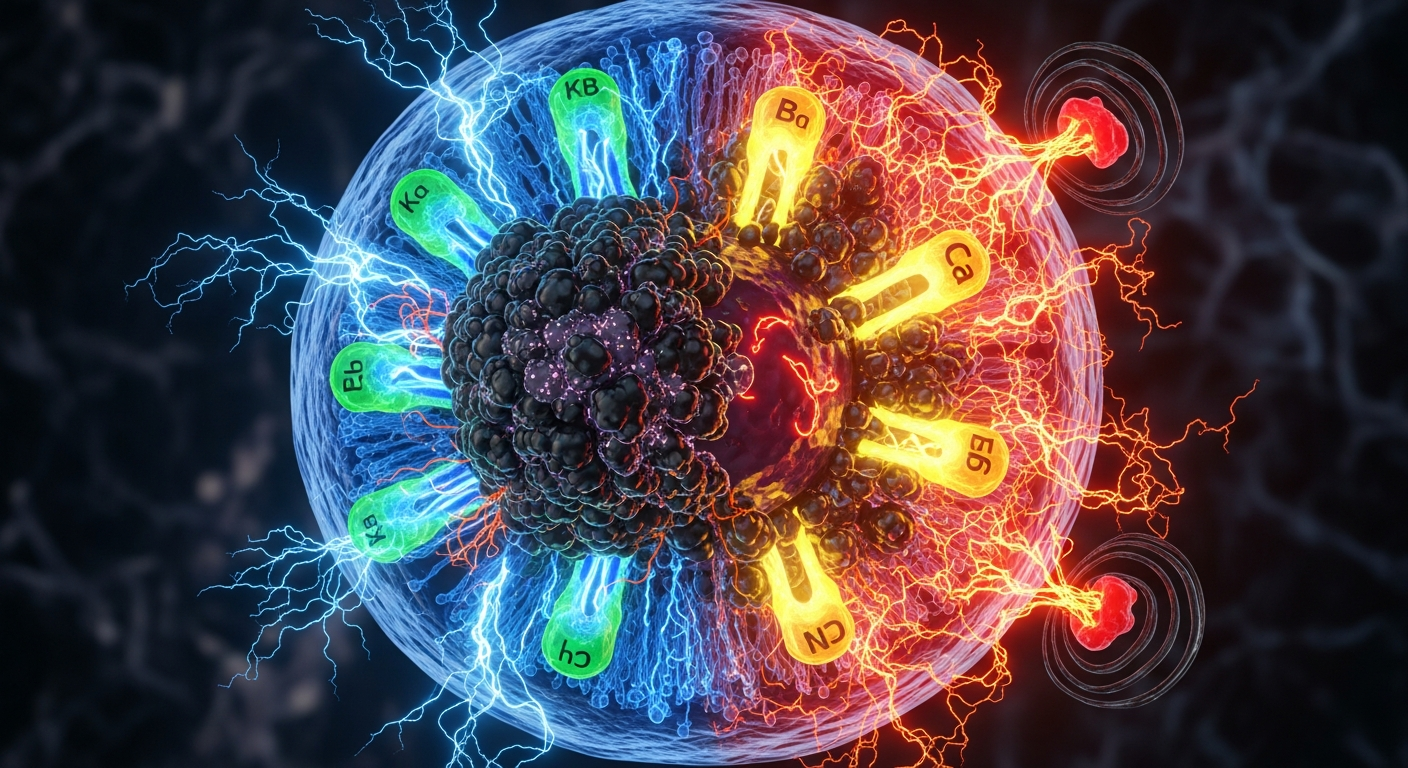
Beyond the genome, a cell's electrical state may be a fundamental determinant of its fate. Here, we explore the emerging link between cellular voltage, cancer, and the potential regulatory role of the enigmatic biopolymer, melanin.
For over a century, biology has operated under the powerful paradigm of the gene. We understood that DNA holds the blueprint, the master instructions for building and operating an organism. Yet, this model, while foundational, leaves critical questions unanswered. How do cells with identical DNA organize into a complex hand, and not a disorganized cluster of skin, bone, and muscle? How does a regenerating salamander limb know when to stop growing? And perhaps most urgently, what makes a cell forget its role in the collective and embark on the chaotic, self-serving proliferation we call cancer? The answers may lie in a much older, faster form of biological information: the language of electricity.
We are accustomed to thinking of bioelectricity in the context of the nervous system, where rapid voltage spikes—action potentials—carry information along axons. But a quieter, more constant electrical conversation is happening in every tissue of the body. Every cell maintains an electrical potential difference across its membrane, a steady-state voltage known as the resting membrane potential (Vmem). This is not mere metabolic noise. Decades of research, pioneered by scientists like Michael Levin at Tufts University, have revealed that Vmem is a powerful instructional signal. The spatial pattern of cellular voltages across a tissue forms a bioelectric blueprint, one that directs cell differentiation, migration, and proliferation to orchestrate growth and form. Disrupt this electrical pattern, and you can disrupt the anatomy itself—persuading a flatworm to grow a head where its tail should be, or preventing a tadpole from developing a face. This discovery forces a profound question: If bioelectricity is the conductor of normal development, what happens when it plays the wrong notes?
The Bioelectric Signature of Cancer
The genetic model of cancer has provided invaluable insights and life-saving therapies. It posits that cancer arises from accumulated mutations in key genes that regulate cell growth and death. Yet, this is not the whole story. A parallel, and potentially more fundamental, characteristic of cancerous cells is their electrical state. Normal, quiescent somatic cells in a mature tissue typically maintain a highly polarized (negative) Vmem, often between -70mV and -90mV. In stark contrast, cancer cells of virtually all types are consistently and significantly depolarized, exhibiting a Vmem that is far less negative, typically ranging from -10mV to -30mV.
This is not a mere correlation; compelling evidence suggests it is a causal factor. In a landmark 2011 study published in Disease Models & Mechanisms, Levin's group demonstrated that introducing an oncogene like mutant Ras into tadpole cells was not, by itself, sufficient to guarantee tumor formation. However, if those same oncogene-expressing cells were forced to depolarize, tumor-like growths invariably appeared. Conversely, forcing the oncogene-expressing cells to remain at a normal, hyperpolarized voltage suppressed tumorigenesis almost completely. The cell's electrical context, it seems, can override its genetic programming.
The mechanism is rooted in the physics of the cell membrane. The Vmem is established and maintained by the tightly regulated activity of ion channels and pumps, which shuttle charged particles like potassium (K+), sodium (Na+), and chloride (Cl-) ions across the membrane. A cell's voltage acts as a master switch. Depolarization beyond a certain threshold (around -20mV) can trigger voltage-gated ion channels, such as those for calcium (Ca2+), to open. The resulting influx of ions can activate downstream signaling cascades—like the MAPK/ERK pathway—that are known drivers of cell proliferation. In this model, the depolarized state of a cancer cell is not a byproduct of its dysfunction but a primary enabler of it. It is a permissive bioelectric state that unlocks the cell's latent ability to divide, migrate, and ignore signals from its neighbors. This "voltage hypothesis" reframes cancer not just as a disease of bad genes, but as a disease of rogue cellular electricity.
Melanin: An Overlooked Bioelectric Player
If cellular voltage is so critical, then the biological components that regulate it demand intense scrutiny. This brings us to melanin. Often dismissed as a simple pigment for coloration and UV protection, melanin is one of the most ancient and sophisticated biopolymers on the planet. Its properties extend far beyond optics and into the realm of solid-state physics and electrochemistry, making it a prime candidate for a biological charge-management system.
Eumelanin, the black-brown form of melanin, is not an insulator. It is an organic semiconductor. Pioneering work by researchers like John McGinness in the 1970s first established that melanin could switch between high- and low-resistance states, behaving much like a man-made electronic device. Its electronic structure is characterized by a band gap of approximately 1.6-2.0 electron volts (eV), allowing it to absorb a vast spectrum of electromagnetic energy—from UV to visible and even infrared light—and convert that energy into charge carriers (electrons and holes).
Furthermore, melanin is an excellent proton conductor, especially when hydrated. Protons (H+ ions) are the fundamental currency of cellular energy and pH regulation, and their gradients across membranes are essential for establishing Vmem. The chemical structure of eumelanin, composed of stacked indolequinone units, creates pathways for efficient proton transport. This means melanin is not a passive bystander in the cell's electrochemical environment; it is intrinsically capable of participating in the very ion dynamics that set the cell's voltage. Finally, melanin possesses a signature of stable free radicals, meaning it is permanently poised to accept or donate electrons, functioning as a potent redox buffer that can quench reactive oxygen species or participate in electron transfer chains. This combination of properties—semiconductivity, proton conductivity, and redox activity—describes not a pigment, but a sophisticated bioelectronic material.
A New Hypothesis: Melanin as a Vmem Stabilizer
The established facts are these: (1) Cellular depolarization is a key enabler of the cancerous state. (2) Melanin is a bio-polymer with intrinsic semiconductor and ion-conducting properties. At the Quantum Melanin Research Foundation, we believe the intersection of these facts defines a critical frontier of cancer biology. We propose a theoretical framework wherein melanin's primary biological role may be to function as a distributed, local regulator of the cellular bioelectric field.
Consider the implications. A network of melanin granules within a cell or tissue could act as a charge-dissipating system. By absorbing stray metabolic or photonic energy and conducting away excess charge (protons or electrons), melanin could help a cell maintain its healthy, hyperpolarized resting state. It could function as a biological "ground," buffering against the fluctuations and stresses that might otherwise lead to oncogenic depolarization. In this view, melanin is not just a shield against external radiation but also a stabilizer of the internal bioelectric environment.
This framework offers a new lens through which to view melanoma, the most dangerous form of skin cancer. The transformation of a melanocyte into a melanoma cell is currently understood through a genetic lens. But what if it is also an electrical failure? A dysfunction in the synthesis or structure of the melanin polymer could impair its bioelectric-stabilizing capacity, rendering the cell more susceptible to the depolarized state that enables proliferation. The very material meant to protect the cell could, when flawed, fail in its electrochemical duty. This hypothesis extends to neuromelanin, the pigment found in the brain's substantia nigra, which is known to chelate iron and manage immense oxidative stress. Its loss is a hallmark of Parkinson's disease, suggesting that the electrochemical functions of melanin are essential for the long-term health of even non-dividing cells like neurons.
What remains unknown is the precise mechanism of interaction. Does melanin directly integrate into cellular membranes? Does it form conductive networks between cells? Does it use absorbed energy to actively power ion pumps? Answering these questions requires a new, interdisciplinary approach, combining the tools of biophysics, electrophysiology, and oncology. By investigating the deep connection between cellular voltage and melanin's fundamental physical properties, we may find that one of nature's oldest molecules holds a key to understanding—and perhaps one day controlling—one of its most persistent diseases.
Key Takeaways
- Cellular bioelectricity, specifically the resting membrane potential (Vmem), acts as a powerful instructional signal for cell behavior, independent of the genome.
- A persistent depolarization (a less negative Vmem) is a universal biophysical hallmark of cancer cells and is causally linked to tumor formation by enabling uncontrolled proliferation.
- Melanin is not merely a pigment but a sophisticated bioelectronic material, functioning as an organic semiconductor, a proton conductor, and a stable free radical capable of managing charge.
- A compelling hypothesis is that one of melanin's primary biological functions is to stabilize a cell's healthy, hyperpolarized Vmem by absorbing energy and dissipating ionic or electronic charge.
- Dysfunction in melanin's bioelectric regulatory capacity, not just its photoprotective role, may be a contributing factor in the development of melanoma and other diseases.
- Future research at the intersection of bioelectricity and melanin biophysics represents a novel frontier for understanding and potentially treating cancer.
References
- Levin, M. "Bioelectric signaling: Reprogrammable circuits underlying embryonic development, regeneration, and cancer." Cell 184(8), 1971-1989 (2021). DOI: 10.1016/j.cell.2021.02.034
- Chernet, B. T., & Levin, M. "Transmembrane voltage potential is an essential cellular parameter for spatial patterning and mind-body integration." Symmetry 5(2), 291-325 (2013). DOI: 10.3390/sym5020291
- Chernet, B. T., & Levin, M. "Endogenous voltage potentials and the microenvironment: a mechanism for long-range communication and management of complexity." Physical Biology 10(5), 055001 (2013). DOI: 10.1088/1478-3975/10/5/055001
- McGinness, J. E., Corry, P. M., & Proctor, P. H. "Amorphous semiconductor switching in melanins." Science 183(4127), 853-855 (1974). DOI: 10.1126/science.183.4127.853 doi:10.1126/science.183.4127.853
- Mostert, A. B. "The hydration-dependent electrical conductivity of eumelanin." Materials Chemistry and Physics 177, 477-482 (2016). DOI: 10.1016/j.matchemphys.2016.04.073
- Pavan, W. J., & Sturm, R. A. "The Genetics of Human Skin and Hair Pigmentation." Annual Review of Genomics and Human Genetics 20, 41-72 (2019). [This provides a good background on melanin synthesis, complementing the biophysics.] doi:10.1146/annurev-genom-083118-015230
- Yang, M., & Brackenbury, W. J. "Membrane potential and cancer progression." Frontiers in Physiology 4, 185 (2013). DOI: 10.3389/fphys.2013.00185 doi:10.3389/fphys.2013.00185
- Turick, C. E., Ekechukwu, A. A., Milliken, C. E., Casadevall, A., & Dadachova, E. "Gamma radiation interacts with melanin to alter its oxidation–reduction potential and results in electric current production." Bioelectrochemistry 82(1), 51-56 (2011). DOI: 10.1016/j.bioelechem.2011.04.009 doi:10.1016/j.bioelechem.2011.04.009