Your Skin Contains the Same Material That Powers Your Phone—And It's Even More Sophisticated
How melanin's hidden semiconductor properties reveal a biological computer running inside every cell
Reading Time: 8 minutes | Category: Quantum Biology / Biophysics
Touch your arm. Feel that skin? Beneath the surface lies one of nature's most elegant pieces of nanotechnology—and until recently, we completely underestimated it.
For decades, scientists thought melanin was just your body's sunscreen: a passive pigment that absorbed UV light and gave your skin its color. But here's what we've discovered: melanin isn't just sitting there protecting you from sunburn. It's actively processing information, conducting electricity, and switching states like a biological transistor. In other words, the same material that determines your skin tone has electronic properties remarkably similar to the silicon chips in your smartphone.
Except melanin does something silicon can't: it operates in water, at body temperature, and it builds itself.
The Semiconductor Hiding in Plain Sight
Let's start with a question: What makes a semiconductor special?
Whether it's silicon in your laptop or germanium in a solar panel, semiconductors have a superpower—they can flip between conducting electricity and blocking it. This on-off switching is the fundamental property that makes all modern electronics possible. Every computation, every pixel on your screen, every bit of data relies on semiconductors toggling between these two states billions of times per second.
Now here's where it gets interesting: melanin can do this too.
Researchers at Monash University made a breakthrough discovery when they measured melanin's "bandgap"—essentially the energy threshold that determines how easily a material can conduct electricity. They found melanin's bandgap sits right around 1.7 electron volts (Mostert et al., 2012). That number might not mean much to you, but to a physicist, it's striking. That's the sweet spot for biological conditions—high enough to prevent random thermal noise from triggering false signals, but low enough to work with the energy currencies available inside cells.
Think of the bandgap like the height of a fence. Too low, and anything can jump over it randomly (creating electrical noise). Too high, and nothing can get over it (making the material an insulator). Melanin's fence is exactly the right height for biological information processing.
But the real surprise came when scientists discovered melanin doesn't just act as one type of semiconductor—it can switch between two different modes. Depending on its oxidation state, melanin exhibits both p-type conductivity (conducting positive charges called "holes") and n-type conductivity (conducting electrons). This dual nature is exactly what you need to build transistors, diodes, and other electronic components.
Your skin, it turns out, contains the biological equivalent of a p-n junction—the fundamental building block of electronics.
When Water Makes the Difference
Here's where melanin gets really clever.
Silicon chips need to be kept absolutely dry and operate in carefully controlled environments. Get moisture on a computer chip, and you've got a problem. But melanin? It needs water to work properly.
Scientists have found that melanin's conductivity can change by ten orders of magnitude—that's a factor of 10 billion—depending on how hydrated it is (Meredith & Sarna, 2006). At very low hydration, melanin barely conducts at all, with conductivity around 10^-13 siemens per centimeter. But as you add water, something remarkable happens: conductivity shoots up to 10^-3 S/cm.
Why does water make such a dramatic difference?
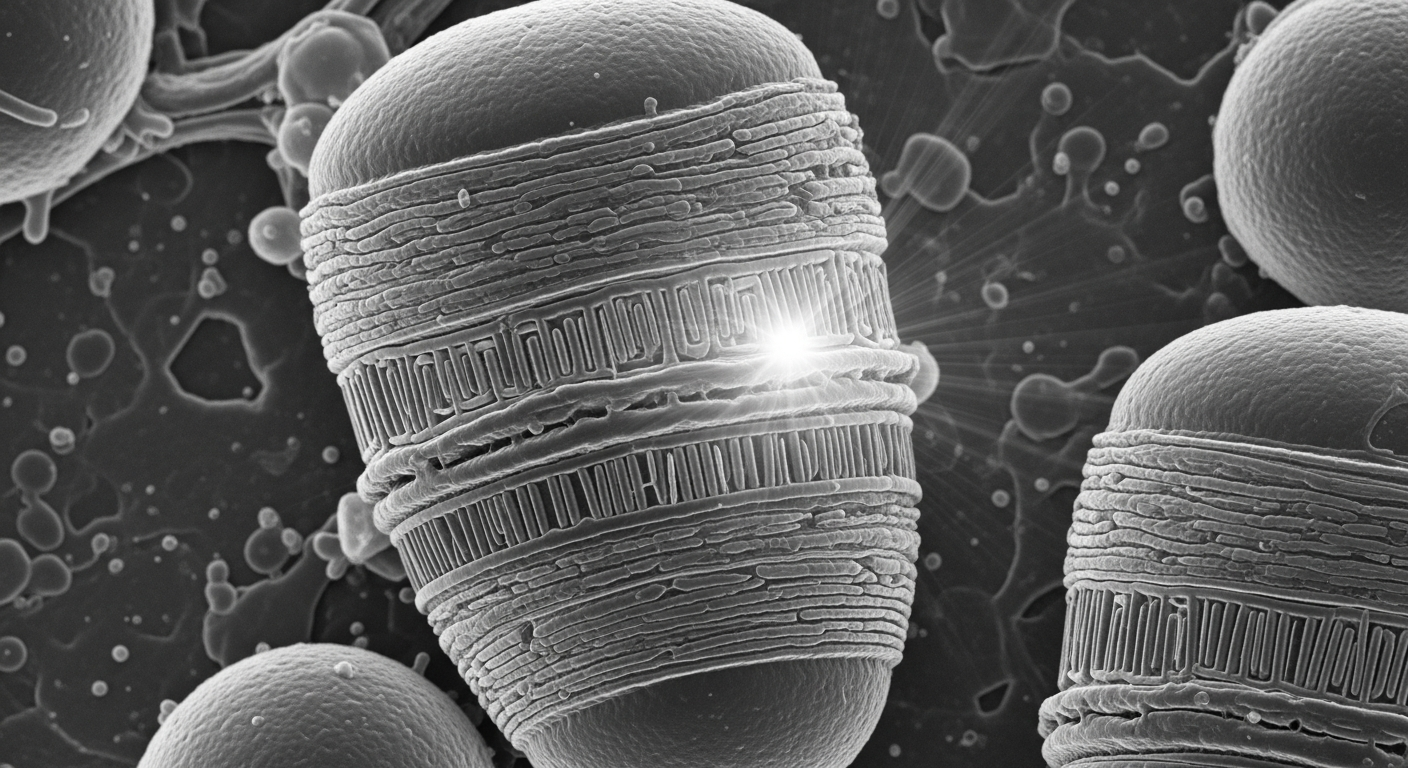
The answer lies in melanin's molecular architecture. Eumelanin (the most common form of melanin) assembles itself into layered nanostructures, kind of like a microscopic stack of sheets. These sheets are held together by π-π stacking interactions—imagine the indole units (melanin's building blocks) as flat plates that stack on top of each other like a deck of cards.
When water molecules slip between these layers, they enable something called proton-coupled electron transfer. Essentially, water creates highways for electrical charges to move through the melanin structure. It's like how adding salt to water makes it conduct electricity—but far more sophisticated, because melanin controls exactly how and when this conduction happens.
The mechanism involves a dance between two forms of melanin's molecular units: quinones and hydroquinones. These chemical cousins can swap electrons back and forth, and water facilitates this exchange. When a quinone accepts an electron, it becomes a hydroquinone. When a hydroquinone donates an electron, it becomes a quinone. This redox cycling creates a switching behavior—melanin's version of a transistor flipping between on and off states.
Nature's Nanotechnology: Self-Assembling Electronic Circuits
Perhaps the most astounding thing about melanin isn't what it can do—it's how it builds itself.
Silicon chips require billion-dollar fabrication facilities, extreme temperatures, toxic chemicals, and nanometer-precision manufacturing. The latest chip factories cost over $20 billion to build. Yet inside melanosomes (the tiny organelles that produce and store melanin), similar nanostructures assemble themselves automatically at body temperature in water.
Here's how it works: melanin monomers—individual building blocks—spontaneously aggregate into ordered structures. The π-electron systems in these molecules naturally want to stack together, creating two-dimensional conductive sheets. These sheets then layer on top of each other, forming three-dimensional architectures with controllable electronic properties (Panzella et al., 2013).
The result? Electron mobility comparable to amorphous silicon—the material used in solar panels and some displays. Researchers measuring electrical conductivity through single eumelanin pigments found that charges can hop from molecule to molecule through a mechanism called polaron hopping (Kim et al., 2013). Think of it like crossing a river by jumping from stone to stone—each melanin molecule is a stepping stone for electrons.
The thermal activation energy for this process is around 0.5 electron volts, which means melanin's electronic properties are naturally tuned to work at body temperature. It's not a coincidence—it's evolution optimizing a biological semiconductor for the conditions inside your cells.
Even more sophisticated: when eumelanin and pheomelanin (the reddish variant of melanin) exist in the same tissue, they form natural heterojunctions—interfaces between different types of semiconductors. In human-made electronics, heterojunctions are carefully engineered to create solar cells, LEDs, and transistors. Your body creates them automatically.
Beyond Sunscreen: What Is Melanin Actually Doing?
So we've established that melanin has all these remarkable electronic properties. But here's the million-dollar question: Why?
Evolution doesn't preserve complex capabilities unless they serve a function. The fact that melanin has sophisticated semiconductor properties suggests it's doing something more than just absorbing UV light.
Several intriguing possibilities emerge:
Biological computing. If melanin can function as a transistor, switching between conductive states based on oxidation, hydration, and other factors, it could be processing information at the cellular level. Neural melanin—found in dopamine-producing neurons—might play a role in signaling beyond what we currently understand. Could melanin be participating in computation within neurons themselves?
Energy harvesting. Melanosomes could be capturing and converting various forms of energy—not just light, but also thermal energy and chemical gradients. With its semiconductor properties, melanin is well-positioned to act as a biological photovoltaic cell, generating electrical potential from absorbed photons. This could provide supplementary energy to melanocytes and surrounding cells.
Cellular communication. Semiconductor properties enable signal transmission. Melanin's ability to conduct charges in response to various stimuli (light, oxidation state, hydration) could allow it to participate in bioelectrical signaling networks within and between cells. We know cells communicate through electrical signals and chemical gradients—melanin's properties position it perfectly to participate in these conversations.
Redox buffering with information processing. Melanin is known to be an antioxidant, but perhaps it's not just passively soaking up free radicals. Its redox cycling capabilities could allow it to actively manage oxidative states while simultaneously encoding information in those oxidation patterns. It's like a battery that also serves as a computer memory.
The truth is, we're still in the early stages of understanding melanin's full functionality. But the semiconductor properties revealed in recent research suggest we've been dramatically underestimating this molecule.
The Bioelectronics Revolution
These discoveries aren't just academically interesting—they're opening entirely new technological frontiers.
Researchers are now exploring melanin-based bioelectronics: devices that interface with living tissue using melanin's natural conductivity. Unlike traditional electronics that the body often rejects as foreign, melanin is biocompatible—your immune system won't attack it because it's already a natural component of your cells.
Imagine neural interfaces that use melanin-based semiconductors instead of silicon, medical sensors that integrate seamlessly with tissue, or even bio-hybrid computing systems that combine biological and electronic components. These aren't science fiction—they're active areas of research enabled by understanding melanin's semiconductor properties.
There's also a profound implication for how we understand biology itself. If melanin—a molecule we thought we understood—turns out to have sophisticated electronic properties, what else are we missing? How many other biological molecules have hidden capabilities we haven't discovered because we weren't looking for them?
The discovery of melanin's semiconductor properties is a reminder that biology is far more sophisticated than we often give it credit for. Evolution has had billions of years to optimize molecular systems, and it's increasingly clear that living organisms have solved engineering problems we're only now beginning to understand.
Key Takeaways
-
Melanin is a biological semiconductor with a bandgap of 1.7 eV, enabling it to switch between conductive and non-conductive states like transistors in electronic devices.
-
Water activates melanin's conductivity through proton-coupled electron transfer, with conductivity increasing by up to 10 billion times as hydration increases—a feature that allows it to function in biological conditions where silicon fails.
-
Self-assembling nanostructures form through π-π stacking of indole units, creating layered architectures with electron mobility comparable to amorphous silicon, all at body temperature without specialized manufacturing.
-
Dual conductivity modes (p-type and n-type) depending on oxidation state suggest melanin can form biological equivalents of p-n junctions, the fundamental building blocks of modern electronics.
-
Functional implications extend beyond UV protection to potential roles in cellular information processing, energy harvesting, bioelectrical signaling, and redox management—suggesting we've dramatically underestimated melanin's biological functions.
Want to learn more? Ask S.H.E.R.A., our AI research assistant, about melanin's quantum properties and bioelectrical functions at [qmrf.org/shera]. Or explore our foundational article, "What is Melanin, Really?" to understand the basics before diving deeper.
Curious about practical applications? Check out "The Q-MEL Protocol" to see how we're translating these discoveries into actionable research methodologies.
Join our newsletter to get the latest melanin research insights delivered to your inbox—from molecular mechanisms to emerging applications in medicine and technology.
References
Kim, Y. J., Wu, W., Chun, S. E., Whitacre, J. F., & Bettinger, C. J. (2013). Biologically derived melanin electrodes in aqueous sodium-ion energy storage devices. Proceedings of the National Academy of Sciences, 110(52), 20912-20917. https://doi.org/10.1073/pnas.1314345110
Meredith, P., & Sarna, T. (2006). The physical and chemical properties of eumelanin. Pigment Cell Research, 19(6), 572-594. https://doi.org/10.1111/j.1600-0749.2006.00345.x
Mostert, A. B., Powell, B. J., Pratt, F. L., Hanson, G. R., Sarna, T., Gentle, I. R., & Meredith, P. (2012). Role of semiconductivity and ion transport in the electrical conduction of melanin. Langmuir, 28(37), 13464-13472. https://doi.org/10.1021/la3014103
Panzella, L., Gentile, G., D'Errico, G., Della Vecchia, N. F., Errico, M. E., Napolitano, A., Carfagna, C., & d'Ischia, M. (2013). Atypical structural and π-electron features of a melanin polymer that lead to superior free-radical-scavenging properties. Angewandte Chemie International Edition, 52(48), 12684-12687. https://doi.org/10.1002/anie.201305747
The Quantum Melanin Research Foundation advances the scientific understanding of melanin through original research and rigorous methodology. We believe that melanin's properties hold keys to understanding fundamental biological processes and developing next-generation biotechnologies.