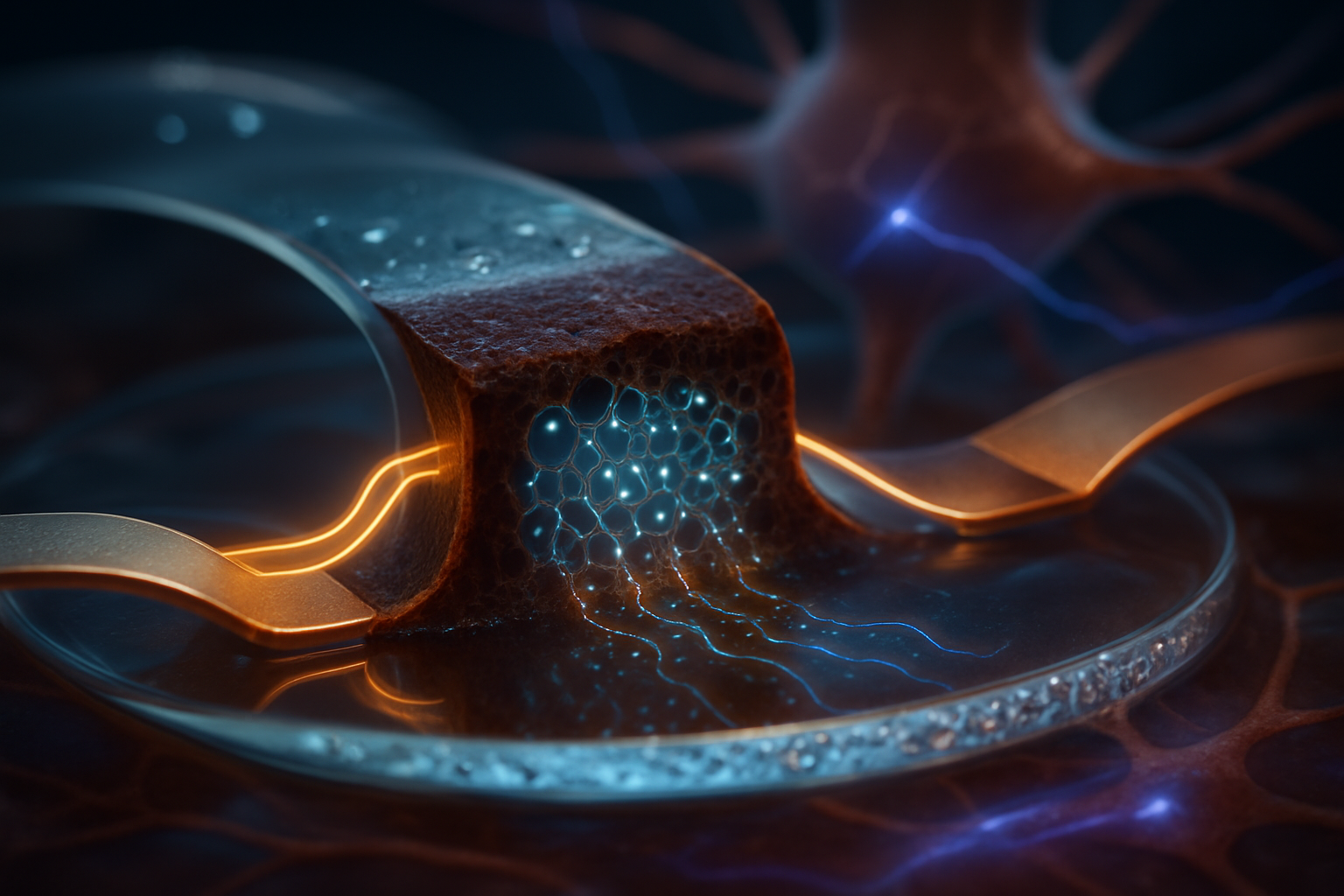
Introduction: Unveiling Melanin's Potential in Bioelectronic Platforms
The exploration into using melanin as a basis for bioelectronic computing originates from its unconventional properties as a pigment famed for light absorption and tissue protection. In biological systems, however, melanin is more than an optically absorbing solid. It is a chemically heterogeneous, redox-active material that can bind metal ions, exchange protons, interact with reactive oxygen species, and alter its electrical behavior in response to hydration and its surrounding ionic environment. These characteristics make it attractive as a possible active material in bioelectronic devices, provided that its chemical complexity can be converted into reproducible engineering performance.
Recent investigations suggest that melanin can function as a chemically active, mixed ionic-electronic conductor. Unlike traditional crystalline semiconductors, melanin does not possess a single sharply defined band structure or a uniform molecular repeat unit. Instead, charge transport is thought to occur through a combination of localized electronic states, redox exchange between quinone-related groups, proton motion, and transport through water-rich regions. Its behavior is therefore strongly influenced by hydration, redox state, pH, ionic strength, counterions, aggregation, and processing history.
This distinction is important. A dry melanin film and a hydrated melanin film should not be treated as the same electrical material under two minor environmental conditions. Hydration can change the dielectric constant, swell the film, alter proton mobility, modify molecular conformations, and facilitate redox reactions. A film equilibrated at 20% relative humidity may exhibit behavior closer to a dry disordered organic solid, whereas a film immersed in buffered saline can behave as a hydrated, ion-accessible electrochemical network. Consequently, any reported conductivity, capacitance, switching speed, or transistor gain must be accompanied by details such as water content, pH, electrolyte composition, film thickness, electrode geometry, and measurement history.
Organic electrochemical transistors (OECTs) offer a significant platform where melanin's potential can be realized. In an OECT, a source electrode and drain electrode define a conducting channel. The channel is in contact with an electrolyte, and a gate electrode applies a potential that drives ions into or out of the channel. Those ions alter the channel's oxidation state and therefore its electronic conductivity. The device translates a relatively small ionic or biochemical event at the gate or electrolyte interface into a measurable drain-current change.
Established channel materials such as PEDOT:PSS capitalize on this mechanism for effective low-voltage operation in aqueous environments. PEDOT:PSS is highly conductive in its oxidized state, and cation ingress can compensate the sulfonate groups of PSS while reducing PEDOT, producing a large change in channel conductivity. Melanin does not necessarily follow this exact mechanism. Depending on its formulation, it may instead combine protonation and deprotonation, quinone/hydroquinone redox exchange, ion binding, and changes in hydration-dependent hopping transport.
Melanin could therefore introduce novel redox chemistry and biological molecular recognition into the device pathway. A pH change might alter protonation of catechol, semiquinone, and quinone-related groups. A metal ion might coordinate to oxygen-containing functional groups and change local charge distribution. An oxidizing species might convert hydroquinone-like moieties into quinones, while a reducing environment could partially reverse that process. Each event could influence channel resistance, capacitance, or transient relaxation.
The central challenge is whether these biochemical advantages can overcome melanin's inherent variability in compositional and electronic performance. The term “melanin” encompasses synthetic eumelanin, natural eumelanin, pheomelanin-containing materials, mixtures of pigment precursors, and formulations containing residual salts, proteins, surfactants, or polymer binders. Two films with the same nominal pigment concentration may differ in particle size, oxidation state, porosity, water uptake, and electrode adhesion. For this reason, melanin-based OECT development is not simply a matter of replacing PEDOT:PSS with a pigment. It requires defining the material, measuring its chemical state, controlling its morphology, and relating those properties to transistor metrics.
If these issues can be addressed, melanin may become useful in chemically adaptive sensors, soft neural interfaces, environmentally responsive circuits, and neuromorphic elements that exploit slow, history-dependent ionic and redox dynamics. At present, however, the most defensible view is that melanin represents a promising research direction rather than a mature transistor technology.
Established Biophysics: Melanin's Dynamic Role as a Conductor
Molecular and Structural Complexity
Eumelanin is characterized as an ensemble of indole-derived units rather than a singular structural entity. Its commonly discussed building blocks include oxidized and partially oxidized forms of 5,6-dihydroxyindole and related indolequinone structures. These units can form stacked or aggregated domains, but the material is neither a perfectly ordered polymer nor a collection of completely isolated molecules. The resulting structure is a disordered ensemble containing chemically distinct sites and a broad distribution of local environments.
Its inherent heterogeneity is evident in the coexistence of quinone, semiquinone, hydroquinone, indole, and indolequinone-like forms. The balance between these forms depends on synthesis conditions, oxygen exposure, pH, illumination, metal ions, and the presence of reducing or oxidizing agents. Semiquinone radicals can contribute to paramagnetic behavior, while quinone/hydroquinone pairs provide a plausible route for reversible or partially reversible redox exchange. The same functional groups can also participate in proton transfer and metal coordination.
This molecular diversity leads to a distribution of electronic states rather than a single well-defined transport level. Charge carriers may become localized on chemically favorable sites and move by thermally activated hopping. In an aggregated film, neighboring aromatic regions may provide short-range electronic coupling, but structural disorder limits the distance over which a carrier can move coherently. The transport picture is therefore more similar to a disordered redox-active network than to a conventional crystalline semiconductor with a simple mobility and band gap.
The performance of melanin is significantly influenced by:
- Eumelanin/pheomelanin ratio: Pheomelanin contains sulfur-containing units and can have different redox behavior, optical absorption, and charge-transfer characteristics from eumelanin.
- Oxidation level: More oxidized material may contain a greater fraction of quinone-like groups, changing electron affinity, proton binding, and redox reversibility.
- Aggregate size: Larger or more densely packed aggregates can improve some electronic pathways while reducing electrolyte penetration.
- Particle morphology: Flakes, nanoparticles, porous coatings, and continuous films present different surface areas and ionic access.
- Counterions and residual synthesis products: Sodium, ammonium, chloride, acetate, and other ions can alter swelling and conductivity.
- Film thickness and drying history: A 100-nm film may equilibrate with water more rapidly than a several-micrometer coating, while slow drying can produce different packing and cracking behavior.
- Mechanical constraint: Flexible substrates, encapsulation layers, or cross-linkers can limit swelling and alter ion transport.
Therefore, “melanin conductivity” is not a fixed attribute but a condition-specific measure. A meaningful report should specify whether conductivity was measured in a dry pellet, a humidity-controlled film, or an immersed electrochemical device. It should also distinguish between electronic conductivity, measured under conditions intended to suppress ionic motion, and total current response, which may include electronic conduction, proton transport, electrolyte leakage, electrode reactions, and capacitive charging.
A useful characterization set would include optical spectroscopy, Raman or infrared measurements, electron paramagnetic resonance for radical content, elemental analysis for sulfur and residual ions, thermogravimetric analysis for water content, and microscopy for morphology. Electrochemical methods such as cyclic voltammetry and electrochemical impedance spectroscopy can then connect chemical state to charge storage and charge-transfer kinetics.
The Impact of Hydration on Charge Transport
Melanin's conductivity under dry and hydrated conditions spans a wide reported range:
[ 10^{-13}\text{ to }10^{-5}\ \mathrm{S,cm^{-1}}. ]
This eight-order-of-magnitude interval should not be interpreted as an intrinsic uncertainty of a single standardized material. It reflects differences in sample preparation, humidity, water activity, electrode configuration, measurement frequency, applied field, and the relative contribution of protonic and electronic processes. A value obtained from a dry pressed pellet at room humidity is not directly comparable with a value measured in a hydrated film under an applied electrochemical bias.
Hydration can influence charge transport through several coupled mechanisms. First, water increases the local dielectric constant and can reduce the electrostatic energy required to separate charges. Second, water molecules and bound hydroxyl groups provide pathways for proton transfer. Third, water enables ions from the electrolyte to penetrate the film and compensate local charge. Fourth, hydration can swell the pigment network, changing intermolecular distances and opening or closing hopping pathways.
Water interfaces form networks that may aid proton hopping, analogous in broad principle to the Grotthuss mechanism. In such a process, a proton does not need to travel as a single hydronium ion over the entire distance. Instead, hydrogen-bond rearrangements transfer proton character between adjacent water molecules and ionizable groups. In melanin, quinone, phenol, carboxyl-like, and other oxygen-containing sites may act as proton donors or acceptors. The exact contribution depends on whether the water is strongly bound to the pigment or exists as a more mobile electrolyte phase.
A simplified acid-base reaction can be represented as:
[ \mathrm{Mel{-}OH \rightleftharpoons Mel{-}O^- + H^+}. ]
The equilibrium depends on local pH and the effective acidity of the site. If a gate voltage or chemical stimulus changes proton activity, the fraction of protonated and deprotonated sites changes. That alteration can influence both the local electrostatic potential and the accessibility of redox states.
Redox exchange can be represented schematically as:
[ \mathrm{Mel{-}Q + 2H^+ + 2e^- \rightleftharpoons Mel{-}QH_2}, ]
where ( \mathrm{Mel{-}Q} ) denotes a quinone-like site and ( \mathrm{Mel{-}QH_2} ) a more reduced hydroquinone-like state. This equation is a simplified chemical representation rather than a complete structural model. Actual melanin contains many coupled sites, and the reaction may be distributed over a range of potentials rather than occurring at one sharp equilibrium potential.
Observed current flows can thus be attributed to several overlapping processes:
- Electronic transport through localized pigment states and aggregated aromatic domains.
- Proton transport through hydrogen-bonded water networks and acid-base sites.
- Ionic conduction through the external electrolyte and hydrated portions of the film.
- Interfacial charge transfer at the source, drain, and gate electrodes.
- Electrochemical reactions involving quinone-like groups, dissolved oxygen, reactive species, or metal ions.
- Double-layer and volumetric charging, in which ions redistribute without necessarily completing a faradaic reaction.
- Water uptake and swelling, which can change film geometry during the measurement itself.
These contributions have different time scales. Electrode double-layer charging may occur in microseconds to milliseconds, depending on geometry and resistance. Ion diffusion through a micrometer-scale film may occur over milliseconds to seconds. Redox-state relaxation and structural reorganization may extend from seconds to minutes. This broad time spectrum is potentially useful for neuromorphic behavior but complicates the interpretation of a simple current transient.
For example, consider a melanin film that shows a current increase after a step in gate voltage. The increase could mean that the film became more electronically conductive. It could also reflect increased ionic strength, a transient capacitive current, enhanced proton mobility, reduction of an insulating oxidized state, or a change in contact resistance caused by swelling. Distinguishing these possibilities requires controls. Useful controls include dry versus hydrated measurements, inert electrolyte versus reactive electrolyte, different gate materials, frequency-dependent impedance, four-terminal conductivity measurements, and repeated voltage sweeps in both directions.
A practical worked comparison illustrates the importance of geometry. Suppose a melanin channel has a length of (100\ \mu\mathrm{m}), width of (1\ \mathrm{mm}), and thickness of (1\ \mu\mathrm{m}). Its cross-sectional area is:
[ A = Wd = (1\times10^{-3}\ \mathrm{m})(1\times10^{-6}\ \mathrm{m}) = 1\times10^{-9}\ \mathrm{m^2}. ]
If its electronic conductivity is (10^{-3}\ \mathrm{S,cm^{-1}}), equivalent to (0.1\ \mathrm{S,m^{-1}}), the approximate channel conductance is:
[ G = \sigma\frac{A}{L} =0.1\frac{1\times10^{-9}}{1\times10^{-4}} =1\times10^{-6}\ \mathrm{S}. ]
At a drain bias of (0.1\ \mathrm{V}), the corresponding current would be approximately (0.1\ \mu\mathrm{A}), assuming ohmic contacts and uniform conductivity. If hydration increases the effective conductivity by three orders of magnitude, the predicted current would rise toward (0.1\ \mathrm{mA}), but only if contacts, morphology, and electrochemical stability permit that increase. This simple estimate shows why reported conductivity cannot be separated from device geometry and measurement state.
Biological Chemical Relevance
Melanin's functionality in bioelectronic devices stems from its interaction with biologically relevant chemistry. As a medium, it can participate in oxidative stress pathways, bind metal ions, interact with catecholamine-related molecules, and respond to proton activity. These interactions may establish melanin as a chemically active sensing layer rather than merely a passive conductor.
Metal binding is particularly relevant. Oxygen-containing groups can coordinate ions such as iron, copper, zinc, and other transition metals. Coordination may alter local electronic states, stabilize specific oxidation states, or change the density of mobile ions. A metal-binding event could therefore produce a transistor signal through several routes: modification of channel conductivity, a shift in redox potential, altered protonation, or a change in interfacial capacitance.
The same chemical reactivity can introduce liabilities. Redox-active materials may undergo irreversible oxidation, generate reactive intermediates, or exhibit response drift as binding sites become occupied. A sensor that responds to both pH and metal concentration may have high sensitivity but poor selectivity unless the device includes a recognition layer, differential reference channel, or calibration model.
Biological occurrence does not automatically guarantee device safety. Melanin in skin, hair, eye, and other tissues exists within cellular, protein, lipid, and extracellular environments with particular particle sizes and biochemical controls. A processed synthetic pigment film may contain residual monomers, salts, solvents, cross-linkers, or nanoparticles with a different biological fate. Compatibility therefore requires separate evaluation of cytotoxicity, inflammatory signaling, degradation products, ion release, and mechanical stability.
An effective OECT requires more than chemical responsiveness. It also requires adequate charge transport, low operational hysteresis, stable channel-electrode contacts, predictable gate leakage, mechanical integrity, and repeatable operation in electrolytes. Melanin holds theoretical promise in each area but requires systematic benchmarking. Measurements should include:
- On/off or modulation ratio under defined gate and drain biases.
- Transconductance (g_m = \partial I_D/\partial V_G).
- Threshold or turn-on voltage, with a clear definition for disordered channels.
- Response and recovery times.
- Hysteresis between forward and reverse gate sweeps.
- Drift over hours or days in physiological electrolyte.
- Cycling endurance, such as current retention after (10^3) to (10^5) gate pulses.
- Gate leakage and electrochemical side reactions.
- Performance after bending, swelling, drying, and rehydration.
Operational Dynamics of a Melanin OECT
Fundamental Principles of OECTs
Within an OECT, defined pathways between source and drain facilitate electronic current through the channel. The electrolyte provides the ionic pathway, and the gate electrode controls the electrochemical potential of the system. A voltage between gate and source drives ionic redistribution, while the drain-source voltage establishes the channel current.
In a simplified model, the drain current in the linear regime can be approximated by:
[ I_D \approx \mu C^* \frac{W d}{L} \left[(V_G-V_T)V_D-\frac{V_D^2}{2}\right], ]
where:
- (\mu) is the effective electronic mobility,
- (C^*) is the volumetric capacitance,
- (W) is channel width,
- (d) is channel thickness,
- (L) is channel length,
- (V_T) is an effective threshold voltage,
- (V_G) is the gate potential relative to source,
- (V_D) is the drain potential.
This equation is most reliable for a relatively uniform, reversible channel. Melanin may depart from these assumptions because its mobility can depend on hydration and redox state, its volumetric capacitance may be distributed over many chemical sites, and its response may not be governed by a single threshold voltage.
The transconductance in the linear regime is approximately:
[ g_m=\frac{\partial I_D}{\partial V_G} \approx \mu C^* \frac{W d}{L}V_D. ]
This relationship explains why volumetric capacitance is important. A large (C^*) allows a given gate voltage to modulate a large amount of channel charge. However, capacitance alone does not guarantee high transconductance. If ions enter efficiently but the resulting redox or electrostatic change does not strongly affect electronic conductivity, the device may store charge without providing substantial amplification.
Melanin introduces an additional layer of operational complexity. Its channel can respond to protonic and electronic changes simultaneously. A gate pulse may:
- Drive cations or anions into the hydrated film.
- Change the protonation state of pigment functional groups.
- Shift the local redox equilibrium.
- Alter the population of semiquinone-like states.
- Change water content and swelling.
- Modify electronic hopping distances and barriers.
- Produce a transient followed by a slower chemical relaxation.
The observed drain current is consequently a convolution of electrostatic gating, ionic transport, redox chemistry, and morphology.
Device polarity must also be established experimentally. A melanin channel may show increased or decreased conductivity when the gate potential is made more positive, depending on the dominant carrier type, the chemical state of the film, the gate electrode, and the electrolyte. It is therefore unsafe to assume that a melanin OECT will behave exactly like a conventional p-type PEDOT:PSS device.
Importance of Volumetric Capacitance
A high volumetric capacitance in OECTs means that substantial charge alterations occur throughout the channel, not just at the surface. In a thin electrical double-layer device, the gate effect is largely confined to an interface. In an OECT, ions can penetrate the bulk of the channel, allowing the entire film volume to participate in electrochemical switching.
For a rough scale estimate, an effective volumetric capacitance of (10\ \mathrm{F,cm^{-3}}) in a film volume of (10^{-7}\ \mathrm{cm^3}) would correspond to a capacitance of:
[ C = C^*V =10\ \mathrm{F,cm^{-3}}\times10^{-7}\ \mathrm{cm^3} =1\ \mu\mathrm{F}. ]
A (100\ \mathrm{mV}) gate perturbation would then involve a charge scale of:
[ Q=CV=(1\ \mu\mathrm{F})(0.1\ \mathrm{V})=0.1\ \mu\mathrm{C}, ]
provided that the capacitance remains approximately constant over that voltage range. This is an illustrative calculation, not a universal melanin value. In a real film, the measured capacitance may include electrolyte double-layer contributions, parasitic capacitances, redox pseudocapacitance, and frequency-dependent ion motion.
Melanin may exhibit substantial pseudocapacitance because quinone-like groups can undergo proton-coupled electron transfer. Such charge storage can be advantageous: the channel may respond strongly to small gate perturbations and retain a chemical memory of previous stimulation. It can also be problematic. Faradaic processes may produce hysteresis, drift, incomplete recovery, or irreversible chemical transformation. A high low-frequency capacitance may therefore coexist with a relatively slow response.
Frequency-dependent impedance can help separate these effects. A nearly ideal capacitor produces a phase angle near (-90^\circ), whereas faradaic charge transfer introduces resistive and diffusion-related components. A hydrated disordered melanin film may show several characteristic regimes: a high-frequency response dominated by electrode interfaces, an intermediate-frequency response associated with ion penetration and film resistance, and a low-frequency response reflecting redox or diffusion processes.
A useful design tradeoff follows. Increasing film thickness increases the active volume and potentially the total transconductance, but it also increases the ionic diffusion length. If the characteristic ion diffusion time is approximated as:
[ \tau \sim \frac{d^2}{D_{\mathrm{ion}}}, ]
then doubling thickness increases the diffusion time by roughly a factor of four. For a (1\ \mu\mathrm{m}) film and an effective ion diffusivity of (10^{-10}\ \mathrm{m^2,s^{-1}}), the estimate is:
[ \tau \sim \frac{(10^{-6})^2}{10^{-10}} =10^{-2}\ \mathrm{s}, ]
or approximately (10\ \mathrm{ms}). If the effective diffusivity falls to (10^{-12}\ \mathrm{m^2,s^{-1}}) because ions are strongly bound or the film is poorly hydrated, the corresponding time becomes approximately (1\ \mathrm{s}). This difference separates a potentially useful signal-processing element from a device unsuitable for fast recording.
Benchmarking Performance
Current benchmarks for OECTs harnessing aqueous environments include transconductance levels from:
[ 10^{-4}\text{–}10^{-2}\ \mathrm{S}. ]
These values serve as comparative standards against which melanin's potential integration would be measured. They are not universal pass-fail thresholds because transconductance depends strongly on channel dimensions, film thickness, drain bias, electrolyte, gate area, and the definition of the operating regime. A large-area device can produce a larger absolute (g_m) than a microscale device without having superior intrinsic material properties.
For a fair comparison, melanin and reference devices should use matched:
- Channel length, width, and thickness.
- Gate and drain electrode materials.
- Electrolyte identity, concentration, and pH.
- Gate and drain voltage ranges.
- Measurement temperature and hydration time.
- Sweep rate and preconditioning protocol.
- Encapsulation and substrate.
- Channel-volume normalization.
Suppose a melanin device has (W=1\ \mathrm{mm}), (L=100\ \mu\mathrm{m}), (d=1\ \mu\mathrm{m}), (V_D=0.1\ \mathrm{V}), and an effective product (\mu C^*=0.01\ \mathrm{S,cm^{-1},V^{-1}}) expressed in a consistent device model. The estimated transconductance would scale with (WdV_D/L). If the channel is made ten times wider, (g_m) should increase approximately tenfold in the ideal linear regime. If the measured increase is much smaller, contact resistance, nonuniform hydration, or electrolyte access may be limiting the device.
Performance should also be assessed through transfer and output curves. A transfer curve plots (I_D) versus (V_G) at a fixed (V_D), while an output curve plots (I_D) versus (V_D) at several gate voltages. Important features include current saturation, leakage, hysteresis, threshold shifts, and whether the response is reversible. Measurements should be repeated at multiple sweep rates, for example (1), (10), and (100\ \mathrm{mV,s^{-1}}). A strong dependence on sweep rate indicates that ion transport or chemical equilibration is controlling the response.
Transient measurements are equally important. A gate-voltage step can reveal a rapid current component followed by a slower relaxation. The response may be fit empirically with one or more time constants:
[ I_D(t)=I_\infty+\sum_i A_i e^{-t/\tau_i}. ]
The presence of several ( \tau_i ) values would be consistent with multiple processes, such as interfacial charging, ion diffusion, and redox equilibration. Such fitting should not be taken as proof of a particular mechanism, but it can provide a compact comparison between formulations.
Research into melanin-based transistors must account for complex permeability, mechanical properties, and electronic pathways while maintaining consistent operation over time. Porosity may increase ion access but reduce mechanical strength. Cross-linking may improve film stability but suppress hydration and lower capacitance. Incorporating a conductive polymer may improve current output but make it difficult to assign the response specifically to melanin. These tradeoffs should be reported explicitly rather than treated as secondary fabrication details.
Applications and Future Directions: Sensing and Neuromorphic Systems
Potential in Biosensing
Melanin's inherent chemical properties present promising opportunities for sensors capable of detecting pH variations, reactive species, and metal ions. A pH-responsive melanin channel could operate by converting protonation-dependent changes into drain-current modulation. If a melanin site has an effective acid-base equilibrium in the relevant pH range, a change from pH 7.4 to pH 6.4 would represent approximately a tenfold increase in proton activity. The resulting current change would depend on the density of responsive sites and how strongly protonation affects electronic transport.
A chemically responsive OECT might be configured in several ways. Melanin could serve as the primary channel, as a thin sensing layer coupled to a separate conductive channel, or as a gate coating that modulates the electrolyte potential. Each arrangement separates chemical recognition and electronic amplification differently. A gate-functionalized architecture may reduce the need for melanin to carry the full source-drain current, while a channel architecture may provide stronger volumetric coupling between chemistry and conductance.
Reactive oxygen species detection is another possibility. Oxidants may convert reduced pigment sites into quinone-like states, producing a conductance shift or a change in redox capacitance. The difficulty is selectivity: dissolved oxygen, peroxide, light, metal ions, and electrode reactions may all influence the same redox network. Appropriate controls should include oxygen-free and oxygenated electrolytes, antioxidant or scavenger controls, inert channel materials, and independent chemical measurements.
Metal-ion sensing faces a similar issue. Binding may change the channel response, but pH, ionic strength, and competing ligands can produce comparable signals. Selectivity could be improved through chelating overlays, molecularly imprinted layers, aptamers, or differential arrays containing melanin variants with different binding profiles. A practical sensor would likely need temperature and pH reference channels because melanin's hydration and redox response can drift with both variables.
Advancements in Neural Interfaces
OECT technology has demonstrated the ability to record and amplify biological signals in aqueous environments, including signals relevant to neural and cardiac activity. The attraction comes from the high ionic-electronic coupling of OECTs, their low operating voltages, and their compatibility with soft, conformable substrates. Neural signals may range from tens of microvolts to several millivolts depending on whether the device records extracellular field potentials, local field potentials, or larger evoked responses. A useful interface must combine low noise, stable electrode potential, mechanical compliance, and minimal tissue disruption.
Melanin could potentially enhance such applications by providing a soft, hydrated, chemically interactive interface. Its proton and redox sensitivity might allow a device to monitor local biochemical changes in addition to electrical activity. For example, a neural interface could attempt simultaneous measurement of electrical signals and local shifts in pH or oxidative state following stimulation. This would be scientifically valuable because neural activity is accompanied by changes in ion concentration, metabolism, and redox balance.
However, melanin's responsiveness could also become a source of recording artifact. Variations in tissue hydration, oxygen tension, inflammatory chemistry, and electrode polarization might shift the transistor baseline independently of neural activity. A stable neural device would therefore require calibration, reference channels, shielding from optical stimulation if the material is light-sensitive, and careful separation of fast electrical signals from slower chemical drift.
Long-term compatibility remains unverified for many processed melanin formulations. Required studies include cytotoxicity assays, neuronal viability, glial activation, inflammatory cytokines, tissue histology, electrochemical impedance, delamination, and degradation over implantation-relevant periods. Sterilization must also be considered: heat, radiation, plasma, and chemical sterilants can alter melanin oxidation state or film morphology.
Potential for Neuromorphic Behaviors
OECTs can mimic synaptic memory and response patterns, a desirable characteristic for neuromorphic computing. In a biological synapse, the effect of an input depends on recent activity. A similar history dependence can arise in an OECT because ions enter and leave the channel over finite time scales. A brief gate pulse may cause a transient conductance change, while repeated pulses can accumulate ionic or redox changes.
Melanin's rich chemical dynamics could provide several internal state variables:
- Protonation state.
- Quinone/hydroquinone balance.
- Semiquinone radical population.
- Bound metal-ion concentration.
- Hydration level.
- Local ionic composition.
- Aggregation or swelling state.
A single device may therefore exhibit short-term plasticity, long-term conductance drift, paired-pulse effects, or multiple relaxation times. For example, two gate pulses separated by (100\ \mathrm{ms}) might produce a larger second response if residual ions or reduced sites remain from the first pulse. If the interval is increased to (10\ \mathrm{s}), the response may return closer to baseline. The ratio of the second to first response, often called a paired-pulse facilitation ratio, could provide a simple measure of short-term memory.
Such behavior is potentially useful for temporal pattern recognition. A melanin OECT array might respond differently to a rapid sequence of chemical or electrical inputs than to isolated events, allowing preprocessing at the sensor rather than transmitting every raw signal to a digital processor. The same dynamics create challenges for deterministic computing. Device-to-device variability, baseline drift, and dependence on prehistory must be characterized and incorporated into circuit models.
Hypothetical Experimentation
A proposed experiment leverages melanin's unique properties within an OECT platform to explore responses to environmental conditions and chemical exposure. A rigorous study would begin with at least two melanin formulations, such as a synthetic eumelanin prepared under controlled oxidation conditions and a second formulation with altered aggregation or cross-linking. A conventional OECT material, such as PEDOT:PSS, could serve as a reference, while an inert or non-redox-active organic film could help identify purely capacitive effects.
The device geometry should be reported in full. For example, one could use channels with (L=50\text{–}200\ \mu\mathrm{m}), (W=0.5\text{–}2\ \mathrm{mm}), and thicknesses of (100\ \mathrm{nm}) to (2\ \mu\mathrm{m}). Devices would be equilibrated in a defined electrolyte, such as a buffered saline solution, for a fixed period before measurement. The electrolyte pH could then be varied incrementally, for example from pH 5.5 to pH 8.0, while holding ionic strength approximately constant. This separation is important because changing pH by adding acid or base can also change total salt concentration and conductivity.
For each condition, researchers would record:
- Transfer curves at a fixed drain bias.
- Output curves at several gate potentials.
- Gate leakage current.
- Current response to gate-voltage steps.
- Electrochemical impedance over a frequency range.
- Recovery after returning to the reference electrolyte.
- Spectroscopic or chemical measurements before and after exposure.
A worked pH-response protocol could use ten-minute equilibration periods at pH 5.5, 6.5, 7.4, and 8.0, followed by a standard (100\ \mathrm{mV}) gate pulse. If the drain current changes from (1.0\ \mu\mathrm{A}) at pH 7.4 to (1.8\ \mu\mathrm{A}) at pH 6.5, the normalized response is:
[ \frac{\Delta I_D}{I_{D,0}} =\frac{1.8-1.0}{1.0}=0.8, ]
or an 80% increase. That value alone is not sufficient to establish pH selectivity. The same experiment should determine whether the response is reversible, whether it persists after a return to pH 7.4, and whether a similar current change occurs when ionic strength is changed without changing pH.
Hydration can be tested by measuring the same device after controlled drying and rehydration. Relative humidity might be stepped through values such as 20%, 50%, and 90%, followed by immersion in electrolyte. Film mass, thickness, impedance, and drain current should be measured where possible. If the current increases rapidly after hydration but the transistor response continues evolving over several minutes, the data may indicate a fast water-access effect followed by slower ion diffusion or redox equilibration.
Chemical exposures should include concentration series rather than single challenge doses. For a metal-ion study, concentrations might span nanomolar to micromolar or micromolar to millimolar ranges depending on the intended application and the expected sensitivity. Controls should include an equivalent concentration of an inert salt, competing metal ions, and a chelator-recovery experiment. A response that disappears when the metal is removed would support reversible binding; a persistent shift could indicate irreversible oxidation, strong coordination, or morphological damage.
Electrical characterization should be complemented by chemical analysis. Raman or infrared spectra could track changes in quinone-related vibrations, while electron paramagnetic resonance could assess radical populations. X-ray photoelectron spectroscopy could compare oxidation and elemental composition before and after exposure, although measurements must account for possible changes during drying or vacuum transfer.
Finally, the study should include repeated devices from independent batches. A credible initial data set might contain at least (n=5\text{–}10) devices per formulation and condition, with results reported as individual points rather than only averages. Batch-to-batch variation is itself an important result because a sensor material that has excellent mean sensitivity but a 50% coefficient of variation may be less useful than a less sensitive but highly reproducible material.
Unraveling Mechanisms: Challenges and "What If" Scenarios
Core Charge-Transport Mechanisms
Uncertainties persist in identifying melanin's primary charge-transport pathways. Proton and electron hopping schemes offer plausible explanations for the complex behavior observed under different hydration and redox conditions, yet definitive mechanistic models require further empirical support.
Several mechanisms may coexist. In electronic hopping, a carrier moves between localized states with a rate that can often be described qualitatively by thermally activated behavior:
[ \sigma(T)\propto \exp\left(-\frac{E_a}{k_BT}\right), ]
where (E_a) is an effective activation energy. A strong temperature dependence would support a thermally activated process, although it would not by itself distinguish electronic hopping from some ionic processes.
Proton conduction may show different dependence on humidity and isotope substitution. Replacing ordinary water with heavy water can alter hydrogen-bond dynamics and proton-transfer kinetics. Comparing ( \mathrm{H_2O} ) and ( \mathrm{D_2O} ) could therefore help estimate the role of proton motion. Similarly, blocking redox reactions with carefully selected potential windows or inert atmospheres could help separate faradaic contributions from purely ionic charging.
Frequency-dependent impedance, isotope experiments, four-terminal measurements, temperature sweeps, and electrochemical quartz crystal microbalance measurements could be combined to determine whether current changes are associated with charge movement, mass uptake, or both. No single measurement is likely to resolve the mechanism because the pigment is intrinsically coupled to its hydration and chemical environment.
Overcoming Obstacles in Material Processing
Consistency in the preparation of melanin remains necessary to mitigate batch variability. Standardized conditions should be established from synthesis through device assembly. Relevant variables include precursor identity, oxidant concentration, reaction time, pH, temperature, oxygen exposure, purification method, drying temperature, milling energy, particle-size distribution, binder content, and film-annealing history.
A useful materials specification would record:
- Average particle diameter and distribution.
- Film thickness and roughness.
- Water uptake at defined humidity.
- Elemental composition, particularly sulfur and residual counterions.
- Radical concentration or another oxidation-state proxy.
- Electrochemical charge-storage capacity.
- Adhesion and swelling ratio.
- Conductivity measured under at least two hydration states.
Processing strategies may involve blending melanin with a conductive polymer, embedding particles in a hydrogel, incorporating a cross-linking network, or creating multilayer films. Each strategy changes the interpretation of the device. A conductive-polymer composite may provide the main electronic pathway while melanin supplies chemical sensitivity. A hydrogel may improve electrolyte access but increase response time and mechanical fragility. Cross-linking may improve longevity but decrease the free volume available for ions.
The key requirement is to report composition and morphology quantitatively. “Melanin composite” is insufficient without the pigment mass fraction, polymer identity, solvent, drying protocol, and film thickness. Otherwise, apparent improvements may arise from changes in the supporting matrix rather than from melanin itself.
Longevity and Safety Considerations
A critical assessment of processed melanin mandates comprehensive evaluation from in vitro testing to in vivo stability. In vitro experiments should examine cell viability, membrane integrity, oxidative stress, inflammatory signaling, and any response to leached material. If the device is intended for neural use, neuronal and glial cell models should be considered separately because a material can be relatively benign to neurons yet activate glial cells.
Electrochemical aging should be performed under realistic bias conditions rather than only by storing devices at open circuit. A device might be held at repeated gate pulses, continuous drain bias, or alternating polarization for thousands of cycles while monitoring current, impedance, leakage, and chemical composition. For an implantable device, the electrolyte should approximate relevant ionic composition, temperature, and oxygen exposure. Mechanical tests should include bending, stretching where relevant, and swelling-deswelling cycles.
Potential degradation pathways include pigment oxidation, dissolution of low-molecular-weight components, particle detachment, metal-ion accumulation, electrode corrosion, and changes in porosity. Encapsulation may suppress some pathways while introducing others, such as reduced ion access or altered oxygen transport.
Safety also includes electrical safety. Low-voltage operation does not automatically mean low electrochemical risk. Local electrode potentials must remain within a window that avoids substantial water electrolysis, gas formation, harmful pH excursions, or uncontrolled production of reactive species. Gate leakage and charge per phase should be measured, particularly for neural applications.
Exploratory Potential: Melanin's Computational Capabilities
What if melanin's responsive behavior enabled real-time biochemical sensing and dynamic response in hybrid systems? Melanin's incorporation could open avenues for hybrid devices uniting the amplification of conventional OECTs with the chemical responsiveness of a redox-active pigment.
One possible architecture would use melanin as a chemically responsive interfacial layer and a separate high-mobility organic semiconductor as the main current-carrying channel. In that configuration, melanin would not need to provide all the electronic conductivity. It would instead modulate the local electrochemical potential, capacitance, or ion distribution seen by the active channel. This approach could preserve transistor performance while exploiting melanin's molecular interactions.
A second architecture would use melanin as the channel but add an ion-conducting hydrogel and a stable reference gate. The hydrogel could control hydration and reduce mechanical cracking, while the reference gate could improve potential stability in biological fluids. A third approach would create arrays of melanin formulations, each with a different oxidation state or binding chemistry. Pattern recognition could then distinguish pH, metal ions, and oxidative stress from their multidimensional response patterns rather than relying on a single current value.
The computational advantage would come from physical dynamics. If each device retains partial information about recent inputs through protonation, redox state, or hydration, an array could perform temporal filtering directly in matter. However, this possibility must be demonstrated with quantitative tasks, such as classifying pulse sequences, detecting chemical transients, or implementing short-term memory under controlled noise. Claims of neuromorphic computation should be supported by repeatable input-output benchmarks, retention measurements, cycle-to-cycle variability, and comparison with conventional OECT devices.
In conclusion, the utility of melanin within bioelectronics remains a field ripe for exploration. Its integration into present technology must be backed by rigorous study focused on reproducibility, safety, mechanism, and capability. The most productive development path may not be to demand that melanin immediately replace established conductive polymers. Instead, melanin could first be used where its chemical activity provides a distinct advantage, while complementary materials supply mechanical reinforcement, ionic control, or high electronic conductivity.
Key Takeaways: Insights and Future Exploration
Resolved: Melanin's role as a redox-active, hydrous biological pigment reflects diverse charge transport with potential applications in sensitive bioelectronic devices. Its conductivity and charge-storage behavior can change by many orders of magnitude across dry, humid, and immersed conditions. Protonation, redox exchange, metal binding, aggregation, and water uptake offer plausible mechanisms for coupling biochemical events to electrical signals.
Resolved: OECTs provide a logical device framework because they intentionally couple ionic motion to electronic current. Their low-voltage aqueous operation, volumetric gating, and intrinsic transconductance can amplify the relatively small chemical changes occurring in a melanin layer.
Unresolved: Despite these advantages, melanin has not yet matched the performance standards set by traditional OECT materials in terms of reproducibility, conductivity, response speed, operational stability, and standardized device metrics. The broad reported conductivity range of (10^{-13}) to (10^{-5}\ \mathrm{S,cm^{-1}}) illustrates the dependence on environmental and processing conditions rather than a single intrinsic material value.
Unresolved: The dominant charge carrier and transport mechanism under particular operating conditions remain difficult to define. Electronic hopping, proton transfer, ionic diffusion, interfacial charging, and faradaic redox reactions may all contribute to the measured response. Mechanistic studies must therefore combine electrical, electrochemical, spectroscopic, and structural measurements.
Priority for future work: Materials should be synthesized and processed under standardized, fully reported conditions. Device studies should use matched geometries and electrolytes, include conventional OECT controls, report individual-device variability, and measure hysteresis, drift, leakage, response time, recovery, and cycling endurance.
Priority for biological translation: Compatibility must be established for the actual processed formulation rather than inferred from the existence of melanin in native tissue. Long-term studies should examine degradation, leaching, inflammation, electrode stability, sterilization effects, and performance in realistic biological environments.
The path forward involves elucidating charge-transport mechanisms, enhancing processing uniformity, and systematically verifying potential within operating devices under relevant biological conditions. Melanin may ultimately function as a primary transistor channel, a chemically active interlayer, a gate-sensing material, or a component of a composite neuromorphic system. Its value will depend on demonstrating a reproducible property that conventional materials cannot easily provide—not merely on showing that it can conduct under selected laboratory conditions.
Related Research
- Eumelanin vs. Pheomelanin: Structural Differences and Their Biophysical Outcomes
- [Melanin as a Biological Semiconductor: Bridging Quantum Physics and Cellular Biology](/articles/melanin-as-a-biological-semiconductor-bridging-quantum-physics-and-cellular-biology-1786976946135)
- Deep-Sea Melanin: Harnessing the Potential of Pigment in the Abyss