Introduction: The Conundrum of Melanin in Photobiomodulation
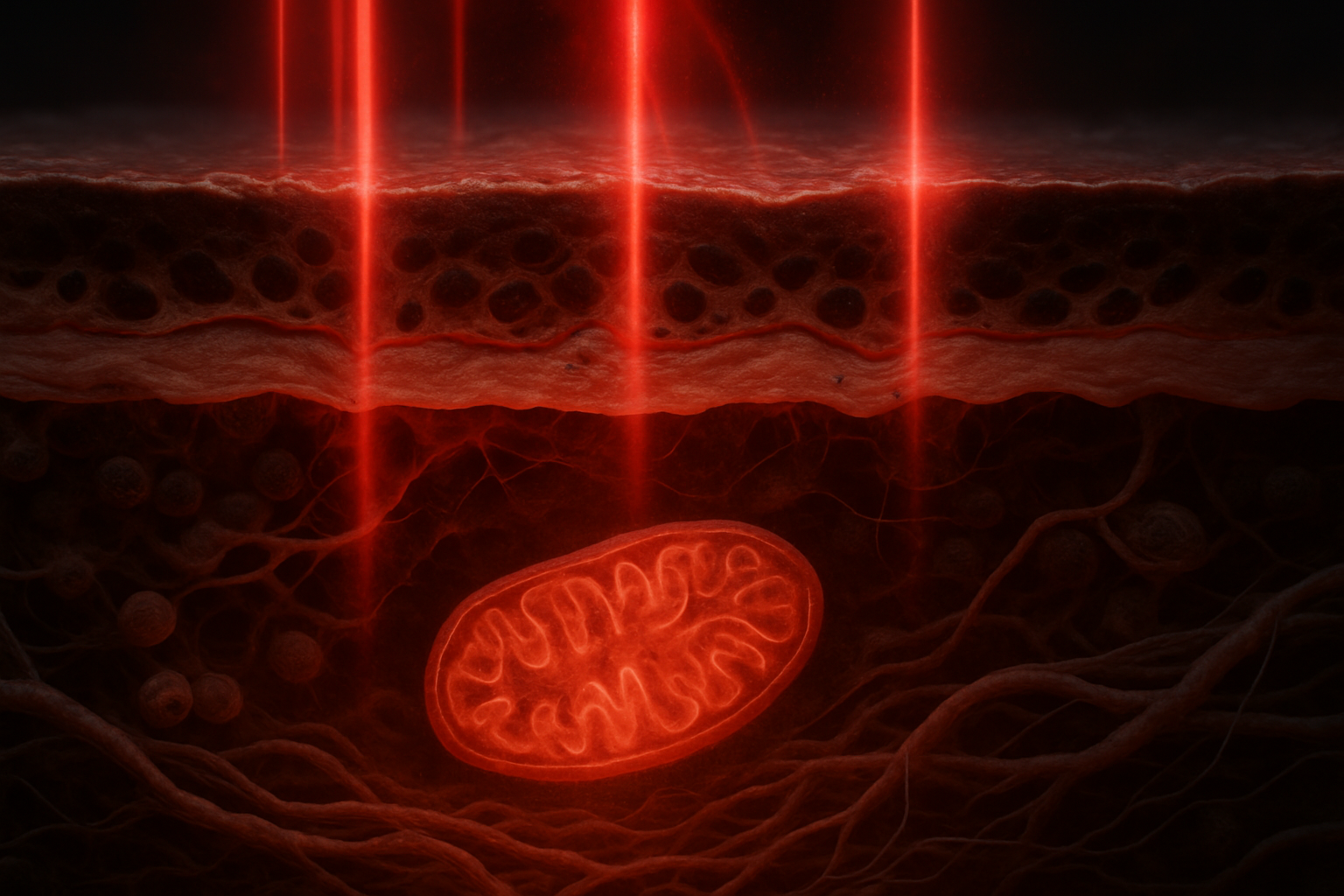
Photobiomodulation (PBM) employs red or near-infrared (NIR) light to modulate cellular mechanisms, including metabolism, redox state, and signaling pathways. The descriptive bands, Red (approximately 600–700 nm) and NIR (approximately 700–1100 nm), illustrate regions where light can engage with mitochondrial, membrane-associated, or other intracellular chromophores. However, in melanin-rich tissues, the surface-applied dose does not equate to the dose received by the target biological structures like mitochondria, fibroblasts, nerves, or muscle cells. The presence of Melanin alters the path of photons, absorbing and redistributing them, which can lead to a miscalculation of the available fluence at the subsurface targets.
This position necessitates the differentiation of two scientific inquiries: first, the influence of melanin on photon transport, absorption, scattering, and thermal dynamics; second, melanin's potential role in directly mediating PBM signaling rather than acting solely as an optical medium. While the established literature supports cytochrome c oxidase (CCO) as a central photoacceptor in PBM, it distinctly separates melanin from being a primary PBM chromophore. The Quantum Melanin Research Foundation (QMRF) upholds the distinction between optical modulation by melanin and active participation in cellular signaling as critical to fostering deeper understanding.
This discourse will analyze established PBM principles, the role of melanin in light transport and thermal disturbances, and explore experimental propositions and hypotheses within defined mechanistic boundaries.
Established PBM Biophysics: From Light Absorption to Cellular Response
Wavelength, Irradiance, and Fluence: Foundational Considerations
Clarity in PBM requires precise definitions of wavelength, irradiance, and fluence:
- Wavelength directs photon energy, defining which molecules absorb the light and the extent of tissue modulation.
- Irradiance refers to the power delivered per unit area.
- Fluence denotes the cumulative energy imparted over the exposure timeline.
These parameters are interconnected yet distinct. Identical fluences at varying irradiances and durations can result in diverse biological outcomes. Similarly, a constant irradiance applied over different durations can produce varying fluences. The essential factor influencing biological response may be the pattern of light reaching the target cells, as seen in the variant effects across different tissues within the red and NIR ranges.
Cytochrome c Oxidase: A Major, Yet Not Sole, Photoacceptor
Cytochrome c oxidase (CCO) remains the primary candidate as a photoacceptor for red and NIR PBM. Investigations, as compiled in reviews such as Red/near-infrared irradiation therapy for treatment of central nervous system injuries and disorders and Photobiomodulation in fibroblasts: from light to healing through molecular pathways, omics and artificial intelligence, showcase the interaction of photons with mitochondrial chromophores altering cellular respiration and signaling pathways.
Rather than directly inducing ATP production, photon absorption can modulate respiratory activities, electron transport, and the interplay among ATP, reactive oxygen species (ROS), and reactive nitrogen species (RNS). These molecules act as secondary messengers, influencing transcription, inflammatory responses, and survival mechanisms within cellular thresholds. However, CCO's dominance varies with wavelength, fluence, tissue oxygenation, and cellular metabolism; other mitochondrial proteins may also engage, with CCO's prominence not being universally applicable across all scenarios.
Secondary Signaling Effects: Beyond Immediate Energy Production
Photo-induced mitochondrial changes propagate through redox-sensitive transcriptional modulation, inflammatory signals, and repair facilitations, particularly pertinent in fibroblasts through extracellular matrix coordination, wound healing, and cellular adaptations. The research outlined in the review Photobiomodulation in fibroblasts: from light to healing through molecular pathways, omics and artificial intelligence elaborates on PBM’s ability to stimulate biological networks from molecular to tissue levels, affirming its potential but requiring further empirical exploration for definitive conclusions.
Biphasic and Non-Linear Dose Responses: The Complexity in PBM
PBM's inherent biphasic dose response describes its complexity; sub-optimal doses may yield negligible effects, while optimal ones evoke the desired response, surpassing which may become inhibitory. This non-linearity introduces significant implications for pigmented tissues. Melanin's interference with photon penetration suggests that simply boosting the incident fluence may fail to optimize the subsurface cellular dose or risk heightened thermal absorption at the surface, complicating treatment strategies in melanin-dense environments.
Melanin as an Optical Mediator in PBM
Broadband Absorption and Wavelength Dependence
Melanin serves as a broadband absorber, with peak intensity at shorter wavelengths which diminishes toward the longer, NIR ranges. Shorter wavelengths confront stronger melanin-based attenuation, potentially restraining deeper photon propagation and altering localized thermal dynamics. While longer NIR wavelengths might experience improved transmission, efficacy cannot be inferred without considering tissue scattering, water absorption, target depth, and cellular response to absorption. The review, Unlocking the Power of Light on the Skin: A Comprehensive Review on Photobiomodulation, illuminates these complex interactions, underscoring the delicate balance of optical properties and biological requirements.
Fluence Loss and Photon Transmittance to Target Cells
The disparity between incident fluence versus cellular fluence underlines PBM studies, especially in melanin-rich tissues. Surface fluence does not guarantee matched cellular reach, necessitating careful calibration. Without a validated model for pigmentation-specific correction, research must account for separate influences—pigment concentration, depth, scattering, wavelength, among others—to reliably determine effective fluence at cellular targets.
Scattering and Illumination Geometry Considerations
Apart from melanin, tissue scattering and structure significantly impact photon pathways, extending travel lengths and diversify irradiance distribution. Variations in epidermal and dermal thickness, contact dynamics, beam geometry, coupled with wavelength-specific absorption (e.g., water absorption in NIR), dictate the effective penetration and dispersion of photons, challenging uniform PBM applications across anatomically and compositionally different tissues.
Non-uniform Energy Deposition and Experimental Variables
Melanin-rich surfaces may disproportionately absorb incident energy, creating a complex topography of energy deposition with differential impacts on deeper layers versus surface responses. Thus, whole-tissue responses observed in these settings demand a nuanced understanding of spatial dose variation, demanding experimental designs that isolate specific cellular responses from overarching thermal inputs or compensatory signaling networks.
Photochemical Versus Photothermal Implications in Pigmented Tissues
Distinguishing Photochemical Signaling from Thermal Effects
Photochemical PBM involves molecular interaction and signaling modulation, while Photothermal effects emerge from heat generated by absorbed light. Melanin’s broadband absorption characteristics can skew outcomes towards thermal rather than photochemical without precise control and attribution of observed effects, underscoring the importance of experimental rigor.
Surface Heating as a Potential Confounder
Surface heating from melanin absorption is a potential confounding variable in PBM results. Variability in temperature resulting from local energy deposition necessitates monitoring and reporting alongside exposure metrics, including wavelength, irradiance, and fluence, to discern true PBM effects versus thermal artifacts. Such methodological transparency remains critical to scientific integrity and the reliability of extrapolated results.
Evaluating Longer NIR Wavelengths in PBM
While reduced melanin absorption in NIR wavelengths might favor transmission, it does not inherently assure superior PBM performance. NIR also encounters other optical properties, including varying scattering and water absorption phenomena, which complicates unequivocal conclusions about its relative benefit without comprehensive integration of wavelength-specific dynamics and biological interaction.
Innovative Experimental Approaches for Mechanism Elucidation
Effective experimentation extends beyond mere exposure standardization. Utilizing designs with explicit controls for temperature calibration, matched cellular fluence, and comparative optical modeling across pigmentation levels can elucidate distinctions between pigmentation’s filtering capacity and direct biological interactivity. Metrics including sub-surface target assessments and intact tissue validations should be prioritized.
Forward-Looking Perspectives on PBM and Melanin
The Current Understanding: Melanin as Optical Modifier
Current paradigms recognize melanin as a mediator that molds PBM’s optical behaviour, adjusting photon delivery and possibly impacting superficial and sub-surface thermal profiles without inherently constituting a primary photochemical actor. This nuanced position underlines the significance of integrating melanin’s absorptive effects into a comprehensive understanding of tissue-specific PBM dynamics.
Inquiry into Melanin’s Direct Signaling Potential
While yet unresolved, melanin’s potential direct involvement in signaling remains a consideration, stimulating hypotheses pertaining to photon absorption, redox processes, and inter-cellular signaling conduits. Controlled experimental dissections of these possibilities are integral to advancing knowledge in this domain.
Toward Individualized PBM Dosing: A Vision of Precision
Recognizing pigmentation’s role in photon modulation advances the hypothetical promise of individualized PBM dosing through comprehensive integration of melanin metrics, optical properties, and clear definition of target fluence. A sophisticated framework promising accurate recalibrated dosing models remains a visionary research direction waiting further corroboration.
Optimizing PBM for Tissue-Specific Applications
Enhancing PBM's precision could eventually tailor interventions to specific tissues considering pigmentation, target depth, and cellular type. Such pursuits necessitate robust computational models, variables mapping, and clinical validations—a challenging yet ambitious horizon for PBM strategy optimization.
Key Insights for Strategic Advancement
PBM’s overarching narrative as a photochemical-intervention leveraging mitochondrial photoacceptors highlights cytochrome c oxidase. Not constrained to narrow wavelength prescriptions, understanding PBM necessitates recognizing melanin’s absorptive influence and non-linear responses dictating individualized protocols. The distinction between melanin's physical filtering and potential biochemical engagement underscores an agenda for future exploration fostered by the Quantum Melanin Research Foundation’s ongoing pioneering efforts.
Related Research
- Proton Tunneling in Melanin: Implications for Biological Energy Storage and Transfer
- [Melanin as a Biological Semiconductor: Bridging Quantum Physics and Cellular Biology](/articles/melanin-as-a-biological-semiconductor-bridging-quantum-physics-and-cellular-biology-1788964204587)
- Photobiomodulation and Melanin: How Red and Near-Infrared Light Interact with Melanin-Rich Tissues
References
- Melinda Fitzgerald, Stuart I. Hodgetts, Corinna van den Heuvel. "Red/near-infrared irradiation therapy for treatment of central nervous system injuries and disorders." Reviews in the Neurosciences. 2013. doi:10.1515/revneuro-2012-0086
- María Luisa Hernández‐Bule, Jorge Naharro‐Rodríguez, Stefano Bacci. "Unlocking the Power of Light on the Skin: A Comprehensive Review on Photobiomodulation." International Journal of Molecular Sciences. 2024. doi:10.3390/ijms25084483
- Paweł Repetowski, Marta Warszyńska, J. Dąbrowski. "NIR-activated multifunctional agents for the combined application in cancer imaging and therapy." Advances in Colloid and Interface Science. 2024. doi:10.1016/j.cis.2024.103356
- Sarassunta Ucci, Eugenio Caradonna, Anna Aliberti. "Photobiomodulation in fibroblasts: from light to healing through molecular pathways, omics and artificial intelligence." Frontiers in Bioengineering and Biotechnology. 2025. doi:10.3389/fbioe.2025.1675619