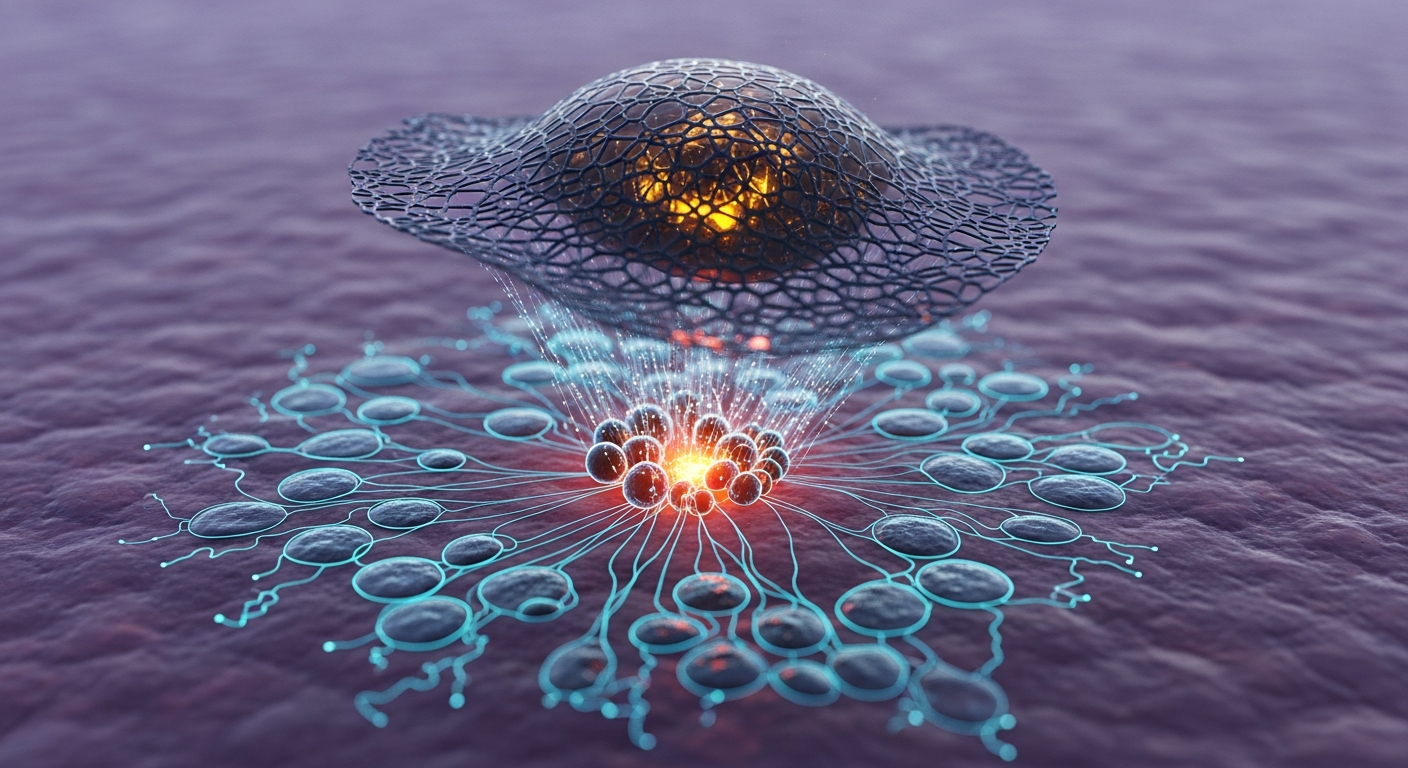
Before a mass is palpable, before a tumor is visible on a scan, and even before genetic mutations trigger uncontrolled physical proliferation, a cell fundamentally changes its electrical language. Normal, healthy tissue exists in a state of bioelectric harmony, constantly communicating through specific ionic gradients. But when a cell begins the transition toward malignancy, it electrically isolates itself. The voltage across its membrane collapses, dropping from a highly polarized, communicative state to a depolarized, isolated one. This localized bioelectric shift is arguably the earliest physically detectable signature of oncogenesis.
The challenge in modern oncology is not merely treating cancer, but detecting it when it is just a whisper—an aberrant electrical spark in an otherwise healthy tissue network. To "listen" to this biological electrical shift, we require materials that can seamlessly bridge the gap between biological ionic signals and readable electronic data. What if the ideal material for this task is already synthesized by the human body? What if melanin, an organic semiconductor capable of conducting both protons and electrons, could be engineered into a highly sensitive, biocompatible transducer to detect the precise bioelectric anomalies that precede cancer?
The Science We Know
To understand this speculative application, we must first look at two well-established, independent domains of biophysics: the bioelectricity of cancer and the solid-state physics of melanin.
Extensive research, most notably pioneered by Michael Levin and colleagues at Tufts University, has demonstrated that the resting membrane potential ($V_{mem}$) of a cell dictates its proliferation and differentiation state. Healthy somatic cells maintain a highly polarized $V_{mem}$, typically ranging from -70mV to -90mV. This resting potential is maintained by the rigorous pumping of ions (such as sodium, potassium, and chloride) across the cell membrane. In contrast, cancer cells consistently exhibit a depolarized $V_{mem}$, usually hovering between -10mV and -20mV. This depolarization acts as a biophysical switch, decoupling the cell from the bioelectric network of the surrounding tissue and reverting it to a highly proliferative, embryonic-like state.
Simultaneously, the biophysical characterization of melanin—specifically eumelanin, the brown-black biopolymer—has revealed it to be far more than a simple photoprotective pigment. In 1974, John McGinness and colleagues published a landmark paper in Science demonstrating that melanin acts as an amorphous semiconductor switch. Modern research by physical chemists such as Paul Meredith and Albertus Mostert has mapped precisely how this works. Eumelanin possesses a broad optical absorption spectrum and a semiconductor bandgap of approximately 1.85 eV.
Crucially, melanin is a mixed conductor. Its electrical conductivity is not driven purely by electrons, as in standard metals, but relies on proton-coupled electron transfer (PCET). Furthermore, its conductivity is extraordinarily sensitive to its environment. As melanin absorbs water, its conductivity increases by up to ten orders of magnitude. The local concentration of ions and the presence of external electric fields directly modulate the structural and electronic state of the melanin polymer, specifically its stable free radical concentration, which is readily detectable via electron paramagnetic resonance (EPR) spectroscopy.
The Possibility
If oncogenesis begins with a persistent shift in local bioelectricity (the collapse of $V_{mem}$), and eumelanin's conductivity is highly responsive to local electrical fields and ionic gradients, then we can envision a novel class of diagnostic devices. We can hypothesize the development of melanin-based organic electrochemical transistors (OECTs) deployed as wearable or implantable bio-monitors.
In an electronic transistor, a "gate" voltage controls the flow of current between a "source" and a "drain." In a melanin-based biological OECT, the biological tissue itself would act as the gate.
Imagine an ultra-thin, biocompatible hydrogel patch integrated with synthesized eumelanin polymers, placed on the skin to monitor for melanoma, or implanted locally in high-risk tissues (such as breast tissue in patients with BRCA mutations). Because melanin naturally bridges ionic (biological) and electronic (digital) conductivity, the melanin sensor would sit silently in the tissue, maintaining a baseline conductivity profile shaped by the healthy -70mV electrical environment.
If a cluster of cells begins to depolarize toward -20mV, the local flux of potassium and sodium ions—and the resulting shift in the micro-electric field—would alter the hydration dynamics and proton conductivity within the adjacent melanin sensor matrix. The semiconductor bandgap would flex, and the proton-coupled electron transfer rate would shift. This alteration in the melanin matrix would instantly transduce the invisible biological depolarization into a measurable change in electronic resistance, transmitting a warning signal weeks or months before a physical tumor aggregates.
Because melanin is native to the human body, it bypasses one of the greatest hurdles in continuous internal monitoring: the foreign body response. Traditional metallic or synthetic sensors trigger immune attacks and fibrotic encapsulation, which eventually deafen the sensor to biological signals. A melanin-based interface, however, presents itself to the immune system as endogenous biological material, theoretically allowing for long-term, uncompromised signal transduction.
Challenges and Unknowns
While the foundational biophysics are sound, constructing a melanin bio-transducer of this sensitivity presents immense technical barriers.
The primary challenge is the signal-to-noise ratio. The human body is a spectacularly noisy electrical environment. Skeletal muscle contractions, baseline nerve action potentials, and even standard cellular metabolic fluctuations create local electrical fields. Isolating a steady -50mV direct current (DC) shift from a microscopic cluster of pre-cancerous cells against the roaring background of natural biological electricity requires sophisticated signal filtering that does not currently exist for organic biomaterials.
Furthermore, melanin's greatest asset—its extreme sensitivity to hydration—is also its greatest engineering liability. Because water concentration dictates melanin's conductivity so aggressively, normal physiological changes in tissue hydration (due to exercise, diet, or localized inflammation) could easily register as false positives, mimicking the conductivity shifts we would expect from oncogenic depolarization.
Finally, there is the challenge of the material itself. Natural melanin is notoriously heterogeneous, forming highly disordered, insoluble aggregates that are difficult to process into uniform electronic components. While progress is being made in synthesizing standardized polydopamine and DHICA-melanin analogs, creating a stable, standardized melanin thin-film that behaves identically across thousands of manufactured biosensors remains an ongoing challenge in organic electronics.
The Path Forward
To translate this speculative framework into a functional diagnostic tool, cross-disciplinary research between quantum biology, oncology, and materials science is required. The immediate next steps involve strictly controlled in vitro experimentation.
First, researchers must systematically map the real-time electrical response of synthetic eumelanin films to specific biological voltage gradients. This requires building microfluidic chambers where melanin interfaces with cell cultures that are artificially forced into depolarized states using ion channel blockers, allowing scientists to measure exactly how the melanin conductivity curve responds to a shift from -70mV to -20mV.
Second, the development of hydration-locked melanin composites is necessary. Materials scientists must engineer melanin-hydrogel matrices that maintain a stable internal hydration state while remaining permeable to external electric fields and specific ionic fluxes.
By leveraging the precise biophysical mechanisms of one of biology's most ancient macromolecules, we may be able to eavesdrop on the electrical whispers of cellular mutiny. Melanin is not simply a biological shield against radiation; it is a highly sophisticated, environmentally responsive semiconductor. By learning to read how melanin reacts to local bioelectric fields, we may unlock an entirely new frontier of prophylactic oncology.
Key Takeaways
- Cancer initiation is heavily correlated with a localized bioelectric shift; normal cells maintain a resting membrane potential of roughly -70mV to -90mV, while cancer cells depolarize to roughly -20mV.
- Eumelanin functions as an amorphous, mixed-conductor semiconductor, utilizing proton-coupled electron transfer (PCET) to conduct charge in a highly hydration- and field-responsive manner.
- Speculative Application: Melanin's mixed ionic-electronic conductivity makes it an ideal candidate for organic electrochemical transistors (OECTs) capable of transducing pre-malignant biological voltage shifts into readable digital data.
- Speculative Application: As an endogenous material, melanin-based sensors could theoretically evade the foreign-body immune response, allowing for long-term implantation in high-risk tissues without fibrotic encapsulation.
- A major unresolved technical challenge is distinguishing the bioelectric signal of early cellular depolarization from the profound conductivity changes melanin experiences due to normal physiological fluctuations in tissue hydration.
References
Chernet, B., & Levin, M. "Transmembrane voltage potential is an essential cellular parameter for the detection and control of tumor development." Disease Models & Mechanisms 6(3), 595-607 (2013). DOI: 10.1242/dmm.010835
D'Ischia, M., Wakamatsu, K., Cito, A., Fronza, G., Pezzella, A., & Ito, S. "Melanins and melanogenesis: from pigment cells to human health and technological applications." Pigment Cell & Melanoma Research 28(5), 520-544 (2015). DOI: 10.1111/pcmr.12393
McGinness, J., Corry, P., & Proctor, P. "Amorphous semiconductor switching in melanins." Science 183(4127), 853-855 (1974). DOI: 10.1126/science.183.4127.853
Meredith, P., & Sarna, T. "The physical and chemical properties of eumelanin." Pigment Cell Research 19(6), 572-594 (2006). DOI: 10.1111/j.1600-0749.2006.00345.x
Mostert, A. B., Powell, B. J., Pratt, F. L., Hanson, G. R., Sarna, T., Gentle, I. R., & Meredith, P. "Role of water in the solid-state electrical conductivity of melanin." Proceedings of the National Academy of Sciences 109(23), 8943-8947 (2012). DOI: 10.1073/pnas.1119948109
Pezzella, A., Barra, M., Musto, A., Navarra, A., Alfè, M., Manini, P., ... & D'Ischia, M. "Stemming in-film properties of eumelanin-like materials by structural tailoring: the DHI/DHICA copolymer route." Materials Horizons 2(2), 212-220 (2015). DOI: 10.1039/C4MH00174K