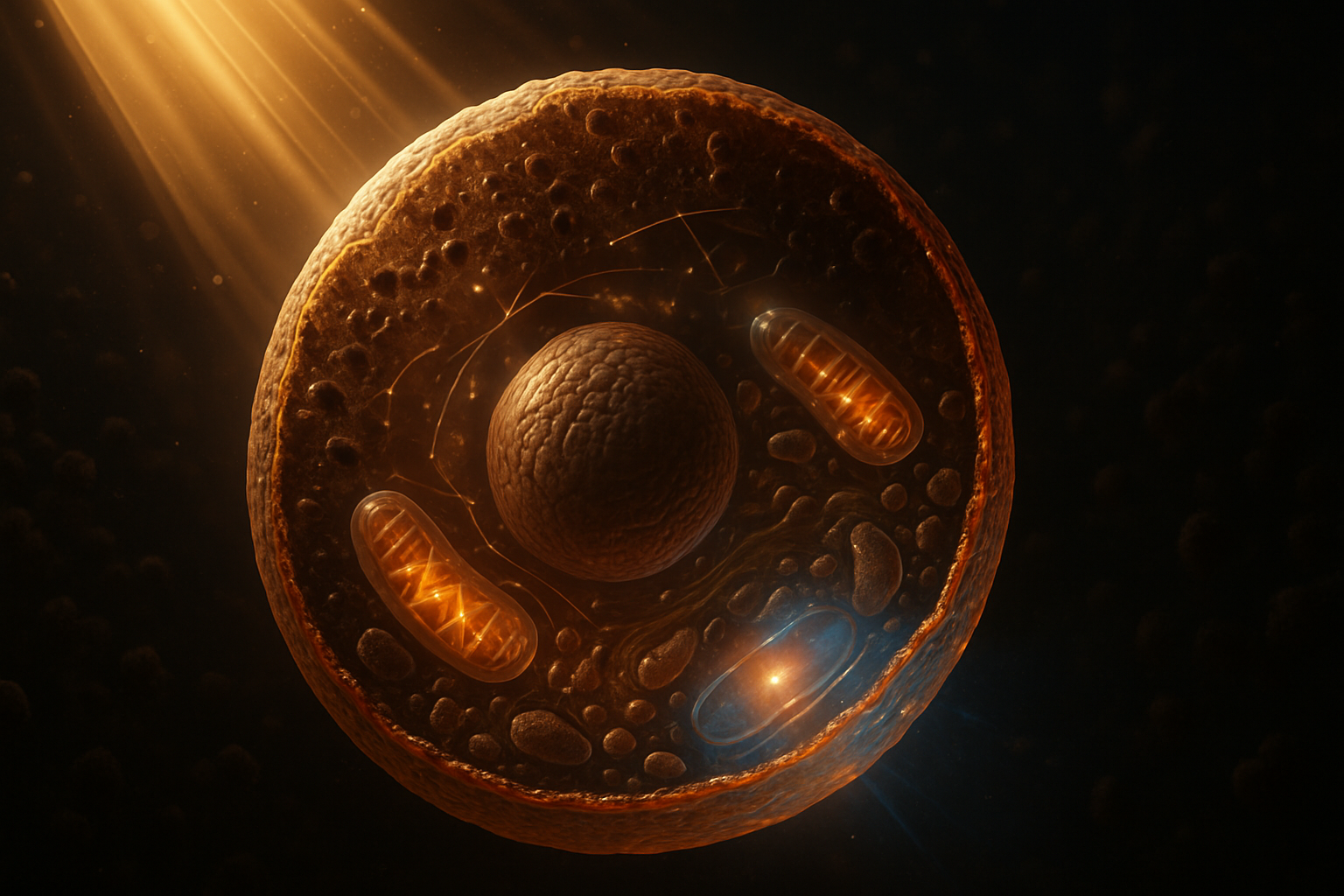
Unveiling the Potential of Melanin
Melanin Is Not a Human Chloroplast
The notion that melanin, a pigment known primarily for its photoprotective capabilities, could also engage in energy conversion akin to photosynthesis in human cells is a tantalizing prospect. Could melanin not only absorb sunlight but convert it into a usable energy source, enhancing cellular ATP production?
While the question is intriguing, it is essential to distinguish between different scientific phenomena. Light absorption is not equivalent to photosynthesis. Similarly, photoconductivity is not synonymous with ATP production. Understanding the mechanics requires acknowledging that a transient photocurrent in melanin does not translate into sustained electron transfer within human metabolic processes. Photosynthesis involves a highly organized system that integrates photon capture with charge separation, redox reactions, proton gradient formation, and enzymatic phosphorylation.
Current evidence categorizes human melanin differently. Known for its broadband absorption capabilities from ultraviolet to visible light, eumelanin is chemically heterogeneous, showcasing redox activity and electronic, ionic, and protonic transport behaviors. However, the energy absorbed tends to rapidly dissipate as molecular vibrations and heat. This characteristic is crucial to melanin's role in photoprotection, with no significant evidence linking it to water splitting, oxygen evolution, or ATP synthesis in human cells.
To explore these possibilities, this article takes a two-pronged approach. We first delve into the known optical and physical properties of melanin, then extend the investigation to a speculative engineering perspective: Could a melanin-containing biohybrid system enable photosynthesis-like energy production? The primary question isn’t about melanin's interaction with light — it undoubtedly does. Instead, it’s about whether melanin can facilitate stable, directional, and metabolic energy conversion under physiological conditions.
The Quantum Melanin Research Foundation addresses this as a cutting-edge biophysics inquiry, identifying the molecular architecture necessary to transform an intriguing pigment into a viable energy-conversion system.
Understanding Melanin’s Light Absorption and Heat Production
The Mechanics of Broadband Absorption
Eumelanin's optical properties are unlike those of highly purified chromophores with distinct absorption peaks; instead, it exhibits a wide, featureless spectrum. This arises from a mix of different oxidized and reduced indole units, quinone-like structures, oligomer fragments, and aggregates, each with unique electronic environments.
Consider eumelanin as a disordered molecular semiconductor or redox polymer rather than a uniform dye. Chemical and structural disorder creates a spectrum capable of absorbing a vast range of wavelengths, offering superior photoprotection by capturing potentially damaging ultraviolet photons over a broad spectral region.
This intrinsic nature differs from chlorophyll-based photosynthesis, where pigments are precisely arranged to guide electron transfer. In eumelanin, broad absorption alone does not indicate an organized reaction center capable of driving biochemical energy processes.
From Photon Absorption to Heat
Upon absorbing light, eumelanin’s electronically excited state relaxes remarkably fast — within (10^{-13}) to (10^{-12}) seconds. The energy pathway is straightforward:
[ \text{photon} \rightarrow \text{excited melanin} \rightarrow \text{internal conversion} \rightarrow \text{molecular vibration and heat} ]
This process, known as internal conversion, transitions electronic excitation to vibrational modes, dissipating energy as heat without forming long-lived charge carriers. Such rapid relaxation is advantageous for photoprotection, as it minimizes chances for harmful photochemical reactions.
However, for photosynthesis-like processes, which rely on trapping and utilizing photon energy, this rapid dissipation presents a significant hurdle. A system optimized for instant energy conversion into heat is not automatically suited for energy storage as ATP or other chemical forms.
Beyond Optical Measurement Limitations
An absorption spectrum alone verifies an interaction with light but doesn’t validate the underlying mechanisms necessary for energy conversion, such as:
- Persistent charge separation
- Targeted electron transfer
- Oxidative and reductive cycles
- Gradients for energetic coupling
- Specific outputs like ATP or reduced equivalents
Physical documentation of melanin’s absorption and dissipation (e.g., studies by Tran and Meredith) underlines its robust optical properties, though these do not establish a photosynthesis-like capability.
Melanin: An Electrical Enigma, Not an Energy System
Electrical and Redox Properties
Melanin behaves as a semiconductor, not just a pigment. Initial work, dating back to McGinness et al., reported semiconducting and switching behavior in melanin films, with conductivity varying dramatically depending on its state: hydration, pH, oxidation, and more.
Different mechanisms appear to contribute to its electrical profile, including electronic hopping, proton conduction, and ionic transport, with hydrated samples behaving distinctly from their dry counterparts. Such complexity complicates interpreting photocurrent measurements as simple photogenerated electron flows.
Challenges in Charge Transport
The interplay of mechanisms such as electronic hopping, proton conduction, ionic transport, redox mediation, and interfacial effects underscores melanin’s scientific value in bioelectronics. However, it challenges the notion of sustained energy conversion as required for metabolic purposes.
To propel metabolism, photon-induced charge must be stable, spatially separated, and directed towards specific molecular targets. Melanin's amorphous structure provides various states that trap charges, extending lifetime but potentially immobilizing functionality, thus not constituting a useful energy form.
Melanin’s redox properties allow interactions with various exogenous and endogenous compounds, from oxygen to metal ions. This functionality could both inhibit and facilitate oxidative stress, depending on cellular or environmental contexts.
Photosynthesis Blueprint: From Photon to ATP
Photosynthesis is an intricate sequence of molecular operations, achieving:
- Photon absorption
- Charge separation
- Electron transport along carriers
- Water oxidation
- Gradient formation
- ATP synthesis
- Reductant formation for carbon cycles
Water Splitting and Charge Compensation
Water oxidation is a multi-faceted reaction:
[ 2H_2O \rightarrow O_2 + 4H^+ + 4e^- ]
Requiring a potential over (1.23\ \text{V}) and sophisticated catalytic environments (like Photosystem II's manganese–calcium complex), no melanin-only water-splitting mechanism has met scientific validation. Arguing for melanin-derived water splitting demands rigorous testing, ensuring mechanisms align with observable outputs detached from artifacts or spurious chemical effects.
ATP Synthase as a Decoupling Challenge
Even successful photochemical electron generation offers no direct ATP synthesis pathway. ATP synthase operates on electrochemical gradients, not raw charge. For melanin-based systems, maintaining a stable proton gradient and coupling it to ATP generation requires elaborate compartmentalization and control—far beyond current capabilities in standalone melanin deployment.
Envisioning the Future: Engineering with Melanin
Conceptualizing a Biohybrid Module
Imagining a biohybrid system, melanin would integrate into engineered frameworks — not existing freely within cells. Potential designs encompass membrane-bound systems, vesicles, or nanostructures, merging melanin’s optical roles with specialized components like:
- Light absorbers
- Electron acceptors/donors
- Redox enzymes and catalysts
- Proton-conducting elements
- ATP-generating assemblages
The challenge lies in overcoming melanin’s rapid energy dissipation trait. Solutions might include organizing pigment domains to increase charge separation or leveraging its proton-coupled transport abilities.
Alternatives to Full Photosystem Imitation
Initial iterations could bypass full water splitting, instead utilizing external redox pairs or metabolic intermediates, emphasizing controlled electron transfers over autonomous photosynthesis. This approach is manageable but doesn’t invoke spontaneous solar energy assimilation.
Case Study: Constructing a Melanin–Vesicle Prototype
Imagine an engineered experiment with keratinocytes introduces melanin-invested vesicles laden with ATP synthase and a quinone electron acceptor. Monitoring under controlled illumination assesses:
- Photophysical properties
- Membrane dynamics
- Proton activity
- Metabolic shifts
- Reactive oxygen detection
Mechanical validation would involve specific controls: ATP production coupled with photovoltage rather than metabolic side effects. By dissecting performances like oxygen fluctuations, false signals are mitigated.
Realistic Energy Expectations
At conventional irradiance levels, gleaning effective energy yields considers many constraints. Scenarios foresee efficiency advances reaching 0.1% to 10%, impacting cellular energetics comparably to basal metabolic demands, albeit with considerable adverse checks: overheating, oxidant imbalance, or cellular stress must be mitigated.
Realizing viable metabolic augmentation from melanin-centered modules would require unprecedented efficiency, safety, and physiological impact validation—marking current findings as the groundwork for expansive later developments.
Conclusion: Navigating Melanin's Biophysical Landscape
The analysis affirms melanin’s significant role as a broad-spectrum light absorber, underpinning photoprotection but not energy storage. Though its conductivity and redox versatility contribute critical values in technology, they do not testify to naturalized ATP synthesis.
Photosynthetic apparatuses necessitate rigorous and organized interplay between reactions, demanding redox capacity beyond melanin’s innate traits. Consequently, the most pragmatic path lies within synthetic biology and engineered interventions, exploring melanin under artificial components rather than attempting direct chloroplastic equivalency.
For the Quantum Melanin Research Foundation, the endeavor doesn't lie in prematurely claiming melanin's photosynthetic potential but in pioneering methodologies that may, one day, form the cornerstone of sustainable energy sourcing inside the human framework.
Related Research
- The Evolutionary Significance of Melanin: Why Nature’s Most Ancient Pigment Persists Across All Kingdoms of Life
- Eumelanin vs Pheomelanin: Structural Differences and Their Biophysical Consequences
- What If Melanin Could Create Electronics That Heal Themselves?
References
- McGinness, J. E.; Corry, P.; Proctor, P. “Amorphous Semiconductor Switching in Melanin.” Science 183, 853–855 (1974). doi:10.1126/science.183.4127.853
- Tran, M. L.; Powell, B. J.; Meredith, P. “Chemical and Structural Disorder in Eumelanins: A Possible Explanation for Broadband Absorption.” Biophysical Journal 90, 743–752 (2006). doi:10.1529/biophysj.105.069096
- Meredith, P.; Sarna, T. “The Physical and Chemical Properties of Eumelanin.” Pigment Cell Research 19, 572–594 (2006). doi:10.1111/j.1600-0749.2006.00345.x
- d’Ischia, M. et al. “Melanins and Melanogenesis: From Pigment Cells to Human Health and Technological Applications.” Pigment Cell & Melanoma Research 28, 520–544 (2015). doi:10.1111/pcmr.12393
- Blankenship, R. E. et al. “Comparing Photosynthetic and Photovoltaic Efficiencies and Recognizing the Potential for Improvement.” Science 332, 805–809 (2011). doi:10.1126/science.1200165