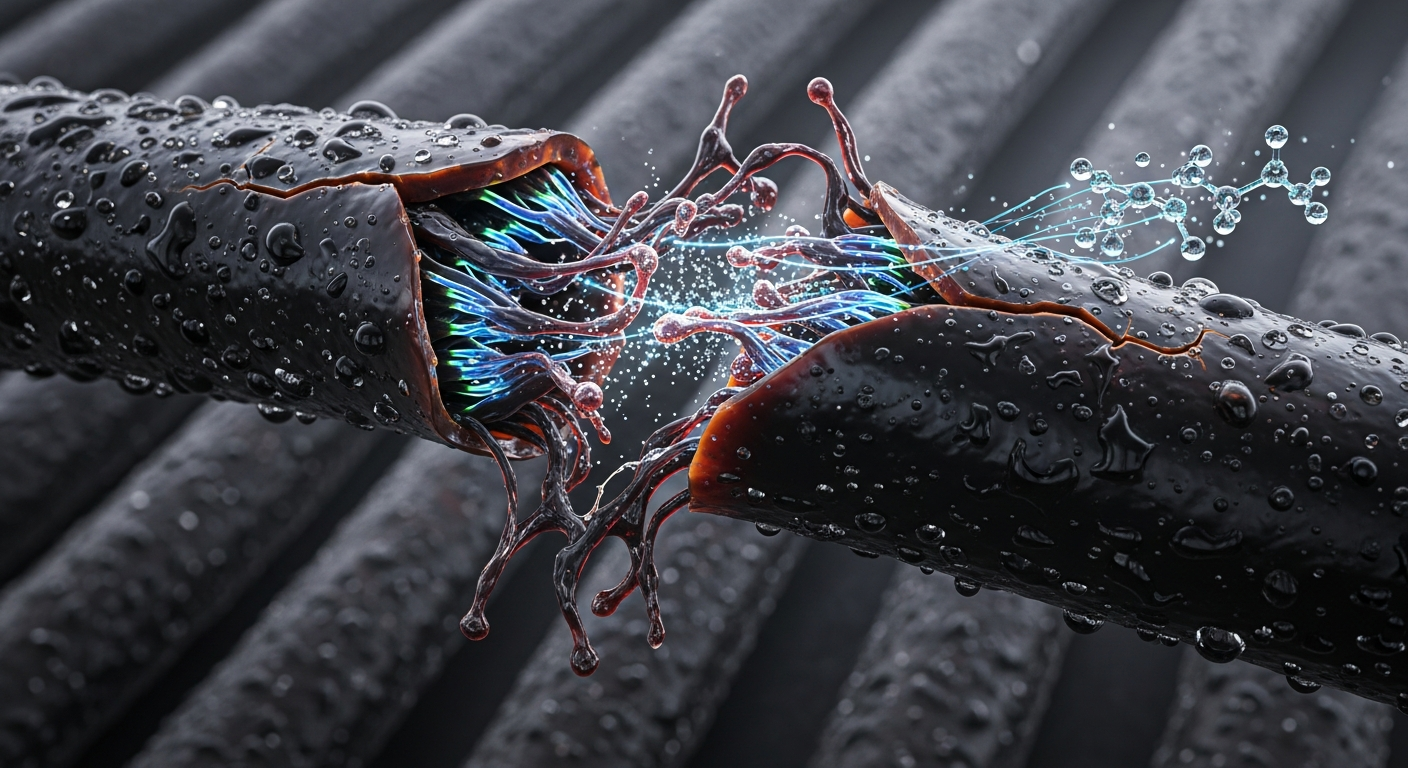
What if the crack in your smartphone screen could heal itself overnight, not just cosmetically, but functionally, reconnecting the delicate circuits beneath? Our modern world is built on a paradox: incredibly sophisticated technology that is profoundly fragile. A single drop can shatter a device, rendering it obsolete and contributing to a growing mountain of electronic waste. Biology, in contrast, has mastered the art of resilience. From a cut that scabs and heals to a bone that mends, living systems continuously repair and regenerate. What if we could bridge this gap, creating technology that mimics biology's capacity for self-repair? The key may lie within one of life's most ancient and enigmatic molecules: melanin.
This is not science fiction, but a line of inquiry grounded in the known biophysics of this remarkable family of polymers. For too long, melanin has been viewed simply as a pigment. But decades of research have revealed a far more complex reality. Melanin is an electroactive, semi-conductive, self-assembling material that sits at the interface of chemistry, physics, and biology. By understanding its fundamental properties, we can begin to ask a compelling question: could the very molecule that protects our skin from the sun one day form the basis of a truly sustainable, self-healing electronic future?
The Science We Know
To entertain this possibility, we must first appreciate what has been established in the peer-reviewed literature. The journey from pigment to functional material began in earnest in the 1970s. Research by John McGinness and his colleagues at the University of Texas demonstrated that melanin is not a simple insulator, as one might expect from a biological polymer, but an amorphous semiconductor. In a landmark 1974 paper in Science, they reported that solid, dehydrated eumelanin exhibited threshold switching behavior—a hallmark of semiconductor devices—transitioning from a high-resistance "off" state to a low-resistance "on" state when a specific voltage was applied.
Since then, our understanding has deepened considerably. We now know that eumelanin, the most common form of melanin in humans, possesses a modest electronic band gap of approximately 1.6-1.9 electron volts (eV), placing it firmly in the category of organic semiconductors. This property is central to its ability to absorb a vast spectrum of electromagnetic energy, from ultraviolet light to near-infrared, and convert that energy into heat with near-perfect efficiency.
Critically, melanin's electrical properties are not static. They are profoundly influenced by its hydration state. As documented by Paul Meredith, an applied physicist at Swansea University, and his collaborators, the conductivity of eumelanin can increase by several orders of magnitude as it absorbs water. This is because melanin is a hybrid conductor, capable of transporting both electrons (like copper wires) and ions, specifically protons (H+ ions), which are the currency of many biological energy systems. Water molecules create pathways for protons to hop through the polymer matrix, dramatically enhancing its overall conductivity. This hydration-dependent electronic character is a vital clue, suggesting a mechanism by which a local environment could modulate a material's function.
Furthermore, melanin is a self-assembling polymer. Its basic chemical precursors, such as the amino acid derivative L-DOPA, can spontaneously polymerize into the complex, cross-linked structure of melanin under simple, aqueous conditions. In biology, this process is constant, as melanocytes in the skin continuously produce and regenerate melanin granules. This innate capacity for synthesis and regeneration from simple building blocks is the final, essential piece of the scientific puzzle we need to consider.
The Possibility
With these established facts, we can construct a plausible, albeit speculative, pathway toward self-healing electronics. The logic proceeds as follows:
- If a material is a semiconductor, it can be used to form the basis of electronic components like wires, resistors, and transistors.
- If that material can be spontaneously assembled from simple, stable precursor molecules in a liquid medium, then it possesses the raw ingredients for regeneration.
- And if that material's assembly and electronic properties can be influenced by local physical conditions (such as hydration and electrical fields), then a mechanism for directed, functional repair becomes conceivable.
Melanin satisfies all three conditions. Imagine a flexible electronic device where the conductive pathways are not etched from metal, but are composed of a melanin-based composite, held within a hydrated polymer gel. Now, imagine a micro-fracture severs one of these pathways, creating an open circuit.
In a conventional device, this is a fatal flaw. But in our hypothetical melanin-based system, the break would create a new set of local conditions. The electrical potential difference across the gap would be significant. This localized electrical field, much like the endogenous fields that guide wound healing in organisms, could become the trigger for repair. Precursor molecules (e.g., DHICA, a key eumelanin building block) embedded in the surrounding gel could be electrophoretically drawn to the gap. There, catalyzed by the local pH and ionic environment, they would begin to polymerize, literally growing a new melanin bridge across the fracture.
Because the new material is chemically and functionally identical to the original, the repair would not be a simple patch; it would be a true regeneration of the electronic pathway. The hydration-dependent nature of melanin's conductivity is key here: the gel matrix provides the necessary water to facilitate the polymerization and ensure the final, healed material is in its high-conductivity state. This process is a direct biomimicry of tissue regeneration, translated from the language of cells and proteins to the language of polymers and electrons.
Challenges and Unknowns
This vision, while compelling, is far from reality. The scientific and engineering hurdles are formidable, and acknowledging them is essential for maintaining intellectual discipline.
First, there is the challenge of precision and control. Biological healing is guided by a complex symphony of genetic and bioelectric cues. How could we direct melanin polymerization to reform a circuit trace just 50 nanometers wide, without it simply forming an uncontrolled blob that shorts out adjacent components? Directed self-assembly at this scale is one of the most significant challenges in materials science. Perhaps patterned electrical fields or chemical gradients could provide the necessary template, but these technologies are in their infancy.
Second, the performance characteristics of melanin as a semiconductor currently lag far behind silicon. Its charge carrier mobility is relatively low, making it unsuitable for high-frequency applications like computer processors. Its switching speed, while observable, does not yet compete with inorganic materials. Therefore, the first applications would likely be in areas where extreme speed is less critical, such as flexible sensors, energy harvesting devices, or bio-integrated electronics.
Third, the issue of environmental stability must be addressed. A device that relies on a hydrated gel is inherently sensitive to temperature and humidity. How do you package such a component to prevent it from drying out or freezing, while still allowing it to function? Creating stable, long-lasting hydrated systems that can be integrated into conventional electronics is a non-trivial materials engineering problem.
Finally, we still have much to learn about the fundamental structure of melanin itself. It is not a simple, repeating polymer like polyethylene, but a complex, disordered macro-structure. This structural heterogeneity makes its properties difficult to predict and control with the precision required for modern electronics manufacturing.
The Path Forward
Transforming this speculative concept into a tangible technology requires a focused, interdisciplinary research program. The path forward is not a single breakthrough but a series of incremental advances.
-
Fundamental Characterization: Research must move beyond bulk measurements. We need to map the electrical properties of melanin at the nanoscale, perhaps using techniques like conductive atomic force microscopy (c-AFM), to understand how conductivity varies across the polymer. This will help us learn how to build more ordered, higher-performance melanin structures.
-
Guided Assembly: Drawing inspiration from the work of biologists like Michael Levin at Tufts University, who have shown that endogenous bioelectric fields guide large-scale morphogenesis, researchers could explore using weak, externally applied electric fields to direct the polymerization of melanin precursors with precision.
-
Materials Engineering: The development of melanin-based composites is crucial. By embedding melanin precursors in novel hydrogels, we might be able to control the material's hydration, provide structural support, and tune the kinetics of the self-healing reaction. Doping melanin with specific metal ions is another promising avenue for enhancing its electronic properties.
-
Prototype Development: The first step is to create a simple, proof-of-concept device—perhaps a single conductive trace that, when physically severed, can demonstrably restore its conductivity through a triggered polymerization event. Such a demonstration would validate the core hypothesis and open the door to more complex applications.
The dream of electronics that heal is a profound one. It represents a shift from a disposable technology paradigm to one that is sustainable, resilient, and more in harmony with the biological world. While the challenges are immense, the underlying science of melanin provides a credible and tantalizingly plausible foundation from which to begin.
Key Takeaways
- Established research from the 1970s confirms that melanin is an amorphous organic semiconductor, capable of switching between high and low resistance states.
- Melanin is a hybrid conductor, meaning it can transport both electrons and protons, and its electrical conductivity is highly dependent on its level of hydration.
- The speculative basis for self-healing electronics lies in combining melanin's semiconductor properties with its ability to self-assemble from simple precursors in an aqueous environment.
- A hypothetical repair mechanism involves using the local electrical field at a circuit break to trigger and guide the polymerization of new melanin, effectively regenerating the damaged pathway.
- Major challenges remain in controlling the precision of the repair process, improving melanin's electronic performance to match conventional materials, and ensuring the environmental stability of hydrated components.
- Future research should focus on nanoscale characterization, using electrical fields to guide assembly, and developing advanced melanin-based composite materials.
References
- McGinness, J., Corry, P., & Proctor, P. "Amorphous semiconductor switching in melanins." Science 183(4127), 853-855 (1974). DOI: 10.1126/science.183.4127.853 doi:10.1126/science.183.4127.853
- Mostert, A. B., Rienecker, S. B., & Meredith, P. "The role of hydration in the electrical conductivity of melanin." Proceedings of the National Academy of Sciences 109(23), 8943-8947 (2012). DOI: 10.1073/pnas.1119951109
- Meredith, P., & Sarna, T. "The physical and chemical properties of eumelanin." Pigment Cell Research 19(6), 572-594 (2006). DOI: 10.1111/j.1600-0749.2006.00345.x doi:10.1111/j.1600-0749.2006.00345.x
- d'Ischia, M., Wakamatsu, K., Cicoira, F., Di Mauro, E., Garcia-Borron, J. C., Commo, S., ... & Ito, S. "Melanins and melanogenesis: from pigment cells to human health and technological applications." Pigment Cell & Melanoma Research 28(5), 520-544 (2015). DOI: 10.1111/pcmr.12393
- Levin, M. "The computational boundary of a 'self': developmental bioelectricity drives multicellularity and scale-free cognition." Frontiers in Psychology 10, 2688 (2019). DOI: 10.3389/fpsyg.2019.02688
- Ball, V. "Polydopamine, a mushroom-inspired polymer, for coating and assembling materials: a brief review of recent advances." Philosophical Transactions of the Royal Society A: Mathematical, Physical and Engineering Sciences 376(2126), 20170192 (2018). DOI: 10.1098/rsta.2017.0192
- Ito, S., & Wakamatsu, K. "Diversity of human hair pigmentation as studied by chemical analysis of eumelanin and pheomelanin." Journal of the European Academy of Dermatology and Venereology 25(12), 1369-1380 (2011). DOI: 10.1111/j.1468-3083.2011.04278.x doi:10.1111/j.1468-3083.2011.04278.x