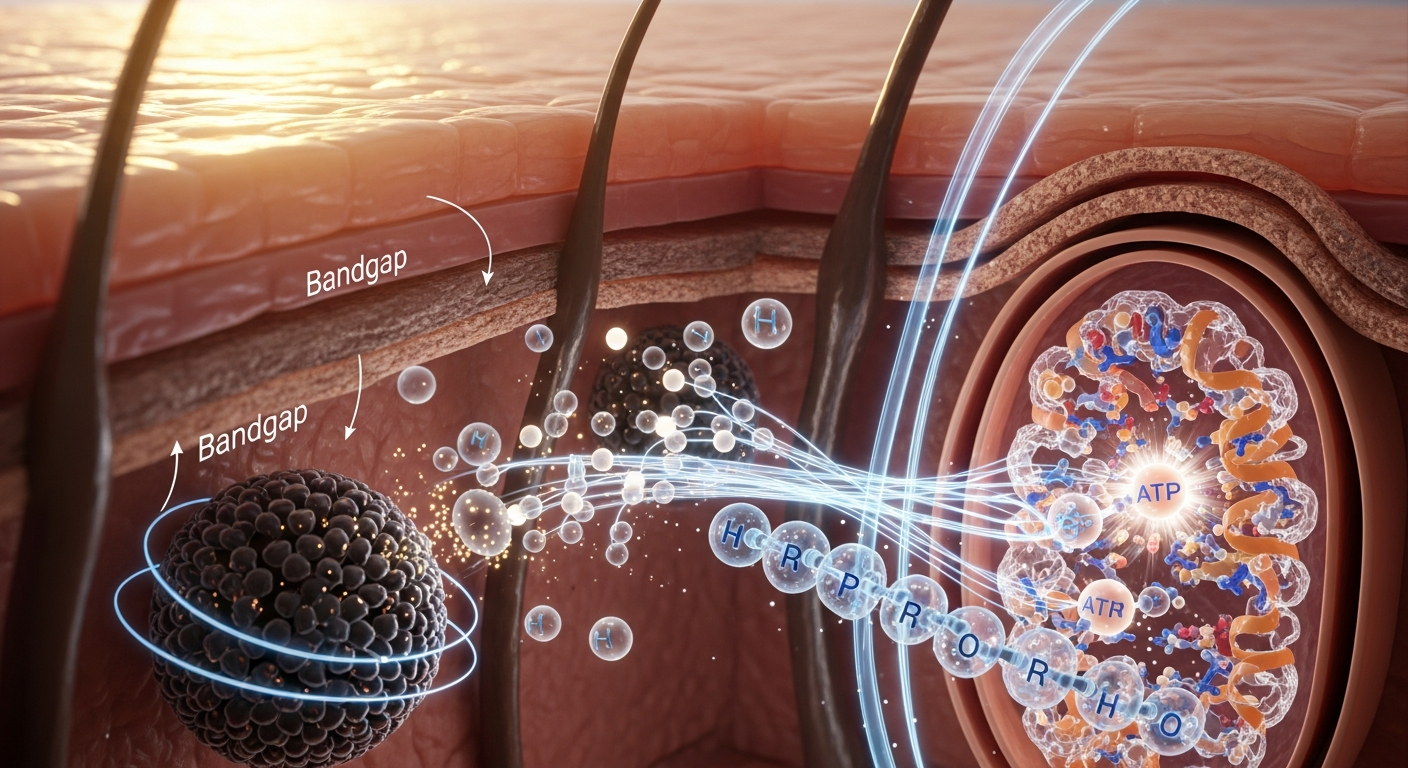
Could the very pigment that colors our skin, hair, and eyes serve as a biological solar panel, supplementing our metabolic energy directly from sunlight? This article explores the established science of melanin's extraordinary physical properties and speculates on the biological possibility of human "photosynthesis."
What if the most fundamental constraint of animal life—the need to constantly consume other organisms for energy—could be partially overcome by tapping into the most abundant energy source on the planet? We are taught that animals eat and plants photosynthesize, a clean metabolic division that has defined biology for eons. Yet, lurking within our own cells is a molecule, melanin, that exhibits a baffling array of properties more akin to an advanced, synthetic material than a simple biological pigment. It absorbs light across the entire electromagnetic spectrum, it can behave like an amorphous semiconductor, and it can conduct electricity. This raises a provocative question: Are we overlooking a latent energy-harvesting system within our own biology? Could humans, and indeed all animals, possess a cryptic capacity for a form of photosynthesis, one that doesn't produce sugar, but perhaps feeds directly into the fundamental energy currency of our cells?
The Science We Know
To move from speculation to scientific inquiry, we must first ground ourselves in the established, and often astonishing, biophysics of melanin. Far from being a passive light-absorber, melanin is a complex, disordered polymer with capabilities that continue to challenge our understanding.
First, melanin is a phenomenal broadband absorber. Unlike chlorophyll, which has specific absorption peaks in the blue and red parts of the spectrum, eumelanin—the black-brown form of the pigment—drinks in light from the ultraviolet through the visible and into the infrared. This property alone makes it unique among biological pigments. The energy from these absorbed photons must go somewhere. The most well-documented pathway is non-radiative decay, where the light energy is converted into heat with near-perfect efficiency. This photothermal conversion is the basis of melanin’s primary role in photoprotection, dissipating harmful UV radiation as harmless warmth.
However, heat is not the only product. Decades of research, pioneered by scientists like John McGinness in the 1970s, have established that melanin is an amorphous semiconductor. Like silicon in a computer chip, it has a band gap—an energy barrier that electrons must overcome to conduct electricity. For eumelanin, this gap is around 1.85 electron volts (eV), meaning a photon of visible light (e.g., a green photon at ~2.2 eV) carries more than enough energy to excite an electron into a conductive state. This creates a charge separation—a free electron and a corresponding "hole"—which is the fundamental principle of a photovoltaic device. Experiments have repeatedly demonstrated that when illuminated, thin films of melanin generate a measurable electric current, a phenomenon known as the photoelectric effect.
Most intriguingly, this photoelectric potential appears to be coupled to water. Research by Dr. Arturo Solís Herrera’s group in Mexico has proposed a controversial but compelling hypothesis: that melanin can absorb light energy and use it to dissociate the water molecule (H₂O) into hydrogen (H₂) and oxygen (O₂), much like the first step of plant photosynthesis. The proposed mechanism suggests melanin acts as a photocatalyst, using the energy from light to break the strong covalent bonds of water. While the efficiency and physiological relevance of this process are subjects of intense scientific debate, the fundamental observation—that light-absorbing melanin can induce chemical reactions in its aqueous environment—points toward a far more active metabolic role than previously imagined.
The Possibility
If we accept the established facts—that melanin converts light to electric charge and may dissociate water—we can construct a plausible, albeit speculative, biological pathway. What if this process could be harnessed to supplement our cellular energy budget?
The energy currency of the cell is adenosine triphosphate (ATP). It is primarily generated in the mitochondria through a process called oxidative phosphorylation. This process is, at its heart, an electrical circuit. High-energy electrons, stripped from food molecules, are passed down a series of protein complexes (the electron transport chain), releasing energy that is used to pump protons (H⁺) across the inner mitochondrial membrane. This creates an electrochemical gradient—a form of stored energy, like water behind a dam. When the protons flow back through an enzyme called ATP synthase, their energy is used to synthesize ATP.
Now, consider the potential products of melanin's interaction with light and water: excited electrons and protons. Could these be directly fed into the mitochondrial powerhouse?
A hypothetical scenario could look like this:
- A photon of sunlight strikes a melanin-rich organelle, a melanosome, located within a skin cell.
- The photon's energy excites an electron in the melanin polymer and also catalyzes the splitting of a nearby water molecule.
- This reaction releases two key products: a high-energy electron and a proton (H⁺).
- The proton contributes to the local cellular proton pool, potentially being shuttled to the intermembrane space of a nearby mitochondrion, adding to the proton gradient that drives ATP synthase.
- The high-energy electron could be transferred to a mobile electron carrier molecule, such as NAD⁺, reducing it to NADH. NADH is the primary electron donor for the mitochondrial electron transport chain.
In this model, sunlight would essentially provide a "boost" to the mitochondrial production of ATP, supplementing the energy derived from the breakdown of glucose. It wouldn't replace the need for food, but it might reduce the caloric requirement, enhance metabolic efficiency, or provide an energy buffer during periods of fasting. This would represent a fundamental re-writing of our understanding of animal metabolism, suggesting a hybrid "photo-heterotrophic" system.
Challenges and Unknowns
This vision, while compelling, faces formidable scientific and biological hurdles. The gap between what we know and what would need to be true is significant, and scientific integrity demands we address these challenges head-on.
First and foremost is the question of quantum yield and efficiency. How many photons are required to split a single water molecule? And how many of the resulting electrons and protons successfully couple to the metabolic machinery? Plant photosynthesis is notoriously inefficient, capturing only 1-2% of incident solar energy in the form of chemical bonds. Melanin's primary, and highly evolved, function is energy dissipation (as heat), not energy storage. It is highly probable that the quantum yield for any useful chemical work is extremely low, perhaps too low to be metabolically significant.
Second, there is the problem of byproducts and safety. Splitting water produces not just hydrogen but also highly reactive oxygen. The generation of reactive oxygen species (ROS) is a major concern. Indeed, pheomelanin, the reddish-yellow pigment, is known to be photosensitizing, generating ROS that can damage DNA and other cellular components under UV exposure. A system that produces uncontrolled bursts of oxygen and other radicals inside a cell could do more harm than good, potentially accelerating aging and increasing cancer risk.
Third is the challenge of biological integration. Melanosomes and mitochondria are typically distinct organelles within the cell. For efficient energy transfer to occur, a sophisticated mechanism for coupling them would be required. Are there physical tethers? Are there dedicated shuttle molecules for electrons and protons? No such systems have been discovered. It is possible they exist and have been overlooked, but it's more likely they would need to be engineered.
Finally, the issue of regulation cannot be overstated. Cellular energy levels are exquisitely regulated. Uncontrolled ATP production could disrupt countless cellular processes, leading to metabolic chaos. How would a cell modulate energy input from an external, fluctuating source like sunlight?
The Path Forward
Transforming this "what if" scenario into a testable scientific paradigm requires a focused, multi-disciplinary research program. The Quantum Melanin Research Foundation is committed to exploring these frontiers with rigor. The key questions that must be answered include:
- Quantifying the Reaction: We must move beyond qualitative observations. Using advanced spectroscopic and electrochemical techniques, researchers need to precisely measure the quantum yield of water dissociation by different types of melanin (eumelanin, pheomelanin, neuromelanin) under physiologically relevant conditions. Is the energy output trivial or potentially significant?
- Isotopic Tracing: The definitive experiment would involve exposing melanin-containing cells to light and isotopically labeled water (e.g., D₂O or H₂¹⁸O). By using mass spectrometry to trace the isotopes, we could determine if the hydrogen or oxygen atoms from water are incorporated into metabolic products like NADH or ATP. This would provide direct evidence of a functional link.
- Mapping the Infrastructure: Using high-resolution cellular imaging, we need to map the spatial relationship between melanosomes and mitochondria in various cell types. Do they interact? Does their proximity change with light exposure? This could reveal evidence of a pre-existing, functional integration.
- Probing Bioelectric Links: The work of researchers like Michael Levin at Tufts University has demonstrated that cellular function is profoundly regulated by bioelectric fields. We should investigate how light-induced charge separation in melanin influences cellular membrane potential and ion channel activity, potentially providing a non-chemical link between light absorption and metabolic state.
The possibility that melanin acts as a biological energy transducer remains on the frontier of science. But the evidence is too compelling to ignore. By asking these questions, we are not just exploring a biological curiosity; we are probing the very definition of what it means to be an animal and questioning the fundamental energy flow of life on Earth.
Key Takeaways
- Established science confirms that melanin is an amorphous semiconductor that absorbs broadband light and can generate an electrical current via the photoelectric effect.
- The hypothesis that melanin can use light energy to split water molecules into hydrogen and oxygen, proposed by Arturo Solís Herrera, is a key—though still debated—premise for its potential role in energy production.
- A speculative but plausible pathway suggests that the electrons and protons from melanin-driven water splitting could be shuttled to mitochondria to supplement the production of ATP, the cell's main energy currency.
- Major challenges to this theory include the likely low quantum efficiency of the process, the potential for generating damaging reactive oxygen species (ROS), and the lack of a known mechanism for coupling melanosomes to mitochondria.
- Future research must focus on quantifying the efficiency of melanin's photocatalytic reactions and using isotopic tracing to find direct evidence of a link between light absorption by melanin and cellular metabolism.
- If proven, this "human photosynthesis" would represent a latent energy system, potentially offering a supplemental, not primary, source of metabolic energy derived directly from light.
References
- McGinness, J. E., Corry, P., & Proctor, P. "Amorphous semiconductor switching in melanins." Science 183(4127), 853-855 (1974). DOI: 10.1126/science.183.4127.853. doi:10.1126/science.183.4127.853
- Solís-Herrera, A., Arias-Esparza, M. C., et al. "The unexpected capacity of melanin to dissociate the water molecule fills the gap between the life before and after the great oxidation event." Medical Hypotheses 79(6), 843-847 (2012). DOI: 10.1016/j.mehy.2012.08.026.
- d'Ischia, M., Wakamatsu, K., et al. "Melanins and melanogenesis: from pigment cells to human health and technological applications." Pigment Cell & Melanoma Research 28(5), 520-544 (2015). DOI: 10.1111/pcmr.12393.
- Mostert, A. B. "The photosplitting of water by melanin: a perspective." Photochemistry and Photobiology 91(1), 11-23 (2015). DOI: 10.1111/php.12356.
- Simon, J. D., Peles, D., Wakamatsu, K., & Ito, S. "Current challenges in understanding melanogenesis: bridging chemistry, biological control, morphology, and function." Pigment Cell & Melanoma Research 23(5), 583-593 (2010). DOI: 10.1111/j.1755-148X.2010.00750.x. doi:10.1111/j.1755-148x.2009.00610.x
- Turick, C. E., Ekechukwu, A. A., et al. "The role of melanin in the extensive degradation of organic compounds by the fungus Exophiala jeanselmei." Journal of Industrial Microbiology & Biotechnology 38(11), 1863-1870 (2011). DOI: 10.1007/s10295-011-0967-8.
- Levin, M., & Martyniuk, C. J. "The bioelectric code: an ancient computational medium for dynamic control of growth and form." BioSystems 164, 76-93 (2018). DOI: 10.1016/j.biosystems.2017.08.009. doi:10.1016/j.biosystems.2017.08.009