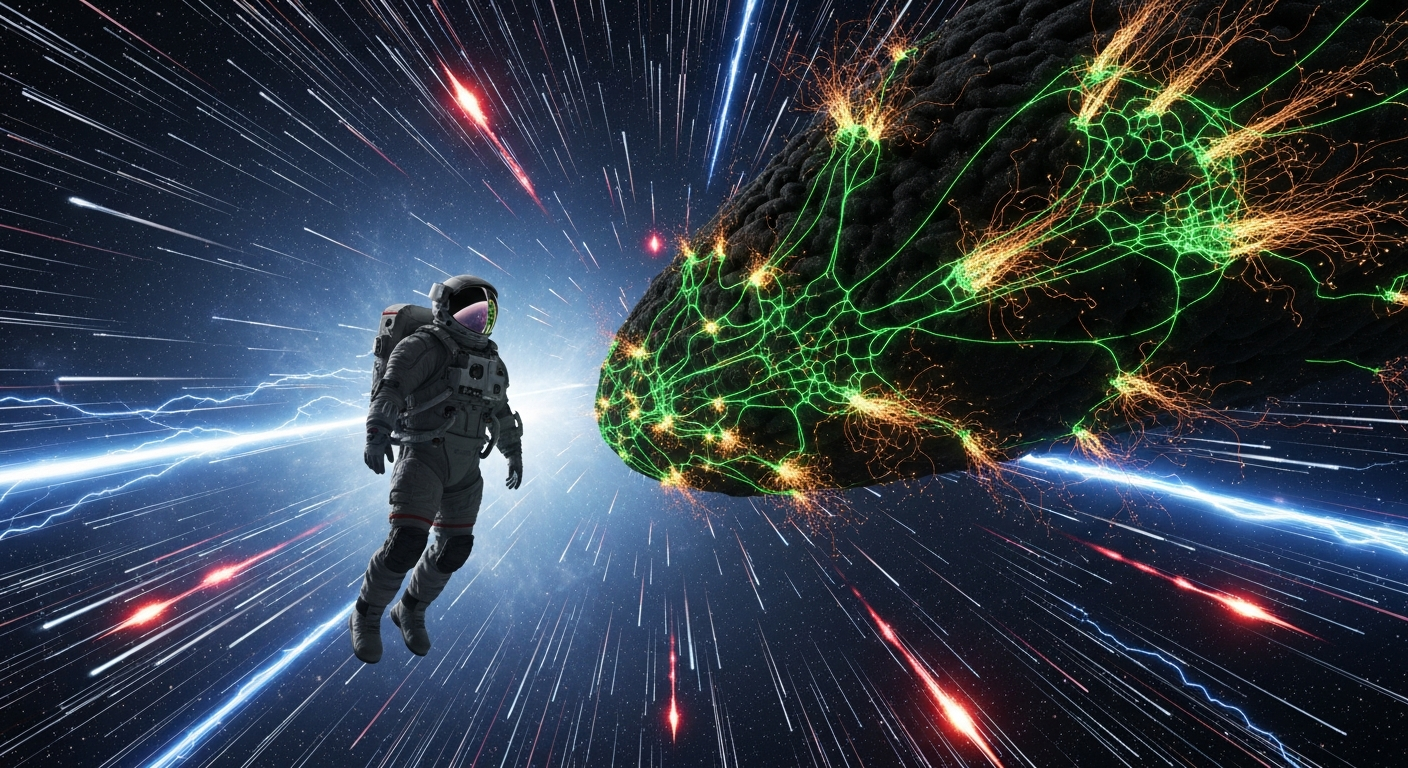
As humanity sets its sights on Mars and beyond, the lethal barrage of galactic cosmic radiation remains the single greatest barrier to deep space exploration. By looking to the ruins of the Chernobyl nuclear reactor, where melanized fungi thrive on radiation, researchers are beginning to ask whether biology’s most ubiquitous pigment could provide the ultimate shield.
In the vacuum of deep space, the human body is subjected to an invisible, continuous bombardment. Galactic Cosmic Rays (GCRs) and solar particle events tear through the DNA of living tissues, accelerating cellular senescence, inducing severe neurological deficits, and dramatically elevating cancer risks. Traditional shielding materials, like lead or thick steel, are prohibitively heavy to launch into orbit, while lighter materials require immense bulk to be effective. For decades, aerospace engineers have searched for a material that is lightweight, highly effective at dissipating ionizing radiation, and ideally, capable of regenerating itself.
The answer may have been discovered in 1991, in one of the most hostile environments on Earth: the highly radioactive, melted core of Reactor 4 at Chernobyl. Robotic probes sent into the ruins did not just find a sterile wasteland; they discovered black fungi growing directly on the highly radioactive graphite walls. These organisms were not merely surviving the catastrophic gamma radiation—they were growing toward it. The secret to their survival, and their seemingly impossible biological feat, was a dense concentration of melanin. This observation ignited a profound scientific inquiry into melanin’s capacity to interact with ionizing radiation, shifting our understanding of this macromolecule from a simple biological sunscreen to a sophisticated quantum-mechanical energy transducer.
The Science We Know
The fungi thriving in Chernobyl, primarily species like Cryptococcus neoformans and Cladosporium sphaerospermum, exhibit a phenomenon known as radiotrophic growth. In 2007, landmark research led by Ekaterina Dadachova and Arturo Casadevall demonstrated that heavily melanized fungi exposed to ionizing radiation experienced a significant increase in growth rate compared to non-irradiated or unmelanized controls. The radiation was not damaging them; it was feeding them.
To understand how this occurs, we must examine the biophysics of eumelanin, the dark brown to black form of the pigment constructed from cross-linked oligomers of DHI (5,6-dihydroxyindole) and DHICA (5,6-dihydroxyindole-2-carboxylic acid). Eumelanin operates as an organic semiconductor with a bandgap of approximately ~1.85eV. Its unique molecular architecture—a continuous conjugated system of pi-electrons—allows it to exhibit broadband absorption across the electromagnetic spectrum.
When high-energy ionizing radiation, such as gamma rays, strikes a biological system, it typically shears electrons from water molecules, creating highly reactive and destructive hydroxyl radicals that shred DNA. However, when radiation strikes melanin, the biopolymer's dense network of conjugated bonds acts as an electron sink. Melanin possesses a naturally high concentration of stable free radicals, which are readily detectable via Electron Paramagnetic Resonance (EPR) spectroscopy. Instead of being destroyed by the ionizing energy, melanin undergoes Compton scattering and captures the erratic, high-energy electrons.
Dadachova's research revealed that exposure to ionizing radiation alters the oxidation-reduction potential of melanin. The pigment continuously absorbs and safely dissipates this energy, preventing radical cascades. In the case of radiotrophic fungi, melanin takes this a step further: it acts as a step-down transformer, harvesting the extreme energy of gamma rays and transferring it to cellular metabolic pathways to synthesize NADH, effectively translating lethal physics into bioenergetic fuel.
The Possibility
If melanin can absorb, dissipate, and biologically utilize ionizing radiation, the implications for deep space travel are profound. By extrapolating the established biophysics of radiotrophic fungi, we can envision a new paradigm in aerospace engineering and space medicine.
Consider the potential of melanin-infused composites. Current spacecraft shielding relies heavily on polyethylene and water walls because low atomic weight (low-Z) elements like hydrogen and carbon are highly effective at absorbing radiation without generating dangerous secondary particle showers. Melanin is natively composed of these low-Z elements but possesses an intrinsic electron-scavenging architecture that inert plastics lack. If synthetic eumelanin could be polymerized at scale and integrated into the resins of carbon-fiber spaceship hulls or the flexible polymers of spacesuits, astronauts would be wrapped in an active radiation sink. This material would not just passively block radiation; it would chemically quench the free radicals generated by high-energy particle impacts.
Taking this a step further into biotechnology, we arrive at the possibility of living shields. On a multi-year mission to Mars, carrying spare parts or extra shielding is mathematically unfeasible. What if a spacecraft’s biological shielding could be grown en route? Fungal mycelium mats of Cladosporium sphaerospermum could be cultured in thin layers of water between the inner and outer bulkheads of a space habitat. As the ship leaves Earth's magnetosphere and enters the heavily irradiated environment of deep space, the ambient radiation would continuously stimulate the growth and metabolic activity of the radiotrophic fungi. The result would be a self-replicating, self-healing radiation shield that grows denser precisely when radiation levels peak.
In the realm of human bioengineering, speculative medicine asks whether we could enhance the astronaut's own biology. While artificially inducing radiotrophic energy harvesting in humans remains firmly in the realm of hypothesis, upregulating endogenous melanin production or utilizing melanin-based nanoparticle radioprotectants could offer localized cellular defense. Injected or targeted melanin nanoparticles could circulate in the bloodstream, acting as radical-scavenging sentinels that protect vital organ systems and mitigate the DNA damage caused by cosmic rays passing through the body.
Challenges and Unknowns
While the theoretical framework is compelling, the transition from Chernobyl’s walls to the hull of a Mars-bound starship is fraught with rigorous technical barriers.
First, we must distinguish between the types of radiation. The fungi at Chernobyl evolved to survive Earth-bound gamma radiation. Deep space presents a fundamentally different threat: Galactic Cosmic Rays comprise high-energy, high-charge HZE particles, such as relativistic iron nuclei. These particles carry staggering kinetic energy and enact devastating localized tissue damage. We do not yet have definitive long-term data on how melanin's pi-electron network handles the catastrophic kinetic impact of a relativistic iron nucleus, nor how efficiently it can prevent the spallation (shattering) of secondary particles under such extreme forces.
Secondly, extracting or synthesizing pure eumelanin at an industrial scale is notoriously difficult. Natural melanin is amorphous, highly insoluble in most solvents, and structurally heterogeneous, making it exceptionally challenging to process into uniform aerospace-grade materials. While synthetic analogs exist, mimicking the exact hydration-dependent conductivity and structural complexity of biological melanin in a vacuum environment remains an active materials science challenge.
Furthermore, relying on living fungal shields presents biological risks. Maintaining a massive fungal culture within a closed-loop spacecraft life support system risks contamination or biofouling. If the containment system were breached, introducing highly resilient, radiation-fed fungi into an astronaut's habitat—or into their respiratory system—could prove disastrous.
The Path Forward
The leap from hypothesis to reality requires systematic, incremental science. The vital next step is translating laboratory observations into applied materials science and off-world testing.
This process has already begun. In recent years, samples of Cladosporium sphaerospermum were sent to the International Space Station (ISS) to test their capacity to attenuate cosmic radiation in low Earth orbit. Preliminary data from these bio-design experiments suggests that relatively thin layers of melanized fungi can measurably reduce radiation loads.
Moving forward, researchers must focus on advanced synthetic chemistry to create soluble, processable melanin analogs that retain the ~1.85eV bandgap and stable free radical properties of natural eumelanin. These biomimetic polymers must then be subjected to rigorous testing in facilities like the NASA Space Radiation Laboratory, utilizing particle accelerators to simulate the exact HZE particle environment of deep space.
We must also deepen our understanding of melanin’s quantum behavior. By mapping the exact quantum tunneling and electron transfer pathways that allow melanin to step down high-energy photons into metabolic energy, we could theoretically reverse-engineer these mechanisms into solid-state organic materials that do not require living fungi to function.
Melanin has spent billions of years evolving as biology’s primary defense against the hostilities of the electromagnetic spectrum. As we prepare to cross the threshold into deep space, our greatest technological defense may require looking inward, at the very pigment that allowed life to survive under the harsh sun of a young Earth.
Key Takeaways
- Radiotrophic fungi demonstrate active radiation utilization: Organisms like Cryptococcus neoformans use melanin not merely to block ionizing radiation, but to capture its energy and transduce it into metabolic fuel (NADH).
- Melanin acts as a quantum-mechanical electron sink: The biopolymer's dense conjugated pi-electron structure and high concentration of stable free radicals allow it to safely undergo Compton scattering, capturing and dissipating the destructive energy of gamma rays.
- Low-Z composition is ideal for aerospace shielding: Melanin’s molecular makeup of hydrogen, carbon, and nitrogen makes it highly effective at absorbing radiation without producing the dangerous secondary particle showers associated with heavy metal shielding.
- Self-healing biological shields are a viable hypothesis: Leveraging melanized fungal mycelium could theoretically provide a self-replicating radiation barrier for spacecraft habitats, reducing the massive launch-weight burdens of traditional shielding.
- Scaling and extreme-particle testing remain significant barriers: Before melanin composites can protect astronauts, materials science must solve the difficulty of synthesizing uniform eumelanin at scale and prove its efficacy against the relativistic HZE particles found in deep space.
References
Casadevall, A., Cordero, R. J. B., Bryan, R., Nosanchuk, J., & Dadachova, E. "Melanin, radiation, and energy transduction in fungi." Microbiology and Molecular Biology Reviews 80(1), 1-10 (2016). DOI: 10.1128/MMBR.00045-15.
Cordero, R. J. B., et al. "Melanin for space travel radioprotection." Environmental Microbiology 19(7), 2529-2532 (2017). DOI: 10.1111/1462-2920.13781.
Dadachova, E., Bryan, R. A., Huang, X., Moadel, T., Schweitzer, A. D., Aisen, P., Nosanchuk, J. D., & Casadevall, A. "Ionizing radiation changes the electronic properties of melanin and enhances the growth of melanized fungi." PLoS One 2(5), e457 (2007). DOI: 10.1371/journal.pone.0000457.
d'Ischia, M., Wakamatsu, K., Cito, V., & Ito, S. "Melanins and melanogenesis: from pigment cells to human health and technological applications." Pigment Cell & Melanoma Research 28(5), 520-544 (2015). DOI: 10.1111/pcmr.12393.
Shunk, G. K., Gomez, O. R., & Averesch, N. J. H. "A self-replicating radiation-shield for human deep-space exploration: Radiotrophic fungi can attenuate ionizing radiation aboard the International Space Station." bioRxiv (2020). DOI: 10.1101/2020.07.16.205534.
Turick, C. E., et al. "Gamma radiation interacts with melanin to alter its oxidation-reduction potential and results in electric current production." Bioelectrochemistry 82(1), 69-73 (2011). DOI: 10.1016/j.bioelechem.2011.04.009.