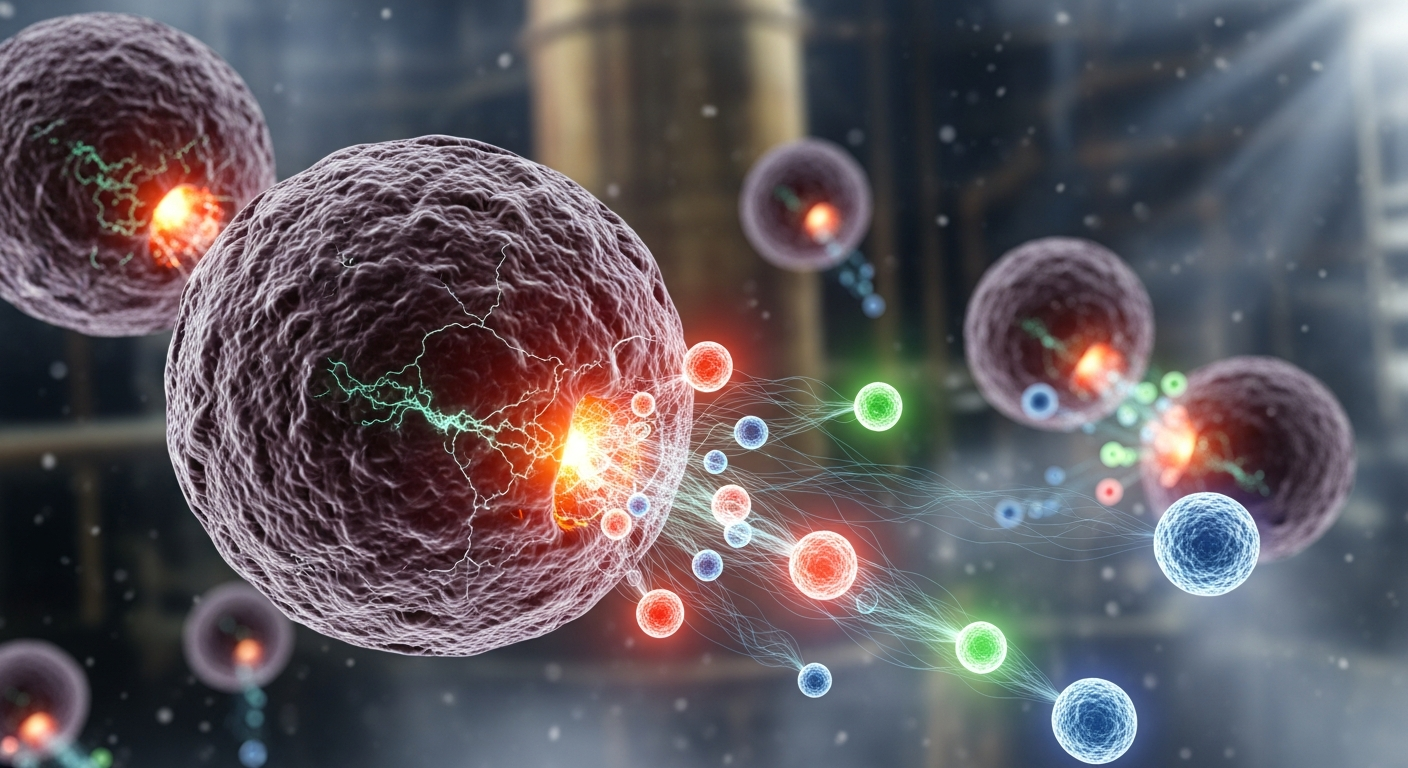
What if the same biopolymer that colors our skin and protects us from ultraviolet light holds a potential solution to one of humanity's most persistent technological poisons: radioactive contamination? This article explores the scientific possibility of engineering melanin-producing bacteria to seek out, concentrate, and perhaps even neutralize radioactive waste.
What if we could deploy armies of microscopic, biological machines to clean the lingering radiological scars at sites like Chernobyl and Fukushima? The idea sounds like science fiction, but it is grounded in a fascinating and unexpected discovery made in one of the most inhospitable places on Earth: the damaged core of the Chernobyl Nuclear Power Plant. There, clinging to the reactor walls, scientists found several species of fungi not just surviving, but thriving in radiation levels that would be lethal to most other forms of life. Their secret weapon, a biopolymer familiar to us all, was melanin. This observation poses a provocative question: If nature has already found a way to use melanin to live with radiation, can we harness that same principle for active remediation?
This is not a question of simple survival. The evidence suggests something far more profound is at play. The fungi are not merely resisting radiation; they appear to be using it as a source of energy, a phenomenon termed radiotrophic growth. This single, stunning observation opens a new frontier of inquiry at the intersection of mycology, biophysics, and nuclear science. It compels us to re-examine melanin not just as a passive shield, but as an active, quantum-mechanical interface between biology and high-energy physics.
The Science We Know
To understand the potential of a melanin-based bioremediation strategy, we must first ground ourselves in the established science. The foundation for this speculation was laid in a 2007 study led by Ekaterina Dadachova, then at the Albert Einstein College of Medicine, published in PLoS ONE. Her team exposed two species of fungi—one melanized (Wangiella dermatitidis) and one non-melanized (Cryptococcus neoformans)—to ionizing radiation at levels approximately 500 times higher than the normal background. The results were unambiguous: the melanized fungi grew significantly faster.
The researchers demonstrated that the electronic properties of melanin itself were altered by the radiation, and they hypothesized that the polymer was capturing gamma ray photons and converting their energy into a form the cell could use for metabolic processes. This suggests that melanin may be acting as a biological energy transducer, analogous to how chlorophyll converts solar energy into chemical energy during photosynthesis.
This capability stems from melanin's unique biophysical properties, which the Quantum Melanin Research Foundation (QMRF) is dedicated to exploring:
-
Broadband Absorption: Unlike chlorophyll, which absorbs specific wavelengths of light, eumelanin—the dark brown/black form of the polymer—is a "blackbody absorber." It can absorb energy across an enormous spectrum, from low-frequency radio waves to ultraviolet light and, crucially, high-energy ionizing radiation like X-rays and gamma rays. This property is due to its complex, heterogeneous structure of stacked indolequinone units, which creates a wide range of available electron energy states.
-
Stable Free Radicals: Melanin is a rare biological material in that it is a stable free radical. This means it has an unpaired electron, a feature detectable via Electron Paramagnetic Resonance (EPR) spectroscopy. This inherent radical nature allows it to efficiently quench other, more dangerous free radicals generated by radiation, acting as a potent antioxidant. But it may also be central to its ability to manage and transport the high-energy electrons produced when gamma photons are absorbed.
-
Semiconductor and Ionic Conduction: Landmark work by John McGinness in the 1970s first established that melanin behaves like an amorphous semiconductor. Its electrical conductivity is highly dependent on its hydration state, and it can conduct both electrons (like a solid-state device) and ions, particularly protons (like a biological membrane). This dual conductivity is critical, as it provides a plausible mechanism for converting the electronic excitation from radiation into the flow of ions that drives cellular chemistry, such as ATP synthesis.
-
Ion Chelation: Melanin is an exceptionally effective ion chelator, meaning it can bind tightly to metal ions. This is well-documented in the context of neuromelanin in the human brain, which sequesters iron and other metals in the substantia nigra. This property is not indiscriminate; melanin has a strong affinity for heavy metals and radionuclides like uranium, plutonium, strontium, and cesium—the very isotopes that are of greatest concern in nuclear waste.
These four established properties—broadband absorption, free radical stability, hybrid conductivity, and ion chelation—form the scientific bedrock upon which we can build a speculative, yet plausible, technological application.
The Possibility
If melanin-bearing fungi can thrive on radiation, and if melanin’s intrinsic properties make it an ideal material for interacting with radioactive elements, then the next logical step is to move from passive observation to active engineering. While fungi are robust, bacteria offer a superior platform for genetic engineering and rapid deployment.
The speculative proposal is this: engineer a radiation-resistant bacterium to overproduce and display eumelanin on its outer surface, creating a "living absorbent" for nuclear contaminants.
Here’s how it might work:
-
The Chassis: The starting point would be a naturally radiation-resistant organism. The prime candidate is Deinococcus radiodurans, a bacterium listed in the Guinness Book of World Records as "the world's toughest bacterium." It can withstand radiation doses thousands of times greater than humans, not because it shields itself, but because it possesses extraordinarily efficient DNA repair mechanisms.
-
The Genetic Circuit: Using standard synthetic biology tools, genes for eumelanin production (such as the tyrosinase gene) would be inserted into the D. radiodurans genome. This circuit would be designed to "turn on" melanin synthesis, effectively coating each bacterium in a layer of the biopolymer.
-
Deployment and Sequestration: These engineered bacteria could be introduced into contaminated soil or water. Their natural motility would allow them to disperse throughout the medium. As they encounter radioactive isotopes (e.g., Strontium-90 or Cesium-137), the melanin on their surface would act like molecular flypaper, binding the radioactive metal ions through chelation. The bacteria would effectively concentrate the diffuse, low-level contamination into a condensed, living biomass.
-
Harvesting: Once saturated, the bacterial biomass could be harvested. One proposed method is to include a "magnetic retrieval" gene in the bacterial chassis—an engineered pathway that causes the bacteria to synthesize magnetic nanoparticles (magnetite). By applying an external magnetic field, the radionuclide-laden bacteria could be efficiently separated from the soil or water, leaving a decontaminated environment behind. The collected biomass, now containing highly concentrated waste, could then be vitrified into glass for permanent, safe geological storage.
This process, known as bioremediation, leverages a biological system to achieve what is currently an expensive and difficult engineering challenge: concentrating dilute waste into a small, manageable volume.
Challenges and Unknowns
While the scientific foundation is sound, the path from concept to application is fraught with significant technical and ethical challenges. Scientific discipline requires we acknowledge them directly.
First, the precise quantum-mechanical mechanism by which melanin converts gamma radiation into metabolic energy remains a subject of intense research. Is it a process of controlled Compton scattering, where photons transfer energy to electrons? Or does it involve more exotic physics? Without a complete understanding of this energy transduction pathway, optimizing it remains difficult.
Second, there is the question of genetic stability. Even D. radiodurans has its limits. Sustained exposure to high-level radiation will still cause DNA mutations. We would need to ensure that the engineered melanin-production circuit remains stable over many generations in a harsh radioactive environment. A mutation that deactivates the melanin pathway would render the bacteria useless.
Third, the distinction between sequestration (binding and concentrating) and neutralization (rendering harmless) is critical. The model described above focuses on sequestration, which is scientifically plausible. The idea that melanin could somehow accelerate radioactive decay or "neutralize" an isotope is far more speculative. While melanin's interaction with high-energy electrons is complex, altering nuclear physics (the behavior of protons and neutrons in a nucleus) is a different order of magnitude and currently has no established biological precedent.
Finally, the ecological implications of releasing a genetically engineered microorganism into a contaminated zone—even one as blighted as Chernobyl's exclusion zone—must be rigorously evaluated. Containment strategies, such as engineering the bacteria to be dependent on a specific nutrient not found in the wild or incorporating a "kill switch," would be essential to prevent unintended ecological disruption.
The Path Forward
Transforming this concept into a reality would require a multi-stage, interdisciplinary research program. The first steps are clear:
-
Fundamental Biophysics: Use advanced spectroscopic techniques (like ultrafast transient absorption spectroscopy) to map the flow of energy within the melanin polymer immediately following a high-energy photon interaction. This would help elucidate the energy conversion mechanism.
-
Optimized Synthetic Biology: Systematically test different bacterial chassis and melanin production pathways to create a strain that is not only radiation-resistant but also an efficient and stable melanin producer. This would involve engineering the bacteria to express melanin on their exterior cell wall for maximum contact with the environment.
-
Controlled Isotope Studies: In secure laboratory settings, test the engineered strains against solutions containing key radioactive isotopes (e.g., Cesium-137, Strontium-90, Americium-241) to precisely quantify their binding affinity and uptake capacity.
-
Microcosm and Mesocosm Experiments: Before any consideration of field deployment, create controlled laboratory ecosystems (microcosms) that simulate the soil and water conditions of a contaminated site. These experiments would be crucial for assessing the organism's survival, efficacy, and potential ecological impact.
The journey from a radiation-eating fungus in Chernobyl to an engineered bacterial cleanup crew is long and uncertain. But it is a journey worth exploring. It represents a paradigm where we look to biology not just for inspiration, but for sophisticated, functional solutions to our most challenging technological problems. The answers may lie hidden in the elegant physics of a humble polymer.
Key Takeaways
- Melanized fungi discovered at the Chernobyl reactor site not only survive but appear to harness high levels of gamma radiation for metabolic energy, a process called radiotrophy.
- Eumelanin's known properties—including broadband energy absorption, stable free radical nature, and high affinity for heavy metal ions—make it a prime candidate for interacting with radioactive materials.
- A speculative but plausible bioremediation strategy involves engineering a radiation-resistant bacterium like Deinococcus radiodurans to overproduce melanin, which would sequester radioactive isotopes from the environment.
- This approach focuses on the scientifically grounded concept of concentrating nuclear waste (sequestration), which is far more achievable than the highly speculative idea of biologically neutralizing it.
- Significant challenges remain, including fully understanding melanin's energy transduction mechanism, ensuring the genetic stability of engineered organisms in high-radiation fields, and managing potential ecological risks.
- Future research should focus on fundamental biophysics, optimizing bacterial strains through synthetic biology, and conducting contained experiments to validate the efficacy and safety of this approach.
References
- Dadachova, E., et al. "Ionizing Radiation Changes the Electronic Properties of Melanin and Enhances the Growth of Melanized Fungi." PLoS ONE 2(5), e457 (2007). DOI: 10.1371/journal.pone.0000457. doi:10.1371/journal.pone.0000457
- McGinness, J., Corry, P., & Proctor, P. "Amorphous semiconductor switching in melanins." Science 183(4127), 853-855 (1974). DOI: 10.1126/science.183.4127.853. doi:10.1126/science.183.4127.853
- Casadevall, A., Dadachova, E., & Pirofski, L. "The weapon of conquest: melanin." The Lancet Infectious Diseases 4(6), 321-322 (2004). DOI: 10.1016/S1473-3099(04)01043-4.
- Turick, C. E., Knox, A. S., & Becnel, J. M. "In situ uranium stabilization by microbial-mediated reduction." Journal of Environmental Radioactivity 99(6), 890-899 (2008). DOI: 10.1016/j.jenvrad.2007.12.010.
- Daly, M. J. "A new perspective on radiation resistance." Nature Reviews Microbiology 7, 237–245 (2009). DOI: 10.1038/nrmicro2073. (Provides context on Deinococcus radiodurans).
- Powell, B. A., et al. "Uranium, Neptunium, and Plutonium Speciation and Sorption on a Tuffaceous Soil." Environmental Science & Technology 43(17), 6568-6574 (2009). DOI: 10.1021/es900599c. (Provides context on radionuclide behavior in soil).
- Zecca, L., et al. "The role of iron and copper in the neurodegeneration of parkinsonism." Journal of Neurochemistry 90(5), 1017-1025 (2004). (Illustrates melanin's role as a metal chelator via neuromelanin).