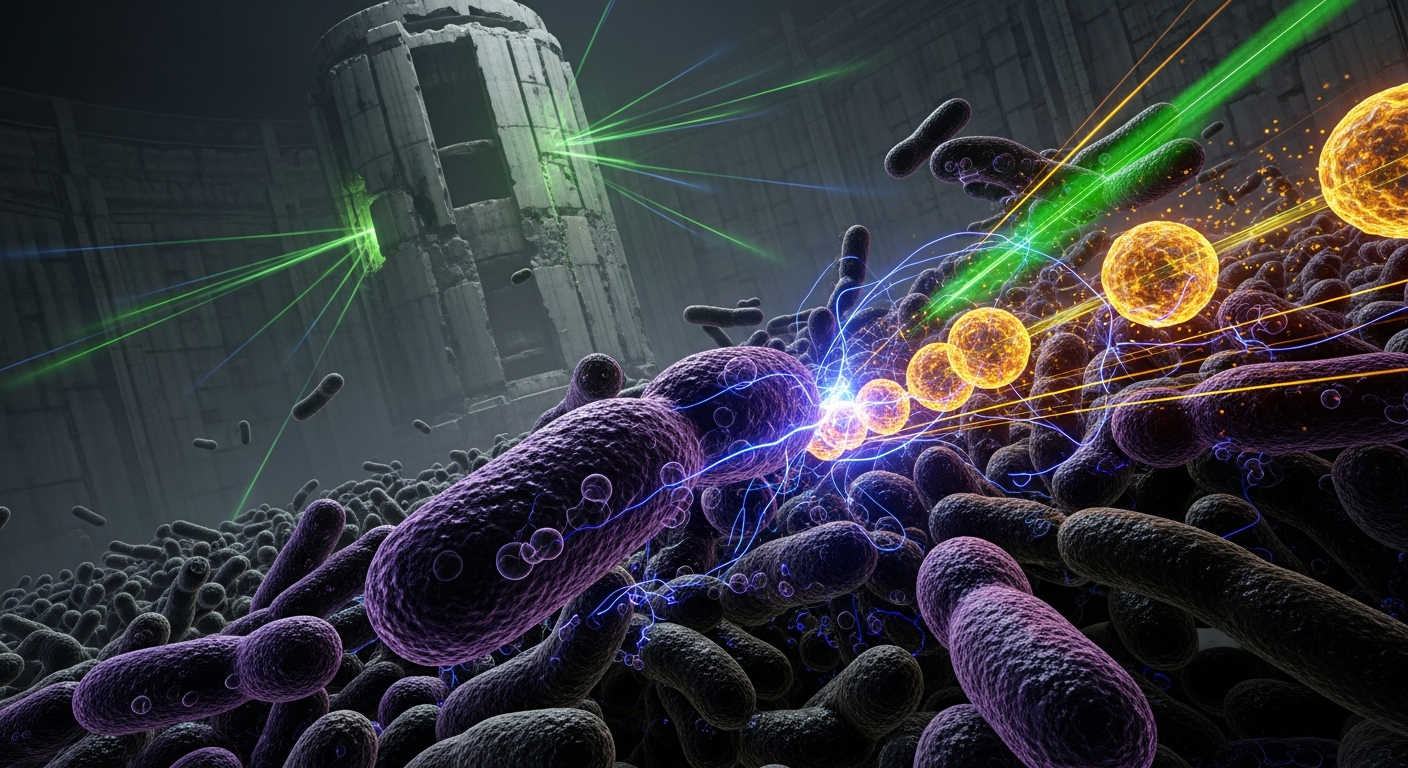
Could the unique biophysical properties of melanin provide a biological solution to the world's most toxic nuclear legacy sites? By combining the radiation-harvesting capabilities of melanized fungi with the scalability of engineered bacteria, we may be able to safely isolate and concentrate radioactive waste.
In 1991, robots exploring the highly radioactive, destroyed Reactor No. 4 at the Chernobyl Nuclear Power Plant returned with unexpected images: dense black patches of fungal growth spreading across the containment walls. Even more astonishingly, these fungi were not merely surviving the intense gamma radiation—they were growing toward it. The secret to their survival was a high cellular concentration of melanin, the same complex biopolymer responsible for pigmentation in human skin. This discovery forced biophysicists to reconsider the evolutionary limits of biological energy transduction. If nature has already evolved a mechanism to thrive in and process ionizing radiation, can we harness this quantum architecture to remediate the most hazardous environments on Earth?
The conventional approach to nuclear cleanup relies on crude physical processes: excavating contaminated soil, pumping millions of gallons of irradiated water through chemical filters, and entombing the waste in concrete. These methods are extraordinarily expensive, labor-intensive, and often incomplete. However, viewing melanin not merely as a biological pigment, but as a robust organic semiconductor and highly efficient chelating agent, opens a radically different avenue. Engineering hyper-melanized microbial systems could allow us to deploy self-replicating, biologically powered "sponges" capable of selectively binding radioisotopes while utilizing the ambient radiation field to fuel their own metabolic survival.
The Science We Know
The foundation of this speculative application rests on two well-established biophysical properties of melanin: its capacity to interact with high-energy ionizing radiation and its profound ability to bind heavy metals.
In 2007, a landmark study led by Ekaterina Dadachova and Arturo Casadevall at the Albert Einstein College of Medicine demonstrated that radiotrophic fungi—such as Cladosporium sphaerospermum and Cryptococcus neoformans—experience accelerated growth when exposed to ionizing radiation, provided they contain melanin. The researchers utilized electron paramagnetic resonance (EPR) spectroscopy to observe melanin's behavior under radiation. They found that exposure to gamma rays alters the electron spin resonance signal of melanin, indicating a continuous restructuring of its stable free radical population.
Melanin operates with an energy bandgap of approximately 1.85 eV, behaving as an amorphous organic semiconductor—a property first documented by John McGinness and colleagues in 1974. When ionizing radiation strikes the melanin polymer, it undergoes Compton scattering, where high-energy photons eject electrons from the melanin matrix. Unlike most biological molecules, which are rapidly destroyed by the resulting reactive oxygen species, melanin safely captures these high-energy electrons. It cycles them through its complex structure of quinones and hydroquinones, stepping down the energy and facilitating electron transfer that the cell can theoretically couple to metabolic pathways (like NADH production).
Concurrently, melanin is a highly cross-linked heteropolymer densely packed with carboxyl, hydroxyl, and amine functional groups. This biochemical architecture makes eumelanin (the structurally robust, dark brown/black form of the polymer) an exceptional chelator. In natural environments, melanized organisms frequently use this property to sequester toxic heavy metals. In the context of nuclear contamination, melanin has been shown to aggressively bind isotopes such as uranium-238, strontium-90, and cesium-137, trapping them securely within its macromolecular matrix.
The Possibility
If melanin can both shield against radiation damage and actively chelate radioactive heavy metals, and if we possess the tools of synthetic biology, then a powerful bioremediation strategy becomes possible. However, fungi are eukaryotic organisms; they grow relatively slowly and can be complex to bioengineer at scale. Bacteria, by contrast, divide rapidly, are easier to genetically manipulate, and can be grown in massive industrial bioreactors.
Imagine taking a known polyextremophile—such as Deinococcus radiodurans, a bacterium famous for its ability to repair massive DNA double-strand breaks caused by extreme radiation—and engineering it to overexpress melanin. By inserting the genetic pathways for tyrosinase (the key enzyme in melanin synthesis) and feeding the bacteria a precursor like L-tyrosine, we could create a microbial strain perfectly optimized for radioactive environments.
The deployment model would be highly targeted. In an environment like the contaminated cooling water tanks at Fukushima, these engineered, highly melanized bacteria could be introduced in specialized biological filters. As the radioactive water flows through, the melanin matrix in the bacterial cell walls would act as a chemical net, binding the dissolved strontium and cesium. The ambient gamma radiation, rather than killing the bacteria, would interact with the melanin to generate an electron cascade, potentially providing a supplementary energy source that sustains the bacterial colony in a nutrient-poor environment.
Once the bacteria have achieved maximum chelation capacity, the biomass can be physically filtered out of the water. Because the radioactive isotopes are now densely bound within the biological matrix, what was once millions of gallons of slightly radioactive water is reduced to a small, compact mass of solid, highly stable melanized biomass that is vastly easier to store, vitrify, or safely entomb.
Challenges and Unknowns
While intellectually compelling, bridging the gap between radiotrophic fungal biology and engineered bacterial bioremediation faces significant scientific hurdles.
First, we must be biologically realistic: biology cannot change physics. Melanin does not "neutralize" radioactivity in the sense of altering atomic half-lives or speeding up nuclear decay. The radioactive isotopes will remain radioactive. The biological intervention simply isolates and concentrates the dispersed isotopes into a manageable solid form. The fundamental physical danger of the waste remains.
Second, the metabolic burden of synthesizing dense eumelanin shields is extraordinarily high for a bacterial cell. Overexpressing tyrosinase requires significant ATP and specific precursor amino acids. In a resource-depleted environment like a nuclear cooling pool, sustaining the metabolic cost of melanin production would require precise genetic tuning so the cells do not simply die from resource exhaustion before remediation is complete.
Furthermore, while melanin's free radicals excellent at absorbing radiation-induced oxidative stress, high-level gamma radiation will inevitably penetrate the cell and strike the bacterial DNA. Relying on melanin alone for radioprotection is insufficient for long-term survival in extreme environments. The host organism must possess endogenous DNA repair mechanisms (hence the theoretical necessity of using a host like D. radiodurans rather than standard E. coli). The exact quantum efficiency of melanin's electron transfer in a recombinant bacterial host—and whether a bacterium can be engineered to actually plug melanin's electron flow into its own electron transport chain—remains entirely unproven.
Finally, there are stringent ecological considerations. Deploying genetically engineered microorganisms into open environments like the soil around Chernobyl carries the risk of unpredictable ecological interactions. Any such bioremediation technology would likely require built-in genetic "kill-switches" to ensure the bacteria cannot persist or spread beyond the designated containment zone.
The Path Forward
Advancing this speculative concept into a tangible technology requires a multidisciplinary research effort across quantum biology, synthetic biology, and materials science.
The immediate next step is characterizing the precise electrical interface between melanin and bacterial cell membranes. Researchers must determine if recombinant melanin produced in bacterial periplasm can successfully couple to bacterial membrane potentials (Vmem), effectively turning the polymer into an external solar panel for gamma radiation.
Laboratory evolution experiments should be initiated to adapt melanin-producing bacterial strains to progressively higher doses of ionizing radiation, selecting for mutations that optimize both melanin yield and heavy metal chelation efficiency. Pilot studies could then be conducted in sealed, scalable bioreactors using low-level, chemically synthesized liquid waste to test the physical filtration and binding capacity of the melanized biomass.
By taking melanin science seriously as a domain of rigorous biophysical inquiry, we open up possibilities that sound like science fiction but are rooted firmly in quantum and cellular mechanics. A biologically driven, melanin-based approach to nuclear waste management could fundamentally transform how we handle the most toxic byproducts of the atomic age.
Key Takeaways
- Melanin as a radiation transducer (Established): Melanized fungi naturally thrive in high-radiation environments like Chernobyl by using melanin's stable free radicals to convert ionizing radiation into continuous electron transfer.
- Dual-action biophysics (Established): Melanin's highly cross-linked, functional-group-dense polymer structure makes it a highly effective chelator capable of trapping heavy metals and radioactive isotopes.
- Engineered bacterial remediation (Speculative): Transferring melanin-synthesizing pathways into rapidly dividing, radiation-resistant bacteria could create scalable biological filters for nuclear waste.
- Concentration vs. Decay (Clarification): Biological remediation cannot alter nuclear half-lives; it can only securely concentrate dispersed radioactive isotopes into a stable, compact biological matrix for easier physical storage.
- The engineering bottleneck (Challenge): Significant research is required to overcome the metabolic burden of high-yield melanin production in bacteria and to successfully link melanin's electron flow to bacterial metabolic pathways.
References
- Dadachova E, Bryan RA, Huang X, Moadel T, Schweitzer AD, Aisen P, Nosanchuk JD, Casadevall A. "Ionizing radiation changes the electronic properties of melanin and enhances the growth of melanized fungi." PLoS One 2(5), e457 (2007). DOI: 10.1371/journal.pone.0000457. doi:10.1371/journal.pone.0000457
- McGinness J, Corry P, Proctor P. "Amorphous semiconductor switching in melanins." Science 183(4127), 853-855 (1974). DOI: 10.1126/science.183.4127.853. doi:10.1126/science.183.4127.853
- Cordero RJB, Casadevall A. "Functions of fungal melanin beyond virulence." Fungal Biology Reviews 31(2), 99-112 (2017). DOI: 10.1016/j.fbr.2016.12.003. doi:10.1016/j.fbr.2016.12.003
- Turick CE, Ekechukwu AA, Milliken CE, Casadevall A, Dadachova E. "Gamma radiation interacts with melanin to alter its oxidation-reduction potential and results in electric current production." Bioelectrochemistry 82(1), 69-73 (2011). DOI: 10.1016/j.bioelechem.2011.04.009. doi:10.1016/j.bioelechem.2011.04.009
- Meredith P, Sarna T. "The physical and chemical properties of eumelanin." Pigment Cell Research 19(6), 572-594 (2006). DOI: 10.1111/j.1600-0749.2006.00345.x. doi:10.1111/j.1600-0749.2006.00345.x
- Daly MJ. "A new perspective on radiation resistance based on Deinococcus radiodurans." Nature Reviews Microbiology 7(3), 237-245 (2009). DOI: 10.1038/nrmicro2101. doi:10.1038/nrmicro2073