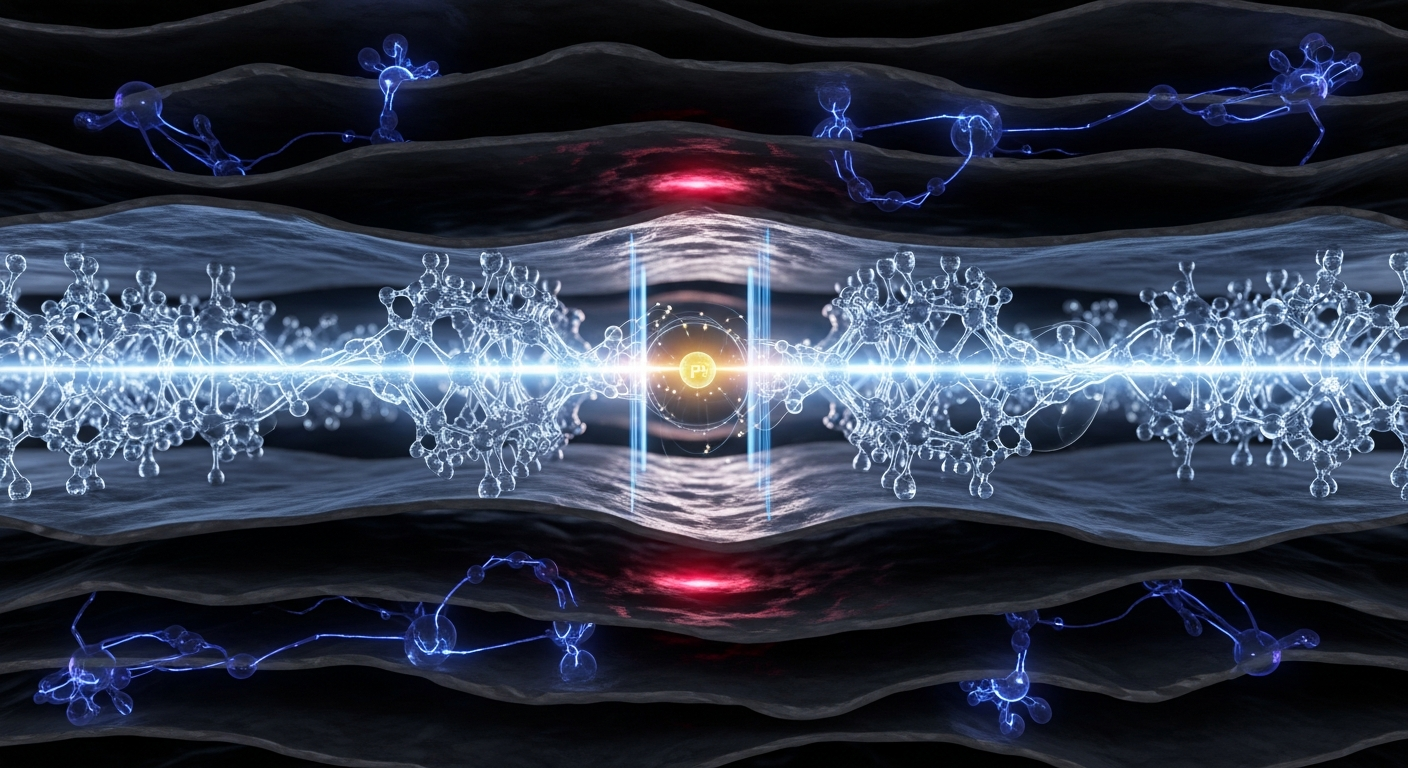
Melanin’s complex hydration networks suggest it operates not just as a broadband photoprotectant, but as a sophisticated biological battery. By leveraging quantum mechanical proton tunneling, this ubiquitous biopolymer may facilitate ultra-fast energy transfer and charge storage across cellular systems.
In 1974, physicists at the MD Anderson Hospital and Tumor Institute made an observation that defied classical biology: when a critical voltage was applied to a sample of melanin, its electrical resistance collapsed, transforming the pigment from an insulator into a highly conductive state. Published in Science by John McGinness and colleagues, this discovery of threshold switching marked the first demonstration of an amorphous biological semiconductor. Yet, for decades, the precise atomic mechanisms underlying melanin's unique electroactive behavior remained intensely debated. The polymer is notoriously disordered, lacking the crystalline symmetry that allows silicon or germanium to conduct charge efficiently. How does such a structurally chaotic molecule manage organized electron flow?
The answer, emerging from the intersection of solid-state physics and quantum biology, lies not within the pigment alone, but in its intimate relationship with water. Melanin is profoundly hygroscopic. In its natural biological state, it binds water molecules into a dense, semi-crystalline lattice. This trapped water creates an extensive hydrogen bonding network that serves as a highway for protons. We are now discovering that the movement of these subatomic particles through melanin is not merely a classical chemical exchange; it is governed by quantum mechanics. Emerging models suggest that protons navigating melanin's structure may bypass classical energy barriers entirely via quantum tunneling, redefining our understanding of biological energy storage, redox buffering, and bioelectric signaling.
The Hydrated Scaffold: Melanin as a Mixed Conductor
To understand melanin’s quantum behavior, one must first dismantle the misconception that it is a simple, static pigment. Eumelanin—the dark brown to black variant of the polymer—is a heterogeneous macromolecule composed of cross-linked oligomers of 5,6-dihydroxyindole (DHI) and 5,6-dihydroxyindole-2-carboxylic acid (DHICA). This chemical architecture gives eumelanin a broadband absorption spectrum and a semiconductor bandgap of approximately 1.85 eV.
However, dry eumelanin is practically an electrical insulator. Its conductivity is entirely hydration-dependent. Research led by Paul Meredith and Albertus Mostert at the University of Queensland has conclusively demonstrated that melanin is a mixed electronic-ionic conductor. As melanin absorbs water, its electrical conductivity increases by several orders of magnitude. The water molecules intercalate between the stacked planar sheets of the DHI and DHICA oligomers, forming structurally ordered networks.
Within this hydrated scaffold, a division of labor occurs. Electrons move through the conjugated pi-orbitals of the polymer sheets, while positively charged hydrogen ions (protons) travel through the water network. This protonic movement often follows the Grotthuss mechanism—a nanoscale "bucket brigade" where a proton binds to a water molecule, causing a cascading shift in covalent bonds that ejects a different proton further down the line. However, the sheer efficiency and speed of proton transport in certain biological matrices cannot be fully explained by classical thermal hopping alone. At the tight junctions of melanin's hydrogen bonds, the distances between donor and acceptor oxygen atoms become incredibly brief, setting the stage for a quantum phenomenon.
Breaching the Barrier: The Physics of Proton Tunneling
In classical physics, a particle requires a specific amount of kinetic energy to overcome a potential energy barrier—much like a ball needing a certain amount of momentum to be rolled over a hill. Quantum mechanics introduces wave-particle duality, dictating that particles like electrons and protons also behave as probability waves. If a potential barrier is sufficiently narrow, the particle's wave function can extend through it. There is a non-zero probability that the particle will simply appear on the other side without ever possessing the energy to climb "over" the barrier. This is quantum tunneling.
While electron tunneling is common in biology—occurring in respiration and photosynthesis—proton tunneling is exceptionally rare because a proton is roughly 1,836 times more massive than an electron. A heavier mass drastically shortens the particle's wavelength, meaning the barrier must be vanishingly thin for a proton to tunnel. The dense, tightly packed hydrogen bonding networks within melanin provide exactly this environment.
The primary experimental tool used to detect this quantum behavior is the Kinetic Isotope Effect (KIE). Researchers can measure proton transport in melanin hydrated with normal water ($H_2O$) and compare it to melanin hydrated with heavy water ($D_2O$), where the hydrogen atoms are replaced by deuterium. Deuterium contains an extra neutron, making it twice as massive as standard hydrogen (protium). In a classical system, doubling the mass only slightly slows down the reaction rate—typically by a factor of about 1.4. However, quantum tunneling is exponentially sensitive to mass. If tunneling is the dominant mechanism, substituting deuterium causes a massive, disproportionate collapse in conductivity. Observations of steep isotopic sensitivity in melanic structures strongly suggest that protons are not simply climbing the energy gradients; they are tunneling through them.
Charging Forward: Marcus Theory and PCET in Melanin
The tunneling of protons through melanin’s hydration network does not happen in isolation; it is intimately linked to the movement of electrons. This synergy is described by Proton-Coupled Electron Transfer (PCET), a framework that explains how the transfer of an electron and a proton can happen simultaneously, effectively bypassing the high-energy intermediates required if they moved sequentially.
The thermodynamics of these electron transfers are largely governed by Marcus theory, developed by Rudolph A. Marcus. The theory explains how the rate of electron transfer depends on the reorganization energy of the surrounding environment. Because electrons move vastly faster than the heavy nuclei of the surrounding solvent (water), the environment must temporarily adopt a higher-energy configuration to allow the electron to jump. However, when a proton tunnels synchronously with the electron via PCET, it effectively "lubricates" the reaction, dramatically lowering the reorganization energy required.
This is highly relevant to melanin because the polymer is rich in stable free radicals—unpaired electrons that are easily detectable via Electron Paramagnetic Resonance (EPR) spectroscopy. Melanin continuously cycles between different redox states: the fully reduced hydroquinone, the intermediate semiquinone radical, and the fully oxidized quinone. By utilizing quantum proton tunneling to facilitate PCET, melanin can rapidly shuttle charges back and forth across these states with minimal thermal energy loss. This effectively turns the melanin polymer into a highly efficient biological capacitor, capable of absorbing, storing, and releasing energy without suffering the chemical degradation that typically plagues synthetic polymers.
The Biological Battery: Implications for Health and Technology
Recognizing melanin as a quantum-enabled, mixed electronic-ionic conductor forces a paradigm shift in how we view its biological function. It is not an inert shield; it is an active bioelectrical participant.
In the realm of neurobiology, this perspective sheds new light on neuromelanin, the darkly pigmented substance densely concentrated in the substantia nigra of the human brain. Neuromelanin acts as a critical chelator, binding toxic heavy metals like iron and buffering oxidative stress. The efficiency of this protective redox cycling relies entirely on the rapid movement of electrons and protons. If proton tunneling facilitates this process, it implies that the degradation of neuromelanin seen in Parkinson’s disease may not just be a chemical failure, but a breakdown of the local quantum mechanical environment, perhaps driven by subtle changes in cellular hydration or pH that widen the tunneling barriers.
Furthermore, melanin's protonic conductivity aligns intriguingly with the frontier field of bioelectricity. Research spearheaded by laboratories such as Michael Levin's at Tufts University has demonstrated that the resting membrane potential (Vmem) of cells serves as a powerful instructional code, dictating tissue morphogenesis, wound healing, and even tumor suppression. Melanin, with its vast capacity to store and shuttle protons, may act as a localized bioelectric modulator. By dynamically absorbing and releasing protons via quantum-optimized pathways, melanin networks could theoretically stabilize local pH gradients and influence the ion channel activity that drives these morphogenetic bioelectric circuits.
Technologically, mimicking melanin's quantum protonic architecture offers a blueprint for next-generation materials. Research groups led by materials scientists like Carlo Santato at Polytechnique Montréal are already utilizing melanin to create biocompatible, biodegradable energy storage devices. By understanding the precise hydrogen bond distances and hydration states required to optimize proton tunneling, we can engineer synthetic melanin-like materials for use in edible electronics, neural interfaces, and highly efficient solid-state biological batteries.
The study of melanin forces solid-state physics to confront the messiness of biology, and biological science to acknowledge the precision of the quantum realm. As we refine our tools to probe the subatomic dynamics of this ancient molecule, we are learning that nature has been utilizing quantum mechanics to store and transmit energy long before we possessed the language to describe it.
Key Takeaways
- Melanin functions as a hydration-dependent, mixed electronic-ionic conductor, where electrons travel via conjugated pi-orbitals and protons navigate through tightly bound water networks.
- The Kinetic Isotope Effect (KIE)—achieved by replacing normal water with heavy water ($D_2O$)—provides a critical method for detecting quantum proton tunneling in biological polymers.
- Proton-Coupled Electron Transfer (PCET) in melanin significantly lowers the activation energy required for redox cycling between quinone, semiquinone, and hydroquinone states.
- Melanin’s ability to harness quantum proton tunneling allows it to act as a highly efficient biological capacitor, capable of buffering oxidative stress and neutralizing free radicals without degrading.
- Understanding the subatomic physics of neuromelanin and dermal melanin opens new avenues for treating neurodegenerative diseases and developing biocompatible solid-state batteries.
References
McGinness, J., Corry, P., & Proctor, P. "Amorphous semiconductor switching in melanins." Science 183(4127), 853-855 (1974). DOI: 10.1126/science.183.4127.853.
Meredith, P., & Sarna, T. "The physical and chemical properties of eumelanin." Pigment Cell Research 19(6), 572-594 (2006). DOI: 10.1111/j.1600-0749.2006.00345.x.
Mostert, A. B., Powell, B. J., Pratt, F. L., Hanson, G. R., Sarna, T., Gentle, I. R., & Meredith, P. "Role of water in determining the electrical properties of eumelanin." Proceedings of the National Academy of Sciences 109(23), 8943-8947 (2012). DOI: 10.1073/pnas.1119948109.
Wünsche, J., Deng, Y., Kumar, P., Di Pietro, E., Gerometta, E., Cicoira, F., & Santato, C. "Proton conductivity of biopolymer melanin." Advanced Functional Materials 23(45), 5591-5598 (2013). DOI: 10.1002/adfm.201301369.
Hammes-Schiffer, S. "Proton-coupled electron transfer: moving together and charging forward." Journal of the American Chemical Society 137(28), 8860-8871 (2015). DOI: 10.1021/jacs.5b04087.
Klinman, J. P., & Kohen, A. "Hydrogen tunneling links protein dynamics to enzyme catalysis." Annual Review of Biochemistry 82, 471-496 (2013). DOI: 10.1146/annurev-biochem-051710-133623.
d'Ischia, M., Wakamatsu, K., Cicoira, F., Di Mauro, E., Garcia-Borron, J. C., Commo, S., Galván, I., Ghanem, G., Kenzo, K., Meredith, P., Pezzella, A., Santato, C., Sarna, T., Simon, J. D., Zecca, L., Zucca, F. A., Napolitano, A., & Ito, S. "Melanins and melanogenesis: from pigment cells to human health and technological applications." Pigment Cell & Melanoma Research 28(5), 520-544 (2015). DOI: 10.1111/pcmr.12393.