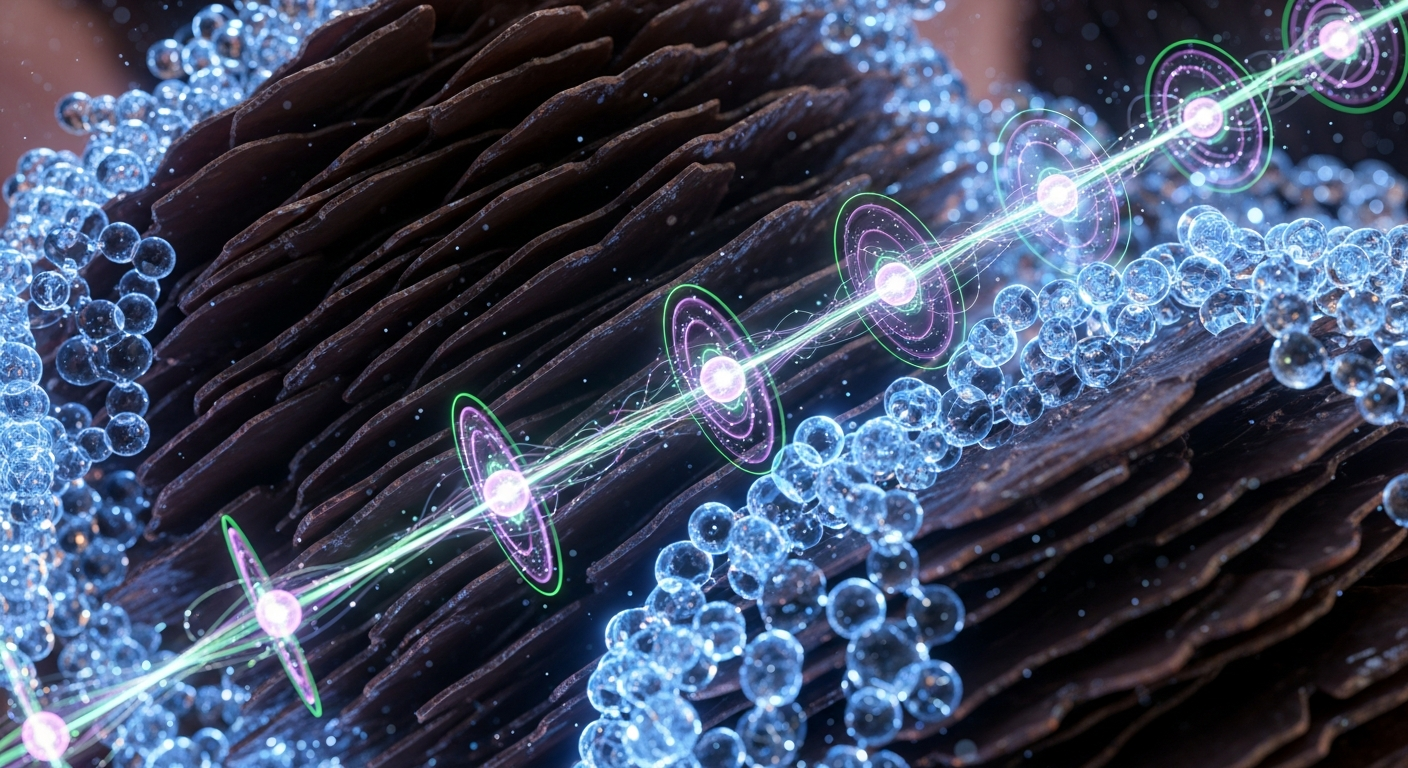
Beyond its established role as a photoprotectant, melanin possesses extraordinary electrical properties governed by quantum mechanics. Emerging research suggests that proton tunneling through extensive hydrogen bonding networks may be the key to melanin’s capacity for biological energy storage and transfer.
In 1974, a paper published in Science by biophysicist John McGinness and his colleagues demonstrated something that seemed biologically impossible at the time: melanin could act as an amorphous semiconductor switch. When subjected to a specific voltage threshold, this ubiquitous biological pigment transitioned from an electrically resistive state to a highly conductive one. This bistable switching behavior was a property previously observed only in synthetic, inorganic materials, not in messy, organic biological polymers. For decades, the precise physical mechanisms underlying this behavior remained elusive. How does a highly disordered, seemingly chaotic macromolecule manage electron and proton transport with such remarkable efficiency?
As modern biophysics peers deeper into the atomic architecture of melanin, the answer appears to reside not in classical chemistry alone, but in the realm of quantum biology. The secret to melanin's extraordinary energy transfer and storage capabilities lies in its unique hydration dynamics and a quantum mechanical phenomenon known as proton tunneling. By bridging structural chemistry and quantum mechanics, we are beginning to understand how melanin functions not merely as a biological sunblock, but as a sophisticated bioelectronic material capable of capturing, storing, and directing energy.
The Structural Matrix: Water, Pi-Stacking, and Hydrogen Bonds
To understand melanin’s quantum properties, one must first examine its physical structure. Eumelanin, the most common form of the pigment, is fundamentally a heterogeneous polymer composed of 5,6-dihydroxyindole (DHI) and 5,6-dihydroxyindole-2-carboxylic acid (DHICA). These molecules assemble into planar, graphite-like sheets that stack upon one another through a phenomenon known as pi-stacking, creating a tightly packed aromatic core. This structure grants melanin a broadband absorption spectrum and a semiconductor bandgap of approximately 1.85 electron volts (eV).
However, the dry melanin polymer is largely an electrical insulator. Its true conductive properties emerge only in the presence of water. Research led by Paul Meredith and Albertus Mostert at the University of Queensland has conclusively shown that melanin is a hybrid electronic-ionic conductor, and its conductivity is profoundly dependent on its hydration state.
Water molecules interleave themselves within the stacked DHI and DHICA sheets, forming extensive hydrogen bonding networks. These networks create structured pathways through the pigment. In classical chemistry, protons (hydrogen ions) migrate through such networks via the Grotthuss mechanism—a process often described as a "bucket brigade" where covalent bonds and hydrogen bonds sequentially break and form, passing the proton along the chain. While this classical hopping explains a baseline level of ionic conductivity, it struggles to account for the speed, efficiency, and switching behavior observed in biological melanin networks. For that, we must look to the quantum wave-function of the proton itself.
Crossing the Barrier: Proton Tunneling and Marcus Theory
In classical mechanics, a particle requires a specific amount of activation energy to climb over a potential energy barrier. If it lacks that energy, it remains trapped. Quantum mechanics, however, dictates that subatomic particles like electrons and protons exhibit wave-particle duality. Because the position of a proton is defined by a probability wave, there is a finite, calculable chance that the proton exists on the far side of the energy barrier, even if it lacks the classical energy to climb over it. When the proton passes directly through the barrier, it is known as proton tunneling.
Proton tunneling is already an established mechanism in other areas of quantum biology, most notably in enzyme catalysis, where enzymes compress hydrogen bonds to facilitate the rapid tunneling of protons across active sites. In melanin, the dense, water-infused hydrogen bonding network provides a theoretically ideal landscape for this quantum transport.
This behavior can be understood through an adaptation of Marcus theory. Originally developed by Rudolph A. Marcus to explain electron transfer, the theory has been extended to proton-coupled electron transfer (PCET) and proton tunneling. In the context of melanin, the surrounding biological environment—the fluctuating water molecules and vibrating melanin lattice—constantly alters the energetic landscape. When thermal fluctuations momentarily align the energy levels of the proton donor and the proton acceptor, a transient "window" opens. If the distance between the donor and acceptor is sufficiently short (typically less than 0.1 nanometers), the proton's wave-function overlaps with the acceptor site, and the proton tunnels through the barrier instantaneously.
Melanin’s tightly pi-stacked layers and the highly ordered water molecules bound within them effectively pre-organize these donor-acceptor sites. This structural geometry reduces the distance protons must travel, dramatically increasing the probability of quantum tunneling events and allowing for rapid, low-loss energy transfer across the macromolecule.
Isolating the Quantum Signature: The Kinetic Isotope Effect
Hypothesizing that a quantum mechanism drives melanin’s conductivity is one thing; proving it empirically is another. Because quantum phenomena are notoriously difficult to observe directly in warm, noisy biological systems, biophysicists rely on a phenomenon known as the kinetic isotope effect to distinguish classical hopping from quantum tunneling.
The wave-like nature of a particle is inversely proportional to its mass—a relationship defined by its de Broglie wavelength. A heavier particle has a shorter wavelength and, consequently, a drastically reduced probability of tunneling. To test for proton tunneling in melanin, researchers substitute standard water (H₂O) with heavy water (D₂O), which contains deuterium. Deuterium is an isotope of hydrogen that possesses an extra neutron, making it twice as massive as a standard proton.
If melanin conducted protons solely through classical thermal hopping over the energy barrier, replacing hydrogen with heavier deuterium would only slightly slow down the conductivity due to the increased mass. However, if conductivity relies heavily on quantum tunneling, the doubling of the mass exponentially shrinks the de Broglie wavelength, effectively shutting down the tunneling mechanism.
When melanin samples are hydrated with D₂O rather than H₂O, experimental data reveals a precipitous, non-linear drop in electrical conductivity. This pronounced kinetic isotope effect serves as a powerful physical signature. It demonstrates that the protons in melanin are not merely diffusing; they are actively utilizing quantum mechanical shortcuts to navigate the polymer’s architectural maze.
Implications for Biological Energy Storage and Transfer
The realization that melanin facilitates proton tunneling has profound implications for how we understand its role in human biology and its potential in future technologies.
Biologically, this quantum-enhanced proton conductivity reframes melanin as a dynamic participant in cellular energy regulation. In the realm of bioelectricity, researchers like Michael Levin have extensively documented how changes in membrane potential (Vmem) govern cellular behavior, embryogenesis, and wound healing. Melanin’s ability to efficiently transport protons could allow it to act as a localized modulator of pH and bioelectric gradients within specialized cells.
This is particularly relevant when considering neuromelanin, the dark pigment densely concentrated in the substantia nigra of the human brain. While historically viewed as a simple waste product of dopamine metabolism, neuromelanin is now recognized for its iron-chelating and neuroprotective properties. If neuromelanin networks engage in quantum proton tunneling, they may serve as biological capacitors, safely dissipating excess electrical energy or participating in sophisticated, yet-to-be-understood bioelectronic signaling pathways within dopaminergic neurons. The gradual loss of neuromelanin associated with Parkinson's disease might therefore represent not just a loss of chemical buffering capacity, but a breakdown of a critical bio-quantum energetic network.
Technologically, melanin is already inspiring a new generation of biocompatible energy storage devices. Because melanin operates at the intersection of electronic and ionic conductivity, it is a prime candidate for bioelectronic interfaces—devices that translate the electronic language of standard circuitry into the ionic and protonic language of human biology. Understanding the exact tunneling mechanics within melanin could allow materials scientists to engineer synthetic melanin derivatives with optimized hydrogen bonding networks, leading to highly efficient, biodegradable supercapacitors and neural interfaces.
Melanin forces us to reconsider the boundaries between biology, chemistry, and quantum physics. By facilitating the quantum tunneling of protons, this ancient pigment bridges the subatomic scale with macroscopic biological function, proving that life routinely harnesses the quantum realm to survive and thrive.
Key Takeaways
- Melanin operates as a hybrid electronic-ionic conductor, a property entirely dependent on the extensive hydrogen bonding networks formed by interleaving water molecules within its structure.
- Energy and charge transfer within melanin is highly likely facilitated by proton tunneling, a quantum mechanical process where protons pass through energy barriers rather than climbing over them.
- The tight geometric arrangement of melanin’s pi-stacked oligomers and bound water molecules provides an ideal structural landscape for bringing proton donors and acceptors into alignment, fulfilling the requirements of Marcus theory for quantum tunneling.
- The presence of quantum tunneling in melanin is evidenced by the kinetic isotope effect; substituting standard water with heavy water (D₂O) drastically reduces conductivity because the heavier deuterium atoms have a shorter de Broglie wavelength, inhibiting their ability to tunnel.
- Understanding these quantum properties positions melanin as a critical macromolecule for modulating cellular bioelectricity and bio-energetic gradients, with particular implications for the function of neuromelanin in the brain.
References
- McGinness, J., Corry, P., & Proctor, P. "Amorphous semiconductor switching in melanins." Science 183(4127), 853-855 (1974). DOI: 10.1126/science.183.4127.853.
- Mostert, A. B., Powell, B. J., Pratt, F. L., Hanson, G. R., Sarna, T., Gentle, I. R., & Meredith, P. "Role of water in macroscopic melanin conductivity." Proceedings of the National Academy of Sciences 109(23), 8943-8947 (2012). DOI: 10.1073/pnas.1119948109.
- d'Ischia, M., Wakamatsu, K., Cito, V., & Ito, S. "Melanins and melanogenesis: from pigment cells to human health and technological applications." Pigment Cell & Melanoma Research 28(5), 520-544 (2015). DOI: 10.1111/pcmr.12393.
- Klinman, J. P., & Kohen, A. "Hydrogen tunneling links protein dynamics to enzyme catalysis." Annual Review of Biochemistry 82, 471-496 (2013). DOI: 10.1146/annurev-biochem-051710-133623.
- Di Mauro, E., Xu, R., Soliveri, G., & Santato, C. "Bioelectronics with Eumelanin: From Fundamental Aspects to Technological Perspectives." Materials Horizons 4(1), 15-24 (2017). DOI: 10.1039/C6MH00284H.
- Meredith, P., & Sarna, T. "The physical and chemical properties of eumelanin." Pigment Cell Research 19(6), 572-594 (2006). DOI: 10.1111/j.1600-0749.2006.00345.x.