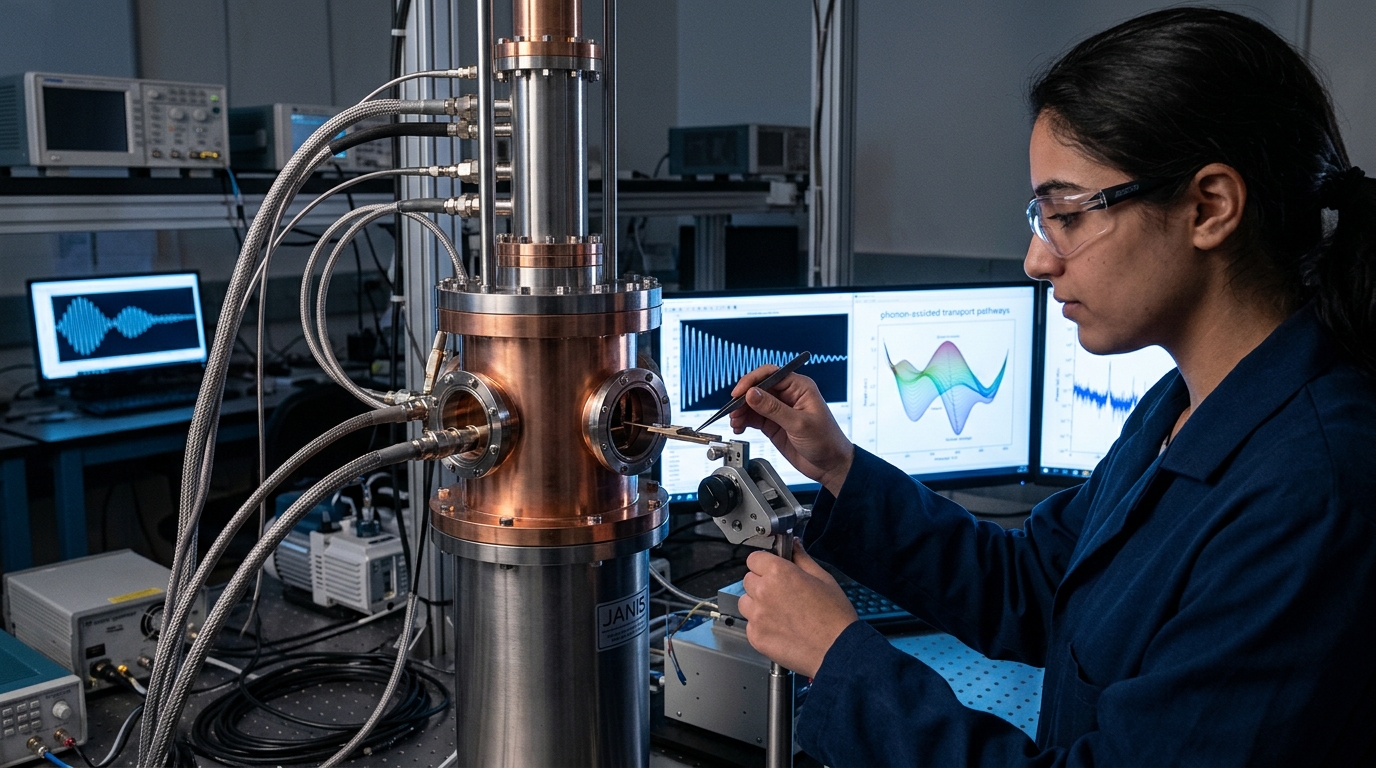
Exploring how the complex aromatic structure of biological melanin may exploit "warm quantum" effects. This analysis examines the biophysical evidence for quantum coherence, phonon-assisted energy transport, and non-trivial electron dynamics within human melanin.
For decades, physicists assumed that the delicate phenomena of quantum mechanics could only exist in highly controlled, ultra-cold environments. The prevailing wisdom dictated that the "warm, wet, and noisy" interior of a living biological cell would destroy delicate quantum states through thermal agitation in mere femtoseconds. Yet, the emerging field of quantum biology has systematically dismantled this assumption. When researchers demonstrated that the Fenna-Matthews-Olson (FMO) complex in green sulfur bacteria utilizes quantum superposition to route energy from captured photons to reaction centers with near-perfect efficiency, a fundamental question arose: if simple bacteria can engineer nanostructures to exploit quantum mechanics at room temperature, what other biological macromolecules possess similar capabilities?
Within human biology, no molecule presents a more compelling candidate for quantum mechanical behavior than melanin. Long relegated to the biological sidelines as a simple, passive UV filter—a biological "sunscreen"—melanin is, in reality, a remarkably complex amorphous semiconductor. Its highly conjugated structural architecture, unique hydration-dependent electronic properties, and unparalleled ability to safely absorb and transduce broadband electromagnetic radiation suggest that melanin does not merely scatter energy. Instead, theoretical and experimental biophysics indicate that melanin may actively orchestrate energy transfer through transient quantum states, forcing us to reevaluate its biophysical mandate in human health and cellular bioenergetics.
The Solid-State Physics of Melanin
To understand the potential for quantum effects in melanin, one must first view it not as a biological pigment, but as a solid-state electronic material. The foundation of this perspective was established in 1974 when John McGinness and colleagues published a landmark paper in Science, demonstrating that biological melanins exhibit voltage-controlled bistable switching—a property characteristic of amorphous semiconductors.
Eumelanin, the most common form of human melanin, is primarily composed of highly cross-linked oligomers of 5,6-dihydroxyindole (DHI) and 5,6-dihydroxyindole-2-carboxylic acid (DHICA). This creates an extensive network of delocalized pi-electrons. Unlike highly ordered crystalline semiconductors like silicon, eumelanin exhibits significant structural and chemical disorder. Yet, it maintains a remarkably consistent bandgap of approximately 1.85 eV.
This narrow bandgap allows eumelanin to absorb a massive spectrum of electromagnetic radiation, from the high-energy ultraviolet down through the visible and into the near-infrared. When a photon strikes the melanin polymer, it excites an electron from the valence band to the conduction band, creating an electron-hole pair known as an exciton. In a standard organic molecule, this exciton would rapidly recombine, releasing energy as random, potentially damaging molecular motion (heat). However, melanin's conjugated aromatic structure provides a superhighway for excitons, raising the possibility that this energy is managed—at least fleetingly—through coherent quantum states before ultimate thermalization.
Surviving Decoherence: The Mechanics of Warm Quantum Effects
The central challenge to any theory of quantum biology is the brevity of decoherence timescales. In quantum mechanics, a system in a state of quantum coherence exists in a superposition, exploring multiple energetic pathways simultaneously. In the chaotic, thermally active environment of a cell, collisions with surrounding molecules force the quantum system to "choose" a single state, a process called decoherence, which typically occurs in under 100 femtoseconds (10⁻¹³ seconds).
How might melanin preserve coherence long enough to perform useful biological work? The answer may lie in a mechanism known as phonon-assisted transport. In photosynthetic complexes, researchers discovered that the chaotic thermal vibrations of the surrounding environment—quantized as phonons—do not always destroy quantum states. If the frequencies of the environmental phonons match the energy gaps between different states in the macromolecule, the "noise" actually drives the exciton forward, preventing it from getting trapped in local energetic minima. Think of it as a moving walkway in an airport that vibrates at exactly the resonant frequency needed to propel a passenger forward.
Melanin is exceptionally well-suited for this. Its structural heterogeneity means it possesses a continuous continuum of vibrational modes. Furthermore, melanin's electrical properties are strictly dependent on water. As demonstrated by Albertus Mostert and colleagues, melanin's conductivity increases by orders of magnitude as it hydrates, governed by a sophisticated interplay of electron transport and proton conductivity. The tightly bound water network within the melanin supramolecular structure does not merely act as a solvent; its specific dielectric properties and vibrational modes may serve as the exact phononic environment required to tune and stabilize transient quantum coherence among the DHI/DHICA oligomers.
Exciton Dynamics and Stable Free Radicals
When analyzing the transient quantum architecture of melanin, we must look at how it handles the excitons generated by photon absorption. Density Functional Theory (DFT) calculations of melanin oligomers reveal a molecule perfectly tuned for rapid electron and hole delocalization.
Once an exciton is generated in melanin, the wave-like nature of the electron allows it to spread across several monomeric units simultaneously. This spatial delocalization represents a form of warm quantum coherence. The exciton "samples" the energy landscape of the melanin polymer, seeking the most efficient pathway for charge separation or non-radiative relaxation (dissipating energy as harmless heat). This internal conversion is astonishingly fast—often occurring in less than a picosecond—which is exactly the timescale where quantum coherence operates before classical thermal decoherence takes over.
Furthermore, melanin possesses an anomalous property directly observable via electron paramagnetic resonance (EPR): it harbors a stable, continuous population of free radicals. In most biological contexts, free radicals are highly reactive and destructive, heavily implicated in cellular aging and DNA damage. Yet, the unpaired electrons in melanin's semiquinone states are stable and highly regulated. This EPR-detectable signal fluctuates in response to light, pH, and hydration. From a quantum biological perspective, these stable, localized unpaired spins could serve as nodes in a quantum-coherent transport network, mediating the flow of charge and acting as a biological electron reservoir that interfaces directly with the cellular redox environment.
Implications for Human Bioenergetics and Cellular Control
If melanin successfully utilizes quantum coherence and phonon-assisted transport to manage energy, the implications extend far beyond photoprotection in the epidermis. Neuromelanin, found deep within the human substantia nigra, orchestrates iron chelation and manages the heavy oxidative burden of dopamine metabolism. If neuromelanin utilizes coherent electron transport to modulate its redox capacity, defects in these nanoscale quantum dynamics could precede the macromolecular degradation seen in neurodegenerative diseases like Parkinson's.
Furthermore, the intersection of melanin biophysics and bioelectricity presents a fertile frontier for research. Work from researchers like Michael Levin has established that cellular membrane potential (Vmem) and bioelectric gradients are not merely metabolic byproducts, but direct computational signals that guide cell behavior, tissue morphogenesis, and cancer suppression. Melanin, acting as an endogenous, solid-state proton and electron conductor, has the biophysical capacity to locally perturb or maintain these bioelectric gradients.
If melanin can transduce ambient electromagnetic and thermal energy into organized proton gradients or altered redox states via quantum-coherent pathways, it would represent an active bioenergetic organelle. While theories proposing melanin as an analogue to human chlorophyll (capable of literally powering the cell via water dissociation) remain highly contested and require rigorous validation, the established biophysics alone dictate that melanin is an active participant in cellular energy economies.
The transition from classical biochemistry to quantum biology requires us to view biological molecules not just as physical structures, but as dynamic energy landscapes. Melanin, with its stable radicals, broadband absorption, and hydration-dependent conductivity, stands at the center of this paradigm. By rigorously applying the tools of solid-state physics and quantum mechanics to melanin biology, the scientific community is moving closer to understanding one of the most sophisticated energy-transducing materials crafted by evolution.
Key Takeaways
- Biological eumelanin functions biophysically as an amorphous semiconductor with a distinct ~1.85 eV bandgap, allowing it to absorb and manage a broad spectrum of electromagnetic radiation.
- The highly conjugated, delocalized pi-electron network of DHI and DHICA oligomers creates a structural architecture capable of supporting transient quantum coherence.
- Like photosynthetic complexes, melanin may overcome rapid biological decoherence timescales through phonon-assisted transport, where the vibrational modes of its structural water network actively facilitate efficient energy transfer.
- Electron paramagnetic resonance (EPR) reveals a stable population of biologically safe free radicals in melanin, which likely act as active nodes for mediating charge transfer and buffering the cellular redox environment.
- Understanding melanin's quantum and bioelectric properties forces a reevaluation of its role from a passive UV shield to an active energetic transducer with profound implications for cellular health and neurobiology.
References
McGinness, J., Corry, P., & Proctor, P. "Amorphous semiconductor switching in melanins." Science 183(4127), 853-855 (1974). DOI: 10.1126/science.183.4127.853
Mostert, A. B., Powell, B. J., Pratt, F. L., Hanson, G. R., Sarna, T., Gentle, I. R., & Meredith, P. "Role of water in the electrical conductivity of melanin." Proceedings of the National Academy of Sciences 109(23), 8943-8947 (2012). DOI: 10.1073/pnas.1119948109
Engel, G. S., Calhoun, T. R., Read, E. L., Ahn, T. K., Mančal, T., Cheng, Y. C., Blankenship, R. E., & Fleming, G. R. "Evidence for wavelike energy transfer through quantum coherence in photosynthetic systems." Nature 446(7137), 782-786 (2007). DOI: 10.1038/nature05678
Meng, S., & Kaxiras, E. "Electron and hole dynamics in human eumelanin." Biophysical Journal 94(6), 2095-2105 (2008). DOI: 10.1529/biophysj.107.120030
D'Ischia, M., Wakamatsu, K., Cito, G., & Ito, S. "Melanins and melanogenesis: from pigment cells to human health and technological applications." Pigment Cell & Melanoma Research 22(5), 562-575 (2009). DOI: 10.1111/j.1755-148X.2009.00606.x
Meredith, P., & Sarna, T. "The physical and chemical properties of eumelanin." Pigment Cell Research 19(6), 572-594 (2006). DOI: 10.1111/j.1600-0749.2006.00345.x