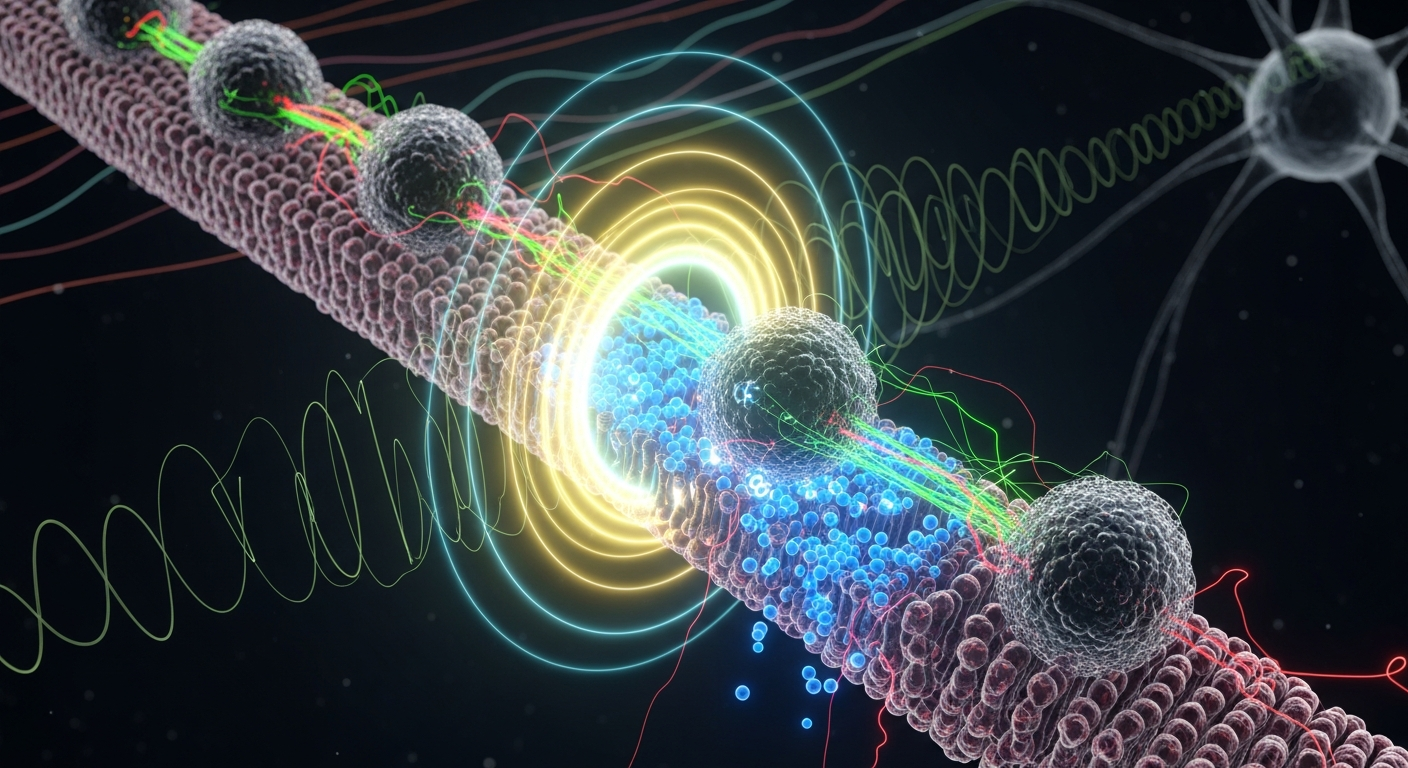
Beyond the well-understood effects of high-energy radiation, decades of research have revealed that biological systems respond to specific, low-energy electromagnetic fields with remarkable precision. This phenomenon, often occurring within narrow "windows" of frequency and amplitude, points to a sophisticated layer of information processing at the cellular level and holds profound implications for understanding the role of biomaterials like melanin in bioenergetics and communication.
The idea that our bodies are inert to the sea of non-ionizing electromagnetic fields (EMF) in which we exist has long been a bedrock assumption of classical biology. Except for heating effects at high power levels—the principle of a microwave oven—the prevailing view held that fields too weak to break chemical bonds or significantly raise tissue temperature must be biologically inconsequential. Yet, for over half a century, a persistent and growing body of evidence has challenged this dogma. The data suggests that living cells are not passive bystanders but active receivers, tuned to specific frequencies in ways that defy simple explanations based on energy transfer alone. This research forces us to ask a more nuanced question: Is biology not only a matter of chemistry but also of resonance and information?
This line of inquiry reveals that the information content of an electromagnetic field—its specific frequency, modulation, and amplitude—can be more biologically significant than its raw power. Far from being random noise, certain frequencies appear to act as signals, capable of initiating cascades of events within cells and tissues. Understanding these interactions is not merely an academic exercise; it opens a new frontier in medicine, bioengineering, and our fundamental conception of what it means for an organism to be alive. It suggests that a subtle, information-rich dialogue is constantly occurring between cells and their environment, a dialogue we are only beginning to decipher.
The Adey Window: A Challenge to Classical Biophysics
The foundational work in this field was pioneered by W. Ross Adey and his colleagues starting in the 1970s. Their experiments exposed living cells and tissues to extremely low frequencies (ELF), typically in the range of 1-100 Hz, at very low intensities—fields far too weak to cause any significant heating. What they discovered was both perplexing and profound. The biological effects, such as changes in the flow of calcium ions (Ca²⁺) across cell membranes, did not increase linearly with the strength of the field. Instead, the effects appeared only within specific, narrow ranges of frequency and amplitude. This phenomenon became known as the Adey window.
For example, in a seminal series of experiments, Adey’s team showed that a 16 Hz field could significantly increase calcium efflux from brain tissue, but fields at 1 Hz or 32 Hz, at the same intensity, had little to no effect. Similarly, the effect was only present within a narrow intensity window. A field that was too weak or too strong would fail to elicit the response. This "windowed" dose-response relationship is a hallmark of a resonant, information-based system, not a brute-force energetic one. It’s the difference between a radio receiver and a hammer; the radio is designed to respond to a specific carrier frequency, while the hammer's effect is purely a function of its kinetic energy.
The choice of calcium as a metric was critical. Calcium ions are one of the most important and universal second messengers in all of biology. Minute changes in intracellular calcium concentration regulate a vast array of cellular processes, from gene expression and neurotransmitter release to muscle contraction and apoptosis (programmed cell death). By demonstrating that a weak, non-ionizing field could modulate this master signaling ion, Adey's research established a plausible link between external electromagnetic phenomena and core cellular control mechanisms.
Mechanisms of Action: From Ion Resonance to Stochastic Amplification
The existence of the Adey window created a significant theoretical challenge: How can a field with energy levels far below the background thermal noise of a cell (the so-called kT limit) produce a coherent biological effect? Several models have been proposed to explain this, moving beyond classical assumptions.
One of the most influential is the Ion Cyclotron Resonance (ICR) model, developed by physicist Abraham Liboff. The ICR model proposes that the cell membrane acts as a staging ground for a subtle physical interaction. It requires the presence of both a weak, static magnetic field (like the Earth’s geomagnetic field) and a weak, alternating EMF. According to the model, these combined fields can impart just enough energy to specific ions (like Ca²⁺, K⁺, or Mg²⁺) to cause them to resonate. This resonance makes it easier for the ions to be stripped from their binding proteins or to traverse ion channels in the cell membrane, altering their concentration inside the cell. The resonant frequency is specific to the charge-to-mass ratio of the ion, providing a direct physical explanation for the frequency-specific effects observed by Adey and others. For Ca²⁺ in the Earth's magnetic field (~50 microteslas), the calculated resonant frequency is around 16 Hz—matching Adey's experimental data with striking accuracy.
Another compelling concept is stochastic resonance, where the inherent noise within a system, normally seen as a hindrance, can actually help amplify a weak, periodic signal. In a biological context, the constant thermal and chemical "noise" inside a cell can be harnessed by a weak external frequency. The weak signal rhythmically pushes the system closer to a firing threshold (e.g., the opening of a voltage-gated ion channel), and the internal noise provides the final, random push needed to cross it. The result is a cellular response that is synchronized with the weak external signal, effectively pulling a coherent signal out of a noisy background. Both models illustrate that cells are not passive targets but dynamic systems capable of exquisitely sensitive detection.
Melanin as a Potential Bio-Transducer: Bridging Photons and Protons
This brings us to a molecule of central interest to the Quantum Melanin Research Foundation: melanin. Given the evidence for frequency-dependent biological signaling, a critical question arises: What endogenous molecules are capable of transducing electromagnetic energy into biologically useful electrochemical signals? Melanin's unique and remarkable portfolio of biophysical properties positions it as a primary candidate.
Melanin is well-known as a pigment, but its function extends far beyond coloration. In its most common form, eumelanin, it functions as an amorphous organic semiconductor. Its structure, an extended polymer of dihydroxyindole (DHI) and dihydroxyindole-carboxylic-acid (DHICA) units, creates a complex electronic landscape of localized states. This allows it to absorb electromagnetic energy over an astonishingly broad spectrum—from UV through visible light and into the infrared—a property known as broadband absorption.
Upon absorbing a photon or interacting with an electric field, melanin can generate mobile charge carriers: electrons and their corresponding "holes." Critically, melanin is also a protonic conductor, meaning it can facilitate the movement of protons (H⁺ ions), especially when hydrated. This dual electronic-protonic conductivity is a rare and powerful combination in a biological material. It provides a direct physical mechanism for converting absorbed electromagnetic energy into either an electron current or a proton current.
The implications are profound. A proton current is, in essence, a direct interface with the cell's bioelectric and biochemical machinery. It can locally alter pH, influence the water structure at membrane surfaces, and directly modulate the activity of voltage-sensitive ion channels. We can therefore advance a compelling hypothesis: melanin may function as a biological transducer, an antenna that receives a wide spectrum of EM information and converts it into localized bioelectric and biochemical signals that the cell can interpret. Its presence in nearly every tissue type—from the skin and eyes to the inner ear and the substantia nigra of the brain (as neuromelanin)—suggests a systemic role. Within the framework of frequency windows, melanin's complex structure could support a variety of resonant modes, allowing it to interact specifically with certain frequencies to amplify their effects on local bioelectricity.
This hypothesis reframes our understanding of melanin from a passive shield to an active participant in the organism's energetic and informational economy. It suggests that the bioelectromagnetic effects observed by researchers over the last 50 years may have a tangible molecular basis in the unique quantum-mechanical properties of this ancient and ubiquitous biopolymer. Further research at the intersection of melanin biophysics and bioelectromagnetics is essential to exploring this frontier.
Key Takeaways
- Biological systems exhibit non-linear responses to weak, extremely low-frequency (ELF) electromagnetic fields, with effects occurring only within specific frequency and amplitude ranges known as "Adey windows."
- The modulation of calcium ion (Ca²⁺) signaling is a primary and well-documented effect of these weak fields, linking them directly to one of biology's most critical cellular control mechanisms.
- Physical models like Ion Cyclotron Resonance (ICR) and stochastic resonance provide plausible mechanisms for how weak, non-thermal fields can overcome background thermal noise to produce coherent physiological effects.
- Bioelectric signals, based on patterns of cellular membrane potential, act as a blueprint for development, regeneration, and tissue organization, suggesting that modulating ion flows with external fields could have profound biological consequences.
- Melanin's unique properties as a broadband-absorbing, hydrated amorphous semiconductor make it a prime candidate for a biological transducer, capable of converting electromagnetic energy into electrochemical signals (electron and proton currents) that interface with cellular machinery.
- The study of frequency-dependent bio-effects pushes biology beyond a purely chemical model, incorporating principles of physics, information theory, and resonance to explain cellular organization and communication.
References
- Adey, W. R. "Frequency and power windowing in tissue interactions with weak electromagnetic fields." Proceedings of the IEEE 68(1), 119-125 (1980). DOI: 10.1109/PROC.1980.11583 doi:10.1109/proc.1980.11591
- Blackman, C. F., Benane, S. G., Rabinowitz, J. R., House, D. E., & Joines, W. T. "A role for the magnetic field in the radiation-induced efflux of calcium ions from brain tissue in vitro." Bioelectromagnetics 6(4), 327-337 (1985). DOI: 10.1002/bem.2250060402 doi:10.1002/bem.2250060402
- Liboff, A. R. "Geomagnetic cyclotron resonance in living cells." Journal of Biological Physics 13(4), 99-102 (1985). DOI: 10.1007/BF01810561 doi:10.1007/bf01878387
- Levin, M. "The computational boundary of a 'self': developmental bioelectricity drives multicellularity and scale-free cognition." Frontiers in Psychology 10, 2688 (2019). DOI: 10.3389/fpsyg.2019.02688
- McGinness, J., Corry, P., & Proctor, P. "Amorphous semiconductor switching in melanins." Science 183(4127), 853-855 (1974). DOI: 10.1126/science.183.4127.853 doi:10.1126/science.183.4127.853
- Mostert, A. B., Tieleman, D. P., & Rauk, A. "The intrinsic charge-transport properties of eumelanin." The Journal of Physical Chemistry B 114(45), 14635-14643 (2010). DOI: 10.1021/jp103762w
- Turin, L. "A Spectroscopic Mechanism for Primary Olfactory Reception." Chemical Senses 21(6), 773–791 (1996). DOI: 10.1093/chemse/21.6.773 (While about olfaction, this paper is a landmark in proposing quantum resonance mechanisms in biology). doi:10.1093/chemse/21.6.773
- Solís Herrera, A., Arias Esparza, M. C., et al. "The unexpected capacity of melanin to dissociate the water molecule fills the gap between the life before and after the great oxidation event." International Journal of Molecular Sciences 23(17), 9673 (2022). DOI: 10.3390/ijms23179673