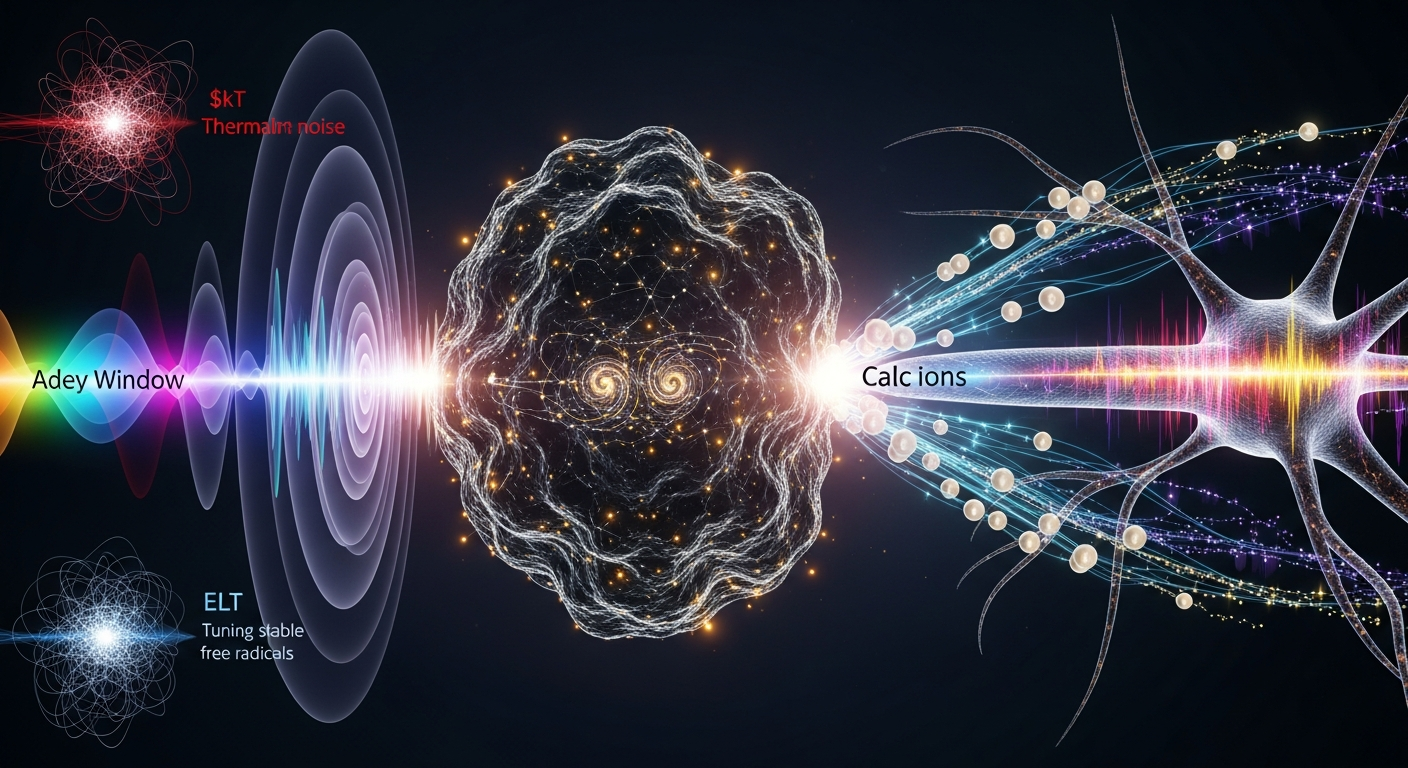
Decades of bioelectromagnetic research reveal that living systems respond to electromagnetic fields not just through intensity, but through highly specific frequency "windows." As we investigate the quantum and biophysical properties of melanin, this ubiquitous biopolymer emerges as a compelling candidate for mediating these non-linear electromagnetic interactions, bridging the gap between quantum phenomena and cellular bioelectricity.
In classical pharmacology and toxicology, the dose makes the poison. We are conditioned to expect biological responses to scale linearly: more chemical concentration or more radiation intensity yields a greater physiological effect. Yet, when living tissues are exposed to specific electromagnetic fields, this foundational axiom collapses. In the realm of bioelectromagnetics, a weaker field can trigger a massive cellular cascade, while a field ten times stronger may produce no measurable effect whatsoever. This non-linear reality suggests that cells do not simply absorb electromagnetic energy as brute force; rather, they tune into it like resonant cavities interacting with highly specific environmental signals.
Understanding how living systems selectively filter and respond to these frequencies requires us to look beyond classical biochemistry. We are forced into the realm of quantum biology and solid-state biophysics, where the structural disorder and electrical properties of macromolecules govern biological computation. At the Quantum Melanin Research Foundation, we hypothesize that the answers to some of bioelectromagnetics’ most persistent mysteries lie hidden in the complex architecture of biological semiconductors—most notably, melanin.
The Adey Window: When Biology Tunes to Specific Frequencies
The conceptual foundation for frequency-specific biological responses was established in the 1970s through the work of W. Ross Adey and his colleagues. Investigating the effects of extremely low frequency (ELF) electromagnetic fields on cerebral tissue, Adey's team observed something that defied classical physics: the efflux of calcium ions from brain tissue increased significantly when exposed to a 16 Hz field, but only within a narrow amplitude range of 10 to 20 V/m. Increase the power, and the effect vanished. Change the frequency to 30 Hz, and the tissue remained entirely unresponsive.
This phenomenon became known as the Adey window—a highly specific set of frequency and amplitude parameters required to elicit a biological response. The implications of this discovery were profound. Calcium signaling is a universal cellular language, regulating everything from neurotransmitter release to gene expression. If external electromagnetic fields could modulate calcium efflux without transferring enough thermal energy to heat the tissue, the interaction had to be informational rather than purely energetic.
Subsequent research by Carl Blackman expanded on this, demonstrating that these calcium efflux windows were also dependent on the local static geomagnetic field. If you changed the orientation of the Earth’s magnetic field relative to the tissue, the resonant frequencies shifted. This geomagnetic dependence strongly implied that the mechanism was governed by precise quantum or atomic-level resonance parameters, rather than simple electrical induction.
Mechanisms of Interaction: Overcoming Thermal Noise
For decades, theoretical physicists dismissed non-thermal bioelectromagnetic effects due to the "$kT$ problem." In biophysics, $k$ represents the Boltzmann constant and $T$ is temperature. The argument insists that the kinetic thermal noise ($kT$) of a warm, wet biological system is far more energetic than the subtle forces exerted by ELF fields. According to classical thermodynamics, any weak electromagnetic signal should be completely drowned out by the chaotic thermal vibrations of surrounding water molecules.
To explain how the Adey window overcomes this thermal noise, researchers have turned to quantum biology. One established theoretical framework is the radical pair mechanism. This model, heavily studied in the context of avian magnetoreception, involves pairs of molecules with coupled electron spins. When a chemical reaction creates a radical pair, the electrons' spin states (singlet or triplet) are highly sensitive to weak external magnetic fields. Because spin is a quantum property insulated from immediate thermal degradation, a resonant electromagnetic frequency can alter the spin dynamics, thereby dictating the chemical fate of the molecules involved.
Another proposed framework involves variations of ion cyclotron resonance, where specific combinations of static and alternating magnetic fields cause unhydrated ions (like calcium or potassium) to resonate, altering their trajectory through biological ion channels. While the exact physical models remain actively debated, the consensus is clear: living systems possess highly specialized, evolved mechanisms for detecting and transducing weak electromagnetic frequencies.
Melanin: A Broadband Absorber and Bioelectric Transducer
To understand how these electromagnetic frequencies are absorbed and translated into ionic currents at the cellular level, we must look for specialized molecular transducers. Eumelanin, the dominant dark pigment in human biology, is uniquely qualified for this role. Far from being a mere photoprotective sunblock, melanin is a highly conjugated biological macromolecule exhibiting amorphous semiconductor properties.
In a landmark 1974 paper, John McGinness, Peter Corry, and Peter Proctor demonstrated that melanin behaves as a threshold switch, capable of transitioning between high and low electrical conductivity states when exposed to specific energy thresholds. This behavior is driven by melanin's unique energetic profile; it possesses a semiconductor bandgap of approximately 1.85 eV, allowing it to absorb and dissipate a massive broadband spectrum of electromagnetic radiation.
Crucially, melanin possesses a stable population of free radicals, which are easily detectable via electron paramagnetic resonance (EPR). These free radicals are not oxidative errors; they are functional, structural features of the eumelanin polymer (specifically the DHI and DHICA monomer units). The presence of localized, stable unpaired electrons makes melanin an ideal candidate for interactions governed by the radical pair mechanism.
Furthermore, melanin's conductivity is heavily hydration-dependent. It acts as an electronic-ionic hybrid conductor. At the melanin-water interface, melanin splits water, generating and conducting protons ($H^+$). If weak ELF fields can modulate the spin states of melanin's free radical population, this quantum interaction could directly alter the polymer's proton conductivity, effectively translating a specific electromagnetic frequency into a measurable biological current.
Integrating Melanin into Bioelectric and Morphogenetic Networks
If melanin acts as an intracellular receiver and transducer of specific electromagnetic frequencies, we must reconsider its physiological distribution. Melanin is found not just in the epidermis, but in the inner ear (stria vascularis), the eyes, the heart, and deeply embedded within the brainstem as neuromelanin.
This broad distribution takes on new significance when viewed through the lens of modern bioelectricity. Research spearheaded by scientists like Michael Levin has demonstrated that the resting membrane potential ($V_{mem}$) of cells is not just a battery for action potentials; it is a profound computational network. Gradients of ions—driven by precisely gated ion channels—instruct morphogenesis, direct tissue repair, and suppress tumorigenesis.
If Adey windows demonstrate that specific frequencies modulate ion fluxes (like calcium), and melanin is an ubiquitous, frequency-responsive semiconductor capable of proton conduction, the connection becomes unavoidable. Melanin may serve as an endogenous structural antenna, absorbing environmental and internal electromagnetic cues and transducing them into localized ionic gradients that feed directly into the bioelectric networks governing cellular behavior.
The scientific community is standing at the precipice of a broader understanding of biological communication. Future research must move beyond the classical biochemical view of melanin and rigorously test its frequency-dependent responses in living tissues. By applying the principles of quantum biology and bioelectromagnetics to melanin research, we may uncover a fundamental, resonance-based regulatory system woven into the very fabric of human biology.
Key Takeaways
- Biological tissues exhibit non-linear, frequency-dependent responses to electromagnetic fields, known as Adey windows, where specific amplitudes and frequencies trigger significant cellular reactions like calcium efflux.
- The interaction between weak electromagnetic fields and biological systems successfully bypasses thermal noise ($kT$) through quantum mechanisms, particularly the magnetic sensitivity of coupled electron spins in the radical pair mechanism.
- Eumelanin functions as an amorphous biological semiconductor with stable, functional free radicals, making its localized electron dynamics highly susceptible to external electromagnetic influence.
- Melanin operates as a hybrid electronic-ionic conductor, possessing the biophysical capacity to transduce quantum spin alterations into proton and ionic currents at the cellular hydration layer.
- Integrating melanin's electromagnetic properties with the study of cellular membrane potentials ($V_{mem}$) provides a compelling theoretical framework for how tissues compute, communicate, and maintain bioelectric homeostasis.
References
- Bawin, S. M., & Adey, W. R. "Sensitivity of calcium binding in cerebral tissue to weak environmental electric fields oscillating at low frequency." Proceedings of the National Academy of Sciences 73(6), 1999-2003 (1976). DOI: 10.1073/pnas.73.6.1999.
- Blackman, C. F., Benane, S. G., Rabinowitz, J. R., House, D. E., & Joines, W. T. "A role for the magnetic field in the radiation-induced efflux of calcium ions from brain tissue in vitro." Bioelectromagnetics 6(4), 327-337 (1985). DOI: 10.1002/bem.2250060402. doi:10.1002/bem.2250060402
- McGinness, J., Corry, P., & Proctor, P. "Amorphous semiconductor switching in melanins." Science 183(4127), 853-855 (1974). DOI: 10.1126/science.183.4127.853. doi:10.1126/science.183.4127.853
- Meredith, P., & Sarna, T. "The physical and chemical properties of eumelanin." Pigment Cell Research 19(6), 572-594 (2006). DOI: 10.1111/j.1600-0749.2006.00345.x. doi:10.1111/j.1600-0749.2006.00345.x
- Hore, P. J., & Mouritsen, H. "The radical-pair mechanism of magnetoreception." Annual Review of Biophysics 45, 299-344 (2016). DOI: 10.1146/annurev-biophys-032116-094545. doi:10.1146/annurev-biophys-032116-094545
- Levin, M. "Molecular bioelectricity: how endogenous voltage potentials control cell behavior and instruct pattern regulation in vivo." Molecular Biology of the Cell 25(24), 3835-3850 (2014). DOI: 10.1091/mbc.e13-12-0708. doi:10.1091/mbc.e13-12-0708
- Mostert, A. B., Powell, B. J., Pratt, F. L., Hanson, G. R., Sarna, T., Gentle, I. R., & Meredith, P. "Role of semiconductivity and ion transport in the electrical conduction of melanin." Proceedings of the National Academy of Sciences 109(23), 8943-8947 (2012). DOI: 10.1073/pnas.1119948109. doi:10.1073/pnas.1119948109