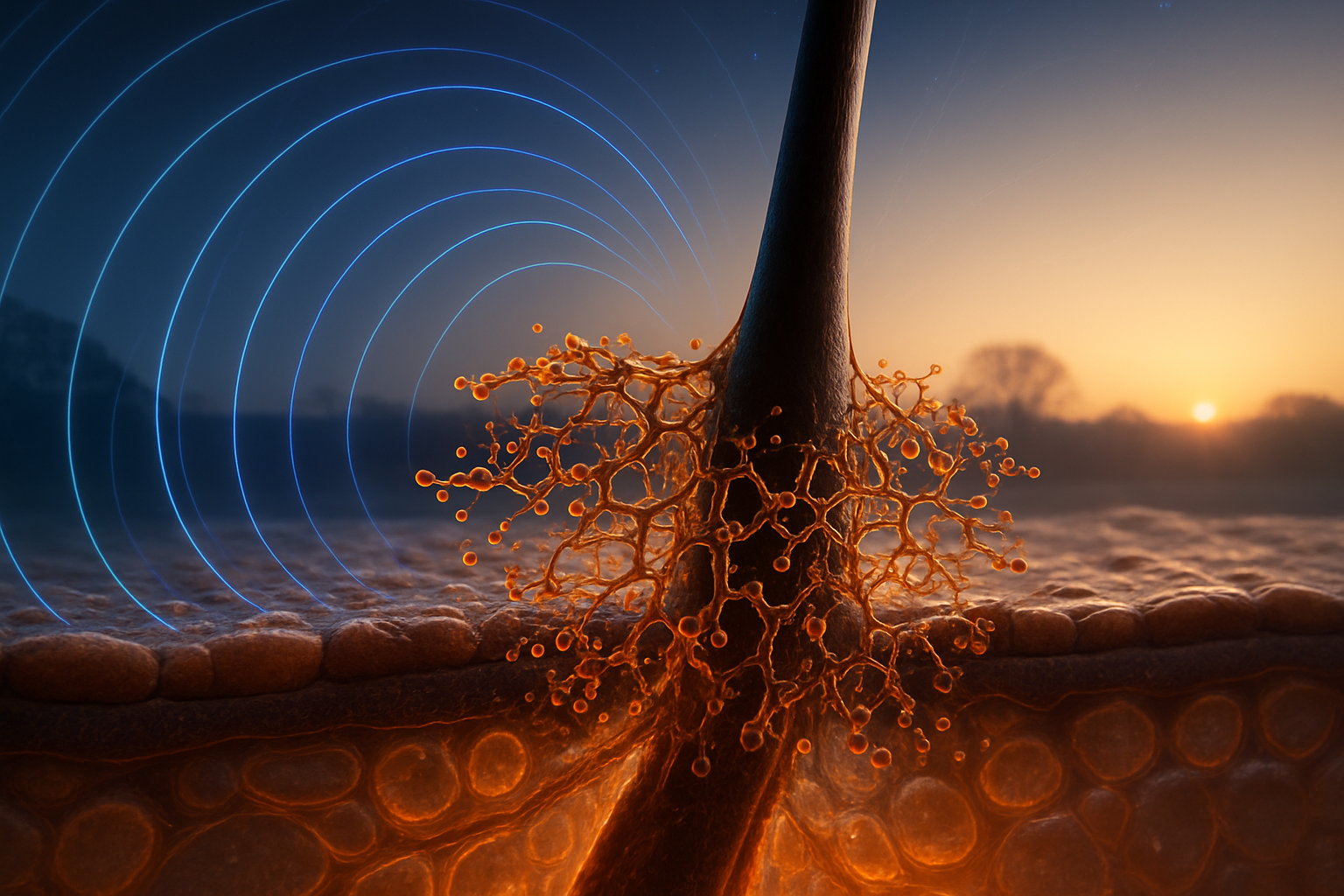
Introduction: From Light-Absorbing Pigment to Hypothetical Biological Antenna
Melanin is traditionally characterized as a material that absorbs radiation, safeguards tissues from photochemical damage, and influences coloration. While this perspective is accurate, it does not encompass the full scope of melanin's capabilities. Eumelanin is recognized for its chemically complex nature, redox activity, paramagnetic properties, and sensitivity to hydration. It interacts with photons, electrons, protons, oxygen, and transition metals, showcasing unique optical and electrical behaviors. The question arises: could melanin do more than merely absorb and dissipate electromagnetic energy? Is it possible that melanin could function to detect, filter, or transmit information about environmental electromagnetic fields?
A critical conceptual distinction here is necessary: electromagnetic interaction is not synonymous with sensory reception. A material may absorb radiation and exhibit a change in conductivity due to oxidation without serving as a receptor. For melanin to act as a biological antenna, it must couple to external fields in a predictable manner, effectuating an information-bearing molecular or cellular alteration. This process should display selectivity for frequency, intensity, polarization, or orientation, and ideally engage an amplification mechanism followed by transmission through a defined physiological pathway.
This article delineates well-established biophysics from hypotheses. It first examines what is known about melanin as an optical, redox, and charge-transport medium. It then establishes experimental criteria for antenna functionality and examines the hypothesis alongside the well-substantiated cryptochrome radical-pair model of avian magnetoreception before exploring possibilities in circadian regulation, migration, and seasonal biology.
The conservative conclusion is that melanin presents as a plausible electromagnetic-interacting biological material and might influence proximate photochemical or redox pathways. However, existing evidence does not yet affirm melanin as a sensory antenna capable of detecting or encoding electromagnetic information from the environment.
Established Biophysics: What Melanin Can Physically Do
Broadband Optical Absorption and Energy Dissipation
Eumelanin is not a crystalline pigment with a singular molecular form. It consists of a complex mix of oxidized and reduced indolic units, oligomeric components, and supramolecular aggregates. This structural heterogeneity leads to broad, mostly featureless absorption that spans from the ultraviolet to the visible spectrum and continues into longer wavelengths.
The effective optical gap for eumelanin typically falls near 1.5–2 eV, with values around 1.7 eV commonly reported in synthetic samples. Rather than serving as a sharp semiconductor band edge, melanin contains a range of electronic states and local energy environments. Excited states generally resolve through ultrafast internal conversion via nonradiative processes.
Eumelanin has an exceptionally low fluorescence quantum yield, often around 10⁻³ or lower. This indicates that most absorbed optical energy is released as heat rather than re-emitted as fluorescence, allowing for efficient photoprotection by converting potentially damaging UV energy into harmless thermal motion.
Despite effective photon absorption and energy dissipation, melanin's broadband absorptive properties do not necessarily translate into optical information processing or frequency discrimination.
Redox Activity, Radicals, and Metal Binding
Eumelanin demonstrates the presence of stable paramagnetic centers, with radical concentrations typically estimated between 10¹⁷–10¹⁹ spins per gram. Electron paramagnetic resonance studies associate these signals with semiquinone-like radical states and associated redox equilibria. Factors such as pH, hydration, oxygen levels, oxidation state, and metal coordination can influence the balance between hydroquinone-like, semiquinone, and quinone-like groups.
Melanin's ability to bind transition metals such as iron and copper can modify local redox potentials, affecting reactions with reactive oxygen species. In a cellular milieu, eumelanin acts as a dynamic chemical matrix, exhibiting potential for external perturbations to modify its radical states or redox kinetics. Nonetheless, a chemically reactive nature does not inherently equate to the encoding of weak electromagnetic signals, given that oxidative stress, temperature changes, or regular photochemical reactions can influence melanin’s radical states without producing sensory information.
Electrical and Proton Transport
Melanin's conductivity ranges broadly from about 10⁻¹³ to 10⁻⁵ S cm⁻¹, depending on factors like hydration, oxidation state, pH, temperature, and preparation method. While dry eumelanin might function poorly as an electronic conductor, hydration greatly enhances its conductivity.
Melanin supports both electronic and protonic transport. Proton mobility possibly occurs via hydrogen-bond networking and protonation-deprotonation mechanisms, and electronic conduction through localized hopping involving different redox sites. In disordered materials, charge rearrangement often involves thermally activated hopping, contrasting with the conventional delocalized conduction band paradigm.
Quantum tunneling could enable electron transfer between closely spaced redox-active sites, especially over short distances in hydrated or metal-bound contexts. However, this does not suggest the presence of coherent quantum information processing, as these events occur within a noisy, thermally dynamic biological environment. Their biological significance depends on whether they effectively modulate a reaction network in a controlled manner that is amenable to amplification.
Overall, while melanin possesses electrical activity, its variability in conductivity does not prove resonance, directivity, frequency selectivity, or amplification capabilities linked with sensory processes.
Why Absorption is Not Equivalent to Antenna Function
A biological antenna translates an external electromagnetic field into an information-rich state change. Simple field responses like heating, oxidation, dielectric polarization, or membrane modulation do not suffice. The crucial question extends beyond melanin's interaction with electromagnetic energy to its capacity to differentiate environmental signals and relay them to a biological control system.
To date, melanin’s role is best described as a physical substrate for electromagnetic interaction, lacking substantiation for sensory functionality.
What Counts as an Electromagnetic Antenna? Biophysical Criteria for Testing the Hypothesis
For the antenna hypothesis to gain scientific traction, it must be subjected to testable criteria.
Coupling at Environmental Field Strengths
Melanin or its structures must demonstrably respond to controlled external fields at physiological intensities. The geomagnetic field ranges from approximately 25–65 µT, varying by location. For melanin to function as a magnetic receptor, it must detect fields much weaker than those typically employed in laboratory electromagnetic assessments.
Experiments involving avian-compass orientation have highlighted disruptive effects from weak fields near 1.3 MHz, important due to their frequency dependency aligning more closely with spin chemistry rather than heating. Nevertheless, these do not definitively establish melanin-specific reception.
Investigations should extend to not only synthetic or isolated melanin but also natural melanocytes, cultured pigmented cells, retinal tissue, and entire organisms. Field responses that disappear in physiological hydration or cellular environments suggest limited biological significance.
Selectivity, Orientation, and Information Content
An antenna-like material should display reproducibility based on action parameters such as frequency, amplitude, polarization, or orientation. Factors such as resonance, anisotropic molecular arrangements, spin-dependent reactions, or structured arrays might account for selectivity.
Natural melanin's structural variance, affected by aggregation, hydration, oxidation, metal binding, and protein association, provides a structural challenge. Melanosomes, thus, might function more like broadband, disordered redox constructs than finely tuned antennas. However, nonlinear chemistry could allow biological systems to decode information from weak, broadband signals, emphasizing the need for quantitative measurement of selectivity rather than presumptions.
Signal Transduction
Field-induced changes require integration into a biological output, potentially involving:
- radical-pair yield or spin-state distribution;
- proton or ion flux;
- local redox potential;
- membrane potential;
- reactive oxygen species production;
- kinase activity;
- transcriptional responses; or
- neuronal activation.
A complete mechanistic pathway would link melanin's electronic or spin-state change upon field exposure to a chemical reaction or transport process alteration, thereby activating a cellular signaling pathway. Rigorous controls must eliminate temperature elevation, indiscriminate oxidative stress, optical dose variations, and mechanical artefacts.
Localization and Causality
A putative receptor should reside in a potential sensory locale, such as the retina or a specialized orientation-aiding tissue. Melanin is common in various tissues, including skin, hair, and eyes, thus giving mere locational presence limited significance.
Causality would necessitate loss-of-function and rescue experiments. Removing, reducing, chemically modifying, or genetically altering melanin while considering pigmentation, retinal formation, antioxidative ability, and skin structure must be pursued. Restoring melanin or a specific melanin feature should reestablish any observed electromagnetic effect. Isolated melanin’s sensitivity would highlight material responsiveness, not sensory function in an organism.
Established Magnetoreception: Why Cryptochrome Currently Leads the Field
Some animals, notably migratory birds, detect geomagnetic inputs for orientation. The leading molecular model involves cryptochrome-associated radical-pair chemistry as implicated in an avian magnetic compass.
Behavioral Evidence and Radiofrequency Disruption
Research indicates that weak radiofrequency fields, notably exposures near 1.3 MHz, impair avian magnetic orientation, dependent on field characteristics instead of energy alone. A mechanism involving spin evolution in transient radical pairs is suggested, differentiated from responses provoked by heating or gross tissue damage.
While these results affirm animal magnetic sensitivity, they do not directly identify melanin as a receptor.
The Cryptochrome Radical-Pair Mechanism
In this proposed mechanism, light activates retinal cryptochrome proteins, triggering electron transfer through aromatic chains predominantly involving tryptophan-based pathways. The result is radical pairs with correlated electron spins.
These pairs experience singlet-triplet state evolution—altered by the geomagnetic field via spin dynamics without necessitating a sizeable energy input. Singlet or triplet state transitions might favor distinct chemical pathways, allowing even weak magnetic perturbations to modulate product yields. The strength of the radical-pair model resides in enabling magnetic conditions to influence reaction dynamics without vectoring substantial energy from geomagnetic sources.
Retinal Cryptochromes and Unresolved Neural Transduction
Reports highlight cryptochrome expression along with neuronal markers within migratory bird retinas, suggesting a light-dependent visual pathway for electromagnetic sensing. This colocalization supports receptor involvement that could integrate into visual and orientation-related neural circuitry.
Nevertheless, the specific cryptochrome essential across different species and scenarios remains to be solidified. The full pathway linking radical-pair yield changes to ensuing neural activity is not entirely elucidated. Moreover, not all cases of animal magnetoreception might be explained by a singular mechanism. Models involving magnetite, iron-mineral systems, mechanosensory effects, or alternative redox processes remain within scientific discourse.
Melanin as a Cofactor or Modulator
Though melanin may impact cryptochrome-based sensing, it might not act as the primary receptor. In pigmented retinal tissues, melanin might offer:
- photoprotection against over-excitation;
- redox buffering;
- stabilization of reactive intermediates;
- management of local oxygen chemistry;
- optical filtration; or
- facilitation of proton and electron transfer proximal to photoreceptive proteins.
Such roles could modulate cryptochrome chemistry's sensitivity or dynamic range, rendering melanin a chemical buffer, optical regulator, or cofactor rather than directly serving as an antenna. Present evidence suggests cryptochrome over melanin as a more viable candidate for primary avian magnetic reception.
What If? Speculative Biological Roles and Experiments That Could Test Them
The possibilities discussed here, while plausible extensions of known melanin chemistry and validated animal magnetoreception, remain speculative.
Circadian Regulation through Indirect Electromagnetic Biology
Melanin could influence circadian biology indirectly by altering the light spectrum and amount impacting photoreceptors, changing retinal oxidative states, or affecting the chemical surroundings of melanopsin-containing retinal ganglion cells and other photoreceptive processes. Given its broad absorption spectrum, shifts in melanosome density or arrangement might reshape the photic environment for photoreceptors.
A more ambitious hypothesis involves melanin’s redox state acting as a slow biochemical integrator of environmental electromagnetic exposure. Outcomes might include fluctuations in semiquinone populations, protonation shifts, or reactive oxygen species production influencing kinase pathways and clock-gene expression. However, this remains speculative. Established circadian entrainment predominantly associates with retinal photoreception and subsequent clock networks, not melanin-based electromagnetic receptors.
Demonstrating a direct role would require evidence of frequency-specific phase shifts within controlled fields reliant on melanin specificity, with outcomes not explainable solely by photon dose variations, temperature factors, or oxidative stress.
Migration and Geomagnetic Orientation
For migratory birds, melanin nearby retinal cryptochromes could affect radical-pair chemistry in multiple ways: electron donation/withdrawal might modify cryptochrome radical lifetime; proton transport could adjust pH and impact redox kinetics; metal binding might change local oxygen chemistry; and optical absorption could influence light accessed by cryptochrome.
Given radical-pair sensitivity to reaction partners, molecular structuring, and local redox conditions, melanin plausibly acts as a microenvironmental regulator. Demonstrating the receptor role would necessitate evidence that magnetically sensitive bird orientation persists even when cryptochrome chemistry is absent or tampered, with direct melanin-derived field-dependent information provision confirmed.
Seasonal Biology
Seasonal adaptation involves coordinating photoperiod, temperature, nutrition, endocrinal state, and circannual cycles. A melanin-dependent pathway could hypothetically augment photoperiodic inputs with geomagnetic or radiofrequency signals. Yet, the challenge is substantial, considering geomagnetic fields’ weak presence compared with more prominent factors like illumination, temperature, metabolism, and oxidative condition changes.
Potential outputs might include changes in melatonin timing, gene expression pertaining to seasonality, hormonal secretion, or neuronal activities associated with migration. Currently, no sound evidence substantiates melanin’s mediation of seasonal responses.
Experimental Case Study: Testing Melanin as a Retinal Magnetic Modulator
A hypothetical, preregistered experiment on a migratory bird with confirmed light-mediated magnetic orientation could involve four retinal samples:
- normal, pigmented tissues;
- tissue with reduced melanin production;
- chemically adjusted melanin with modified redox abilities but preserved pigmentation;
- rescue tissue restoring melanin expression or a specific melanin fraction.
Comparative analysis would include cryptochrome presence, retinal structure, visual capacity, temperature regulation, oxygen profiling, and antioxidative capability. Samples would undergo exposure to a systematic geomagnetic field, approximately 40–50 µT, with field orientation changes. Simultaneous trials would introduce weak radiofrequency fields near 1.3 MHz, in conjunction with sham exposures and temperature-equivalent controls.
Core physiological metrics would encompass electron paramagnetic resonance, radical lifespan, redox potential, proton conductivity, and increased reactive oxygen species measurement. Patch-clamp or voltage-sensitive imaging could ascertain field-related membrane potential changes or neuronal excitability alterations. Behavioral evaluation would gauge magnetic orientation with controlled lighting, maintaining constant photon dosages.
A significant outcome would demonstrate: melanin chemistry change due to field effects; dependency on frequency or orientation; absence of comparable oxidative or temperature artifacts; neuronal activity changes; impaired orientation post-melanin modification; rescued effects upon restoration of essential melanin properties. Isolated changes in melanin chemistry without concurrent behavior or neural fluctuation would imply material sensitivity rather than sensory function. Behavioral alterations concurrent with changes in cryptochrome presence or visual capacity would leave causality ambiguous.
This multiscale design approach—combining material, cellular, tissue, and behavioral perspectives—meets a heightened evidentiary standard beyond proving conductivity or radical presence alone in purified samples.
Experimental Roadmap
An exhaustive study program should concurrently evaluate purified natural melanin, synthetic eumelanin, isolated melanosomes, cultured pigmented cells, retinal tissues, and whole organisms. Measurements should detail field-intensity thresholds, frequency correlations, orientation impacts, radical behavior, ion and proton transport, and subsequent signaling. Thermal imaging and dosimetry must confirm absence of heating artifacts. Chemical controls should differentiate melanin-related phenomena from broader redox-polymer responses.
A conclusive result would highlight a physiologically pertinent, repeatable, melanin-dependent response with a well-defined downstream signaling cascade and an associated causal behavioral or hormonal expression.
Key Takeaways and Future Directions
Melanin is a broadband absorber, stable-radical